Tadepalli, Nov 27: YSR Congress Party (YSRCP) parliamentary affairs committee member Duvvuri Krishna on Friday charged the Chandrababu Naidu‑led coalition with the investment credit controversy over claiming credit for investment projects that began during the YSRCP administration. Speaking at the party’s central office, Krishna presented figures on memoranda of understanding (MoUs), implementation rates and foreign direct investment (FDI) to back his allegation that the ruling alliance is misleading the public about Andhra Pradesh’s investment performance.
Krishna said the data, drawn from official government releases, an RTI response and published reports, show a stark contrast between the implementation of MoUs signed under the previous Telugu Desam Party (TDP) governments and those secured during the five‑year YSRCP tenure. He challenged IT Minister Nara Lokesh to address the evidence and retract remarks that suggested the former government failed to attract investment.
Implementation rates reveal gaps in earlier MoUs
According to Krishna, MoUs worth Rs.1,03,375 crore signed at the 2017 CII Partnership Summit recorded a meager 17% ground‑level implementation. A similar batch of agreements valued at Rs.61,546 crore in 2018 showed an even lower implementation rate of 7.26%.
By contrast, the YSRCP government, he said, received investment proposals totaling Rs.4,38,161 crore, with 75.25% of those proposals progressing to the implementation stage, based on information supplied in response to a Right‑to‑Information query.
Rs.2.5 lakh crore linked to YSRCP initiatives
The coalition’s recently published Project Status document lists investments of Rs.22.63 lakh crore, dividing them into Rs.17.11 lakh crore of “converted” investments and Rs.7.30 lakh crore of “grounded” investments. Krishna claims that roughly Rs.2.5 lakh crore of the grounded investments stem directly or indirectly from groundwork done during the YSRCP tenure.
He warned that the issuance of government orders or signing fresh MoUs does not automatically translate into construction, commercial operation or tangible economic benefit. By presenting administrative approvals as fresh achievements, the coalition, he argued, is inflating its own record.
Flagship projects originated under YSRCP
Krishna highlighted a series of large‑scale projects that, according to him, were initiated or substantially advanced between 2019 and 2024. These include the Rs.16,350‑crore JSW Steel plant in Kadapa district, the AM Green ammonia project in Kakinada that relies on renewable‑energy inputs, and a suite of pumped‑storage hydropower agreements for Adani Renewable Energy covering 3,700 MW across four sites.
He also cited land‑lease arrangements for a green hydrogen project by NTPC in Achyutapuram, Anakapalli district, and the groundwork for the BPCL petrochemical complex at Ramayapatnam, which involved land acquisition, compensation and port‑infrastructure development.
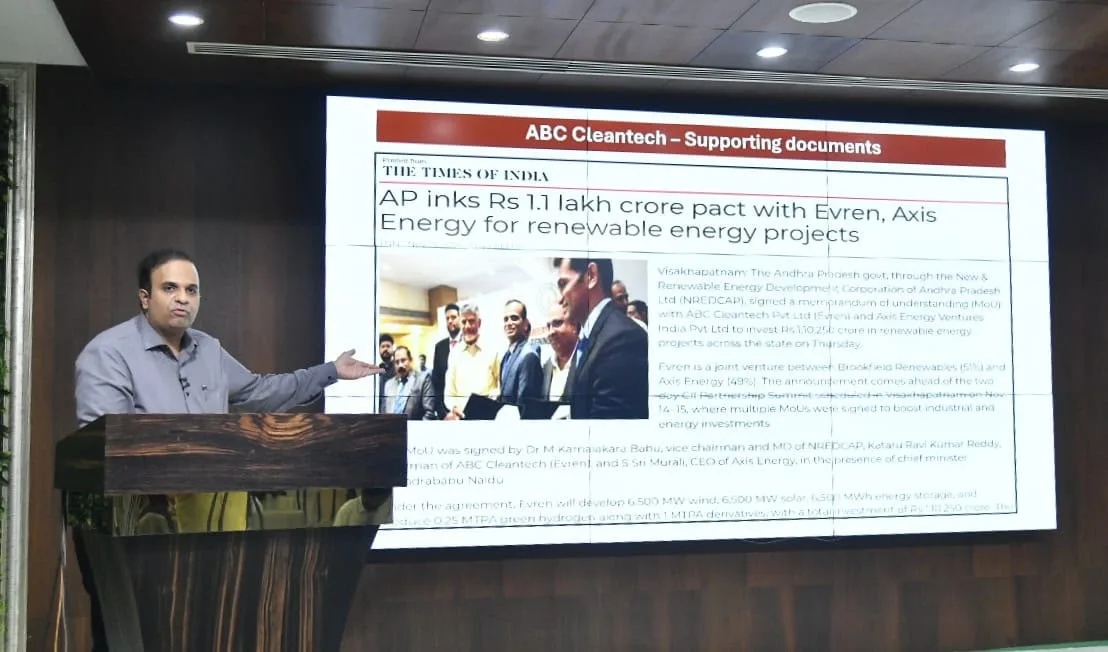
Other investments mentioned were a March 2023 MoU for ABC Clean Tech, later refreshed in November 2025, and agreements with firms such as Hero Future Energies, EcoRene India, JSW Neo Energy, Greenko, ACME CleanTech, ReNew Power, Adani Hydro Energy, Asda Green Energy Ventures and Indosol Solar.
Industrial expansions framed as new achievements
Krishna argued that several cement and manufacturing expansions are being portrayed as coalition successes, even though the original approvals date back to the YSRCP era. Shree Cement and My Home Cement filed for clearances in 2019, receiving approvals during the YSRCP government. The Ramco Cement plant, inaugurated by former Chief Minister Y.S. Jagan Mohan Reddy in September 2022, is now being listed among the coalition’s accomplishments.
The party also pointed to the Mondelez/Snack India project, whose MoU was signed in March 2023 and whose construction began in July of the same year, as another example of pre‑existing momentum being recast as a current‑government win.
Foreign investment share under scrutiny
Krishna questioned the coalition’s record on attracting foreign direct investment. He noted that India recorded about $114 billion in FDI across 2024‑2026, while Andhra Pradesh’s share was roughly $820 million, just 0.72% of the national total. He asserted that a sizable portion of the state’s reported FDI, such as the Pioneer Aluminium Industries investment, was approved during the YSRCP tenure.
To counter claims that the previous administration had scared away investors, Krishna presented manufacturing‑sector data showing growth in fixed capital, productive capital, investment capital, employment and gross output between 2019 and 2024. RBI figures, he said, place Andhra Pradesh’s manufacturing growth fifth nationally and first among southern states.
Fiscal management and borrowing disparities
The PAC member also slammed the coalition’s financial handling, citing RBI and Finance Commission data. He claimed the YSRCP government borrowed Rs.23,535 crore less than the permitted ceiling between 2021 and 2024, whereas the coalition has allegedly overspent its limit by Rs.37,848 crore.
Further, Krishna said 33% of YSRCP‑era borrowings (2019‑2023) funded capital expenditure, compared with only 27% of the coalition’s borrowings up to September, the remainder being channeled to revenue expenditure. He urged the government to focus on fiscal prudence and fresh investment rather than repackaging past approvals as new achievements.
Krishna challenges Lokesh to respond
Concluding the press conference, Krishna demanded that Nara Lokesh examine the documentary evidence and either withdraw or clarify his earlier statements that the YSRCP government had failed to draw investments. He warned that misrepresenting past projects hampers transparent policy making and undermines the state’s credibility with investors.
Krishna’s remarks come as the coalition pushes forward on other development initiatives, including a planned district‑cooling project for Amaravati backed by UNEP and a new investment‑protection act aimed at shielding investors from policy reversals.