
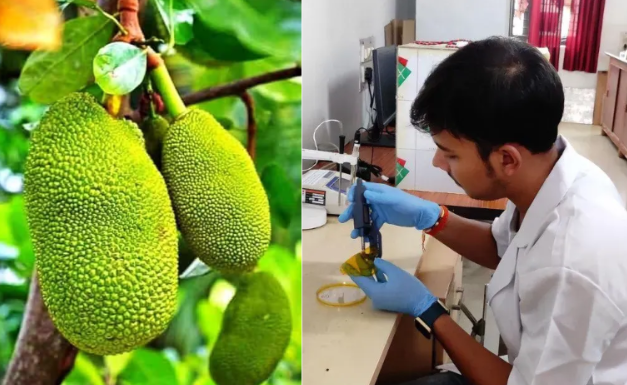
New Delhi, Oct 14: Researchers at the National Institute of Technology (NIT) Rourkela have patented a low-cost material made from discarded jackfruit peels that could help remove excess fluoride from contaminated groundwater. The technology offers a potential solution to drinking water problems in fluoride-affected regions of India, including parts of Andhra Pradesh and Telangana.
The material uses activated carbon produced from jackfruit peels and modified with zirconium to improve its ability to capture fluoride. Laboratory tests showed that it could remove more than 90 per cent of fluoride from water within approximately 10 minutes under the tested conditions.
The research could pave the way for affordable and sustainable water purification methods, particularly in rural and semi-urban communities where access to reliable drinking water treatment facilities remains limited.
How Does Jackfruit Peel Help Remove Fluoride from Water?
The research team developed the material by converting discarded jackfruit peels into activated carbon and modifying it with zirconium. This process improves the material’s ability to capture and remove fluoride from contaminated water.
Susmita Mishra, Professor in the Department of Chemical Engineering at NIT Rourkela, said the technology uses agricultural waste as a resource for water purification.
According to the research team, laboratory experiments demonstrated fluoride removal efficiencies exceeding 90 per cent within approximately 10 minutes. In tests involving fluoride concentrations of around 1–5 milligrams per litre, the material achieved removal efficiencies of more than 90–97 per cent within 10–20 minutes under the tested conditions.
These results indicate the material’s potential for future drinking water treatment applications. However, further testing is needed before the technology can be used on a wider scale.
Why Is Fluoride Removal Important for Drinking Water?
Fluoride occurs naturally in groundwater in several parts of India. However, excessive concentrations can make drinking water unsafe for long-term consumption.
According to the World Health Organization (WHO), prolonged exposure to excessive fluoride through drinking water can cause dental and skeletal fluorosis. These conditions can affect both children and adults.
The WHO guideline value for fluoride in drinking water is 1.5 milligrams per litre. Groundwater containing fluoride above this level requires appropriate assessment and treatment to protect public health.
Affordable fluoride removal technologies are particularly important in areas where communities depend heavily on borewells and other groundwater sources for their daily drinking water needs.
Fluoride Contamination in Andhra Pradesh and Telangana
Fluoride contamination remains a concern in several parts of Andhra Pradesh and Telangana, where local geological conditions can contribute to elevated fluoride levels in groundwater.
In Telangana, the erstwhile Nalgonda district has historically been among the most affected regions. Areas including Marriguda, Munugode and Nampally have faced concerns over fluoride-contaminated drinking water. Other areas, including parts of Rangareddy and Adilabad, have also reported groundwater quality concerns.
In Andhra Pradesh, fluoride contamination has been reported in parts of Prakasam, Anantapur and Palnadu districts, as well as sections of Rayalaseema and other hard-rock regions.
Groundwater quality can vary significantly between villages and individual water sources. The presence of fluoride in a particular borewell must therefore be established through testing rather than assumed from district-level figures.
Reports and state-level assessments have also raised concerns about groundwater quality in thousands of habitations across the two states. The scale of the problem highlights the need for regular water testing and reliable treatment facilities, especially in rural communities that depend on groundwater.
If successfully developed for practical use, the NIT Rourkela technology could offer another option for communities facing fluoride contamination. Its effectiveness and suitability would need to be established for local water conditions.
How Is This Technology Different from Existing Water Purification Methods?
Several conventional methods are available for removing excess fluoride from groundwater. However, each has certain limitations.
Reverse osmosis (RO): RO systems can remove fluoride effectively, but they produce wastewater and may also remove beneficial minerals such as calcium and magnesium.
Ion exchange: This method can remove fluoride, but its performance depends on water chemistry and the treatment materials used. Regeneration and chemical management may also be required.
Activated alumina: This material is used in fluoride treatment systems, but its performance depends on operating conditions and appropriate maintenance or regeneration.
The NIT Rourkela research team aims to address some of these challenges by developing a material from an easily available agricultural by-product.
Using discarded jackfruit peels could also help reduce agricultural waste while creating a potentially useful material for water purification.
However, the new technology has not yet been established as a commercially available replacement for existing treatment systems.
Low-Cost Material Could Benefit Rural Communities
Pratima Minz, a research graduate at NIT Rourkela and co-owner of the patent, said the material demonstrated promising results in laboratory-scale experiments.
She noted that the technology could support decentralised drinking water treatment solutions, particularly in rural and semi-urban areas where access to dependable water treatment infrastructure is limited.
The use of agricultural waste also supports a waste-to-resource approach, in which discarded materials are converted into useful products.
Based on the laboratory work, the researchers estimated the material synthesis cost at approximately ₹37 per gram, considering the electricity and chemicals used during preparation.
This figure represents the estimated cost of producing the material under the research conditions. It does not represent the total cost of treating drinking water, which would also depend on system design, operating requirements, material replacement and maintenance.
Technology Still Requires Further Testing
The research has reached Technology Readiness Level 4 (TRL 4), indicating that the technology has been validated at the laboratory level.
The next stage involves developing a physical prototype and evaluating its practical performance. The team plans to assess long-term effectiveness, operational costs and the feasibility of deploying the material in real-world water treatment systems.
Further studies will be important to determine how the material performs with different groundwater compositions, how frequently it needs to be replaced or regenerated, and how safely the treated water can be supplied for drinking.
Until these assessments are completed, households should continue to rely on tested and verified fluoride treatment methods rather than treating the patented material as a ready-to-use household solution.
A Promising Step Towards Safer Drinking Water
The NIT Rourkela patent highlights how agricultural waste can potentially be converted into a useful resource for addressing environmental and public health challenges.
For fluoride-affected areas of Andhra Pradesh and Telangana, an affordable and effective treatment technology could eventually help improve access to safe drinking water.
While the laboratory results are encouraging, prototype development, field testing and independent verification will determine whether the jackfruit peel-based material can become a practical solution for communities affected by excess fluoride in groundwater.





