
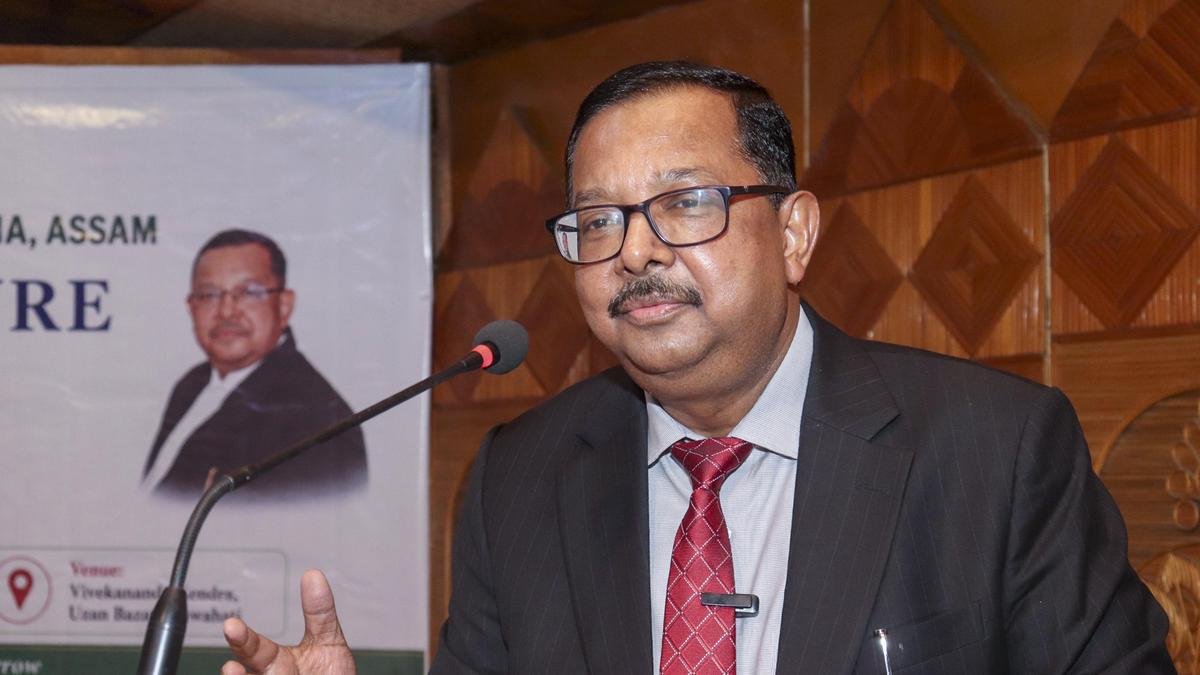
Hyderabad, Oct 5: Supreme Court judge Justice Ujjal Bhuyan has said that any process that disenfranchises millions of Indian citizens is inherently arbitrary and goes against the constitutional order. He stressed that no justification or political argument can defend a process that takes away citizens’ voting rights on a large scale.
Justice Bhuyan made the remarks while delivering the valedictory address at the 19th Justice Bodh Raj Sawhney Memorial Moot Court Competition at the NALSAR University of Law.
Voting Rights Are Central to Constitutional Democracy
Justice Bhuyan said the Indian Constitution does not create two categories of citizens—those who have voting rights and those who do not.
According to him, any process resulting in the wholesale disenfranchisement of Indian citizens could violate Articles 326 and 14 of the Constitution.
He said that making millions of citizens effectively second-class citizens by taking away their right to vote would strike at the core of the Constitution.
Justice Bhuyan also stressed that no individual, authority or institution is above the Constitution.
“No authority can do it; no court can endorse it or condone it. No one is above the Constitution,” he said.
Right to Vote Linked to India’s Democratic Struggle
Justice Bhuyan observed that the right to vote is closely connected with India’s long struggle for freedom and democracy.
He said voting rights represent the freedom achieved after years of struggle and sacrifice. Therefore, Article 326, which deals with elections based on adult suffrage, cannot be undermined.
He further argued that the right to vote should not be viewed merely as a statutory right created by parliamentary legislation such as the Representation of the People Act, 1951.
According to Justice Bhuyan, the right to be a voter and participate in elections is closely connected with the constitutional framework and the democratic structure of India.
Voter Deletion Requires Due Process
Justice Bhuyan also referred to the rules governing the deletion of names from electoral rolls.
He said Section 22 of the Representation of the People Act permits deletion of an entry in the electoral roll, but the concerned voter must be given a reasonable opportunity to be heard.
Referring to Supreme Court judgments, he said that voter names cannot ordinarily be removed from electoral rolls without following due process, except in cases such as the death of a voter.
The judge emphasised that the right to be included in the electoral roll and the right to vote are fundamental to free and fair elections.
He compared the relationship between citizenship and voting rights to that between a body and its soul, stressing the importance of voting rights in a democratic system.
Democracy Depends on Citizens’ Voting Rights
Justice Bhuyan also referred to the views of US judge Justice Felix Frankfurter, who had said that the highest office in a democracy is not that of the President but that of the citizen.
Quoting Frankfurter, Justice Bhuyan highlighted the continuing nature of democracy and the need to protect freedom through constant effort.
He posed a fundamental question: What is the worth of a citizen without voting rights?
Justice Bhuyan Praises NALSAR Students and Faculty
Justice Bhuyan, who previously served as Chancellor of NALSAR, also praised the university’s students.
He said NALSAR students had demonstrated the qualities expected from university students, particularly law students, describing them as brilliant, bold and brave.
He also appreciated the faculty members for performing their responsibilities effectively and fulfilling the role expected of university teachers.
Justice Bhuyan congratulated NALSAR Vice Chancellor Srikrishna Deva Rao and said he had led the university admirably.
The remarks underline the importance of protecting voting rights, ensuring due process in electoral roll revisions and preserving the constitutional foundations of democracy.





