Amaravati, Nov 4: Renowned environmentalist and Waterman of India Dr Rajendra Singh has expressed serious concerns over the potential environmental damage caused by Amaravati capital construction. He warned that construction activities, sand mining and mechanical dredging along the Krishna River could affect its natural floodplains, fertile agricultural lands and ecological balance.
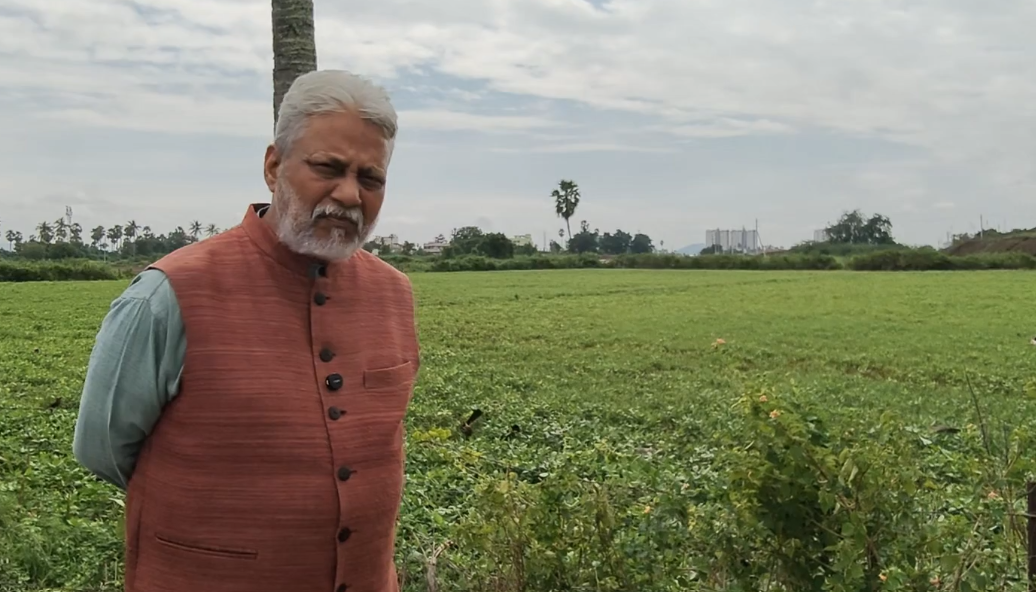
During his visit to the Amaravati capital region, Rajendra Singh, accompanied by environmental activist Bolisetti Satyanarayana, reportedly inspected the Krishna River floodplains, ongoing construction activities along the riverbank and areas affected by sand mining and dredging. Bolisetti shared details of the visit on his social media account.
Rajendra Singh stressed that development should not come at the cost of destroying nature and that construction activities must respect the ecological importance of rivers and their natural floodplains.
Questions Over Amaravati’s Environmental Clearance Conditions
Bolisetti Satyanarayana drew attention to Ecology Condition No. 9 included in the environmental clearance granted for Amaravati’s capital construction.
According to him, the condition specifies that a stretch of land extending approximately 2 to 3 kilometres parallel to the Krishna River should be used exclusively for developing blue-green infrastructure.
He also highlighted the importance of protecting fertile agricultural lands in this region for urban farming and the capital’s future food security.
Bolisetti questioned whether the ongoing construction activities, land acquisition and changes in land use were complying with these environmental clearance conditions. He urged the government to clarify whether the prescribed ecological safeguards were being properly implemented.
High Court Urged to Examine Krishna River Floodplain Damage
Bolisetti also appealed to the Chief Justice of the Andhra Pradesh High Court and other judges to take note of the developments along the Krishna River.
Pointing out that judges regularly travel along the Krishna riverbank road, he requested the High Court to examine the implementation of environmental clearance conditions and the alleged damage to natural floodplains.
He further suggested that the court consider taking suo motu cognisance of the issue and ordering an independent examination if necessary.
Sand Mining and Dredging Raise Concerns Over Riverbank Safety
Concerns have also been raised over alleged mechanical dredging and deep sand mining activities in the Krishna River since 2015.
Local concerns reportedly include claims that sand has been extracted from depths of nearly 40 feet in certain locations. Such activities could alter the natural structure of the riverbed and increase the risk of riverbank erosion.
Environmental activists have warned that excessive sand extraction and dredging could potentially affect the stability of the riverbanks and the safety of the Krishna river embankment.
If these concerns are substantiated, the consequences could extend beyond Amaravati and potentially affect low-lying areas of Vijayawada and Guntur as well.
Why Krishna River Floodplains Are Important
The Krishna River floodplains and fertile Jareebu agricultural lands play an important role in maintaining the region’s ecological balance.
These lands help:
- Store excess water during floods.
- Recharge groundwater resources.
- Protect biodiversity and natural ecosystems.
- Support agricultural activities and food security.
- Reduce the impact of flooding on nearby settlements.
Environmental activists argue that these areas must be protected in their natural condition rather than converted indiscriminately for urban development.
Bolisetti Satyanarayana also spoke about the challenges faced by farmers in protecting their agricultural lands. He alleged that the government was attempting to acquire his own agricultural land despite his efforts to protect farmers’ interests.
Demand for Independent Environmental Investigation
Bolisetti has called for a series of measures to address the concerns surrounding Amaravati’s development.
His key demands include:
- Constituting an independent expert committee to investigate construction activities and land acquisition in the Krishna River floodplains.
- Releasing a white paper on the implementation of all environmental clearance conditions, particularly Ecology Condition No. 9.
- Conducting a comprehensive investigation into sand mining and mechanical dredging activities in the Krishna River.
- Carrying out independent hydrological and geotechnical studies to assess the safety of the Krishna river embankment.
- Suspending construction and land acquisition activities that could affect the floodplains until environmental and legal reviews are completed.
Development Should Not Come at the Cost of Nature
Bolisetti Satyanarayana clarified that he was not opposed to the development of Amaravati as the state capital. However, he maintained that capital construction should not damage the Krishna River, natural waterways or fertile Jareebu agricultural lands.
Referring to Articles 48A and 51A(g) of the Indian Constitution, he reminded the government and citizens that protecting the environment is a shared responsibility.
The concerns raised by Rajendra Singh and Bolisetti have brought renewed attention to the environmental sustainability of Amaravati’s capital development.
Protecting the Krishna River’s natural floodplains, maintaining riverbank stability and safeguarding fertile agricultural lands are crucial not only for the region’s ecological balance but also for Amaravati’s long-term safety and future.