Fresh data from the Centre’s Periodic Labour Force Survey (PLFS) has delivered a sobering assessment of Andhra Pradesh’s employment landscape under the Telugu Desam Party (TDP)-led coalition government. Despite ambitious promises of massive investments, industrial revival, and the creation of lakhs of jobs since assuming power in 2024, official statistics reveal no improvement, and in some segments, a marginal deterioration, in the state’s unemployment situation.
The latest parliamentary reply from the Union Ministry of Labour and Employment lays bare the ground reality: unemployment in Andhra Pradesh has refused to budge, challenging the narrative of rapid economic turnaround peddled by the ruling dispensation.
The Numbers That Tell the Story
According to PLFS data:
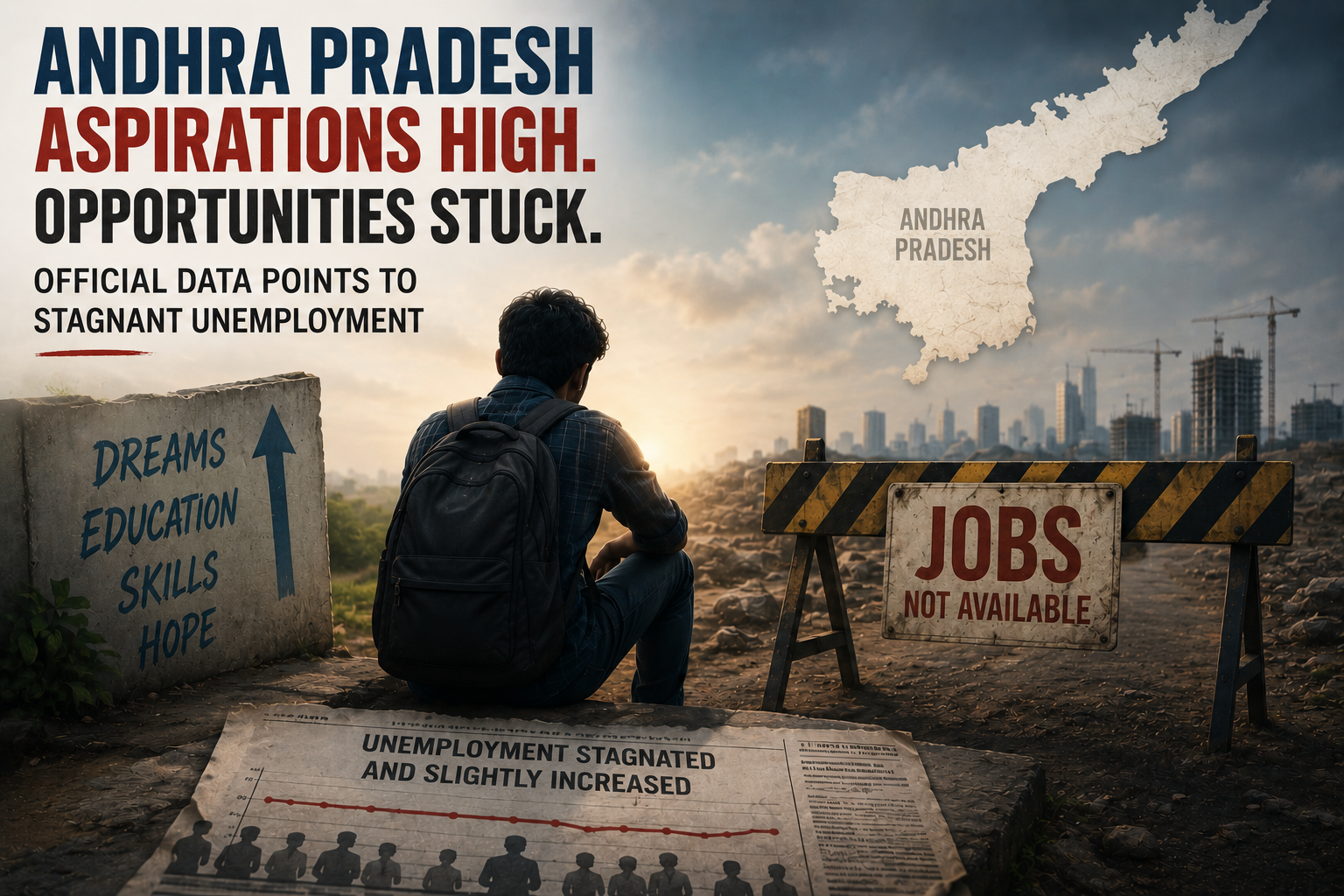
- The overall unemployment rate stood at 4.1% in 2023-24 (the last year of the YSRCP regime) and rose marginally to 4.2% in 2025, the first full year under the TDP coalition.
- Urban unemployment increased from 5.9% to 6.2%, indicating growing distress in cities and towns where expectations of new industries and services were highest.
- Rural unemployment remained stagnant at 3.4%.
- Most alarmingly, youth unemployment (for those aged 15-29 years) hovers at a worrying 16.2%, pointing to a serious mismatch between the aspirations of young people and available opportunities.
These figures are not mere statistical blips. They represent the lived experiences of thousands of families across the state who continue to struggle with job scarcity despite high-profile MoUs, investor summits, and repeated government assurances.
A Point Against Government Efforts: Promises vs Performance
This data serves as a strong indictment of the coalition government’s efforts on the employment front. Far from the much-touted “job revolution,” the absence of any decline, let alone significant reduction, in unemployment rates strongly suggests that no meaningful, result-oriented efforts are translating into tangible outcomes on the ground.
Announcements of attracting billions in investments and creating lakhs of jobs have not been backed by visible progress in labour market indicators. If large-scale employment generation were truly underway, the PLFS data should have reflected a downward trend in unemployment. Instead, the numbers show stagnation and slight regression, especially in urban areas where new economic activities were expected to flourish. This gap between rhetoric and reality raises fundamental questions about the effectiveness of policy implementation and the prioritisation of job creation.
Political Backdrop and Counter-Narratives
The TDP coalition came to power in 2024 on the back of strong electoral promises, including the creation of two million jobs, monthly stipends for unemployed youth, and rapid industrialisation. Chief Minister N. Chandrababu Naidu and his cabinet have frequently highlighted government recruitments, filled posts in various departments, and ongoing infrastructure projects as steps toward fulfilling these commitments.
However, opposition parties, particularly the YSRCP, have seized on the PLFS data to accuse the government of failing to deliver. They contrast the current stagnation with their own tenure’s claimed achievements in job creation through welfare-linked employment and MSME support. TDP ministers have pushed back by arguing that the previous government left the state with one of the highest unemployment burdens, citing earlier PLFS rankings and youth distress metrics.
Broader Economic Context
Andhra Pradesh’s challenges exist against a national backdrop where PLFS reports have shown gradual improvements in labour force participation rates (LFPR) and modest declines in overall unemployment in several quarters. Nationally, increased women’s participation and formalisation trends have been positive signals. Yet, states like Andhra Pradesh continue to grapple with structural issues: limited large-scale industrial clusters, over-reliance on agriculture and informal sectors, skill gaps, and outward migration of talent.
Youth unemployment remains particularly stubborn, often reflecting not just a lack of jobs but also a mismatch between education systems and market demands. In Andhra Pradesh, this is compounded by the state’s transitional phase, rebuilding administrative capabilities post-bifurcation and competing with more industrialised neighbours.
Central government schemes in skill development, apprenticeships, and MSME promotion are active, but their on-ground penetration and coordination with state initiatives appear insufficient to move the needle on PLFS metrics.
Implications for the State and Its People
Persistent unemployment carries heavy economic and social costs. It dampens consumer spending, slows poverty reduction, and risks increasing youth disillusionment. For a state aiming to position itself as an investment destination, credible progress on jobs is essential to build investor confidence and retain local talent.
Economists note that while headline unemployment rates provide one snapshot, underemployment, low-quality jobs, and disguised unemployment in rural areas may paint an even more challenging picture. The slight urban uptick is particularly concerning given the government’s focus on urban-centric growth models.
The Road Ahead
As Andhra Pradesh moves forward, the PLFS data should serve as a wake-up call rather than a political football. Bridging the gap between ambitious targets and measurable outcomes requires:
- Accelerated implementation of skilling programmes aligned with emerging industries.
- Transparent tracking and public disclosure of jobs created under various schemes.
- Greater focus on labour-intensive sectors such as manufacturing, tourism, food processing, and IT/ITeS.
- Enhanced coordination between Central schemes and state-level initiatives.
The Periodic Labour Force Survey, conducted by the Ministry of Statistics and Programme Implementation, remains one of the most reliable barometers of India’s labour market. For the TDP coalition government, reversing the current trend is not just an economic imperative but a political necessity to retain public trust.
Until concrete improvements appear in future PLFS rounds, the latest data stands as a stark reminder: promises alone are insufficient. Sustained, effective efforts on employment generation are what the people of Andhra Pradesh urgently need.