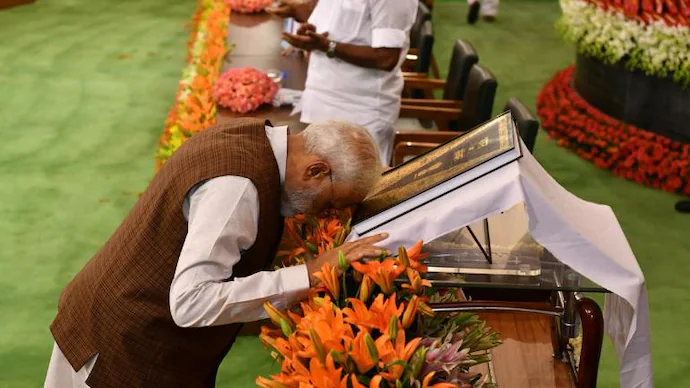
New Delhi, Nov 26 : Prime Minister Narendra Modi on Thursday said the Indian Constitution has played a major role in shaping the lives of millions of citizens. He said its extraordinary spirit made it possible for even a child from a poor and underprivileged family to become the Prime Minister of the world’s largest democracy.
In a signed article published in leading newspapers on the occasion of Constitution Day, Modi highlighted the importance of the Indian Constitution and its role in promoting equality, social justice and national unity. He said the Constitution is not limited to Parliament and courts but is an important part of every Indian’s life.
The Prime Minister also criticised the Congress party, accusing its governments of weakening constitutional values during their time in power. He referred to the Emergency, constitutional amendments and the repeated use of Article 356 to dismiss elected state governments.
Constitution Day: Why November 26 Is Important
Modi recalled that the Constituent Assembly adopted the Indian Constitution on November 26, 1949. He paid tribute to Dr Rajendra Prasad, Dr B R Ambedkar and other members of the Constituent Assembly for their contribution to framing the Constitution.
He said India celebrates November 26 as Constitution Day to increase public awareness about constitutional values, particularly among young people.
According to Modi, the Constitution reflects India’s rich cultural traditions, diverse languages, religions and different schools of thought. He also referred to constitutional scholar Granville Austin’s description of the Indian Constitution as a social document.
Modi Highlights Constitutional Values and Poverty Reduction
The Prime Minister said social and economic justice are among the most important goals of the Constitution. Referring to a recent World Bank report, he claimed that nearly 50 crore Indians had moved out of poverty.
He said government welfare programmes have helped improve the living conditions of poor and disadvantaged families.
Modi cited several central government schemes to explain how constitutional values are being implemented through welfare initiatives.
- PM Awas Yojana: Helping poor families move from temporary houses to permanent homes.
- Ujjwala Yojana: Providing LPG connections to women and reducing the difficulties of cooking with traditional fuels.
- Ayushman Bharat: Helping economically weaker families access healthcare without facing heavy medical expenses.
- MUDRA and PM-SVANidhi: Supporting small businesses, entrepreneurs and street vendors.
- UPI and Digital Technology: Making financial services and digital transactions more accessible to ordinary citizens.
He said these initiatives are helping strengthen the principles of equality, dignity and social justice.
Modi Explains the Importance of 101st, 102nd and 103rd Constitutional Amendments
The Prime Minister also highlighted three important constitutional amendments introduced in recent years.
He said the 101st Constitutional Amendment introduced the Goods and Services Tax (GST), bringing major changes to India’s taxation system.
The 102nd Constitutional Amendment granted constitutional status to the National Commission for Backward Classes (NCBC), addressing a long-standing demand of backward communities.
He also referred to the 103rd Constitutional Amendment, which introduced 10 per cent reservation for Economically Weaker Sections (EWS) among communities not covered by the existing reservation system.
Modi said these amendments were important steps towards addressing the needs of different sections of society.
Constitution Now Available in All 22 Scheduled Languages
Modi said an updated version of the Indian Constitution is now available in all 22 languages listed in the Eighth Schedule.
He described this as an important step towards making the Constitution more accessible to people across the country.
He also highlighted the introduction of the Bharatiya Nyaya Sanhita, which replaced the colonial-era criminal laws. According to him, the new criminal justice framework focuses on justice rather than punishment.
Modi Accuses Congress of Weakening the Constitution
Without directly naming the Congress in every instance, Modi accused the party of weakening constitutional institutions and fundamental freedoms during its decades in power.
He referred to the First Constitutional Amendment of 1951, alleging that it restricted fundamental freedoms before India’s first general elections.
The Prime Minister also criticised the 42nd Constitutional Amendment, introduced during the Emergency in 1976. He said it affected judicial review and changed the balance of power among constitutional institutions.
He urged young people to study the 38th and 39th Constitutional Amendments to understand how political leadership can misuse constitutional powers.
Modi also criticised the repeated use of Article 356 to dismiss elected state governments. He said one political party had imposed President’s Rule nearly 100 times, pointing to what he described as a misuse of constitutional provisions.
Article 370 and 35A: Modi Says Historical Wrong Was Corrected in 2019
Referring to Jammu and Kashmir, Modi said Articles 370 and 35A prevented the full implementation of the Indian Constitution in the region for more than seven decades.
He argued that these provisions affected the rights of Scheduled Castes, Scheduled Tribes, Other Backward Classes and women in Jammu and Kashmir.
The Prime Minister said the abrogation of Articles 370 and 35A in 2019 corrected what he described as a historical wrong and helped extend constitutional provisions to the region.
Modi Calls for ‘India First’ and Duty-Based Governance
Concluding his article, Modi said India is at an important stage in its development journey. He said the central government’s goal is to build a developed India by 2047.
He highlighted two guiding principles for achieving this goal: India First in our thinking and Kartavya (duties) in our actions.
The Prime Minister said the Constitution should remain the source of strength for the country and guide future generations towards unity, equality and development.