Three decades after the first feasibility studies were ordered and after successive governments took up the project at different stages, Phase I of the Poola Subbaiah Veligonda Project is finally inaugurated on August 31, with Krishna water being released into Nallamala Sagar.
Turning a project of this scale into reality required something far more difficult than laying a foundation stone: sustained political commitment and years of physical execution, which was clearly evident under the tenures of former Chief Minister YS Rajashekhara Reddy, who initiated the project, while tunnel excavations were completed under former CM YS Jagan Mohan Reddy.
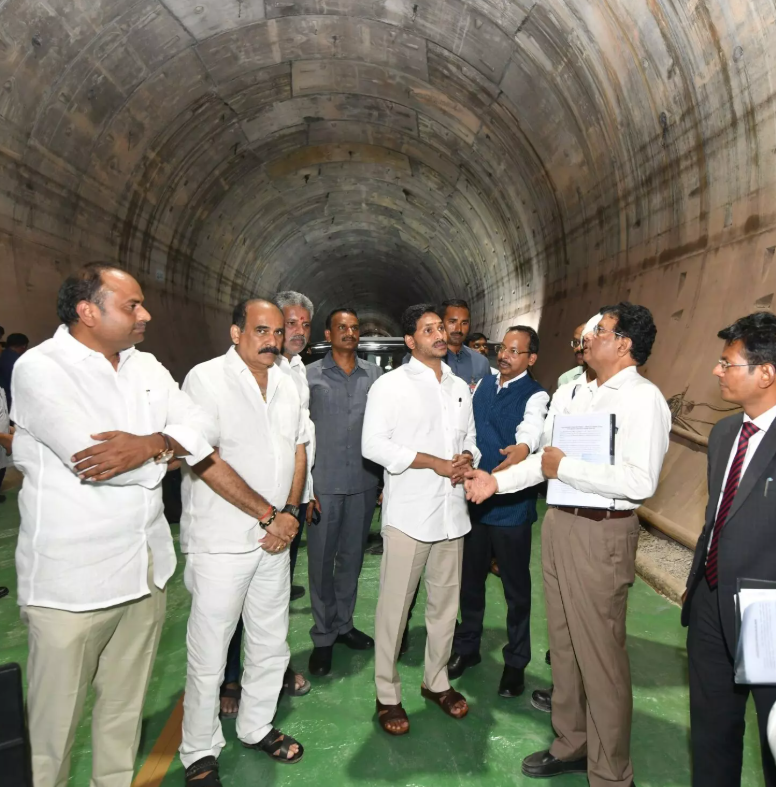
Photo Credit: Sakshi
An Engineering Project of Enormous Scale
For the drought-prone regions of Markapuram, Prakasam, Nellore and Kadapa, this is more than the completion of a long-pending irrigation project. It is the realization of a dream that has endured for generations—bringing drinking water to villages that have struggled with water scarcity and fluoride contamination while providing irrigation to farmers who have faced repeated droughts.
The Veligonda project is designed to draw floodwater from the foreshore of the Srisailam reservoir, near Kollam Vagu, by gravity through two massive tunnels beneath the Nallamala hills.
Each tunnel is approximately 18.8 kilometres long. From there, water will travel through a feeder canal of about 21.3 kilometres into Nallamala Sagar, which has a gross storage capacity of approximately 53.85 TMC. The water will then be carried through branch canals to the command areas.
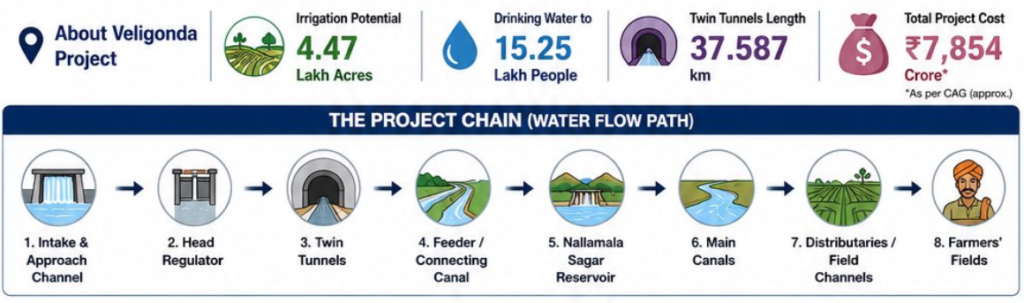
At full operation, the project is designed to irrigate approximately 4.47 lakh acres across 30 mandals—including 23 mandals in Prakasam, five in Nellore and two in Kadapa—and provide drinking water to nearly 23 lakh people.
Under the Phase I inauguration, around 10.70 TMC of Krishna water will be released into Nallamala Sagar, providing irrigation to roughly 1.19 lakh acres and drinking water to about four lakh people.
For regions that have lived with drought and water scarcity for decades, the significance of these numbers is measured not in TMCs and kilometres, but in crops, drinking water and livelihoods.
More Than a Foundation Stone
The tunnel excavation figures provide an interesting perspective on the project’s long political journey.
Of the total 37.587 kilometers of twin-tunnel excavation, 20.333 kilometres had been completed by 2014, following the major construction push initiated under former Chief Minister Dr. Y. S. Rajasekhara Reddy. During Chandrababu Naidu’s 2014–19 tenure, another 6.686 kilometres were completed. Between 2019 and 2024, under Y. S. Jagan Mohan Reddy, a further 10.568 kilometres were completed.
The figures show where the project made substantial progress and where its pace slowed. They also provide the context for understanding the contributions of successive governments.
To understand that journey, it is worth going back to the beginning.
The Beginning
The Veligonda story dates back to 1982 when the initial proposal was submitted. In February 1991, the government headed by then CM N. Janardhana Reddy ordered feasibility studies and investigations for the project. By 1994, a detailed project report had been prepared, initially envisaging a single tunnel with limited capacity.
On March 5, 1996, then Chief Minister N. Chandrababu Naidu laid the foundation stone at Gottipadu. But the foundation stone did not translate into meaningful construction. The project remained largely stalled, leaving the people of the drought-prone region waiting for the promised water.
When Veligonda Became a Construction Project
The major turning point came in 2004, when then Chief Minister Dr. Y. S. Rajasekhara Reddy took up Veligonda under his flagship Jalayagnam program. Administrative approval was issued, turning what had remained largely an idea into an active construction project.
In 2005, the project was substantially redesigned as a much more ambitious twin-tunnel system aimed at optimally utilizing floodwater. The revised plan incorporated the twin tunnels,the Nallamalaa Sagar reservoir, three dams, the feeder channel, and the main canal system.
Most importantly, construction began in earnest. Tunnel-boring machines were deployed, and excavation of the tunnels and construction of associated works gathered momentum.
The work continued through the subsequent governments of K. Rosaiah and N. Kiran Kumar Reddy. By 2014, the combined excavation of the two tunnels had reached 20.333 kilometres. That represented a dramatic transformation from the stalled project that existed before 2004.
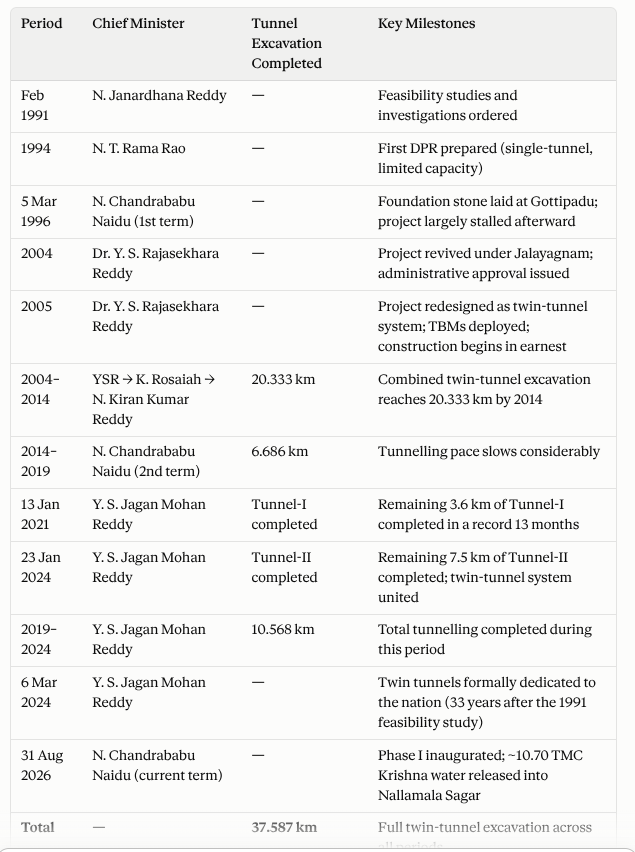
Table: Timeline of the Project Progress
A Slowdown Between 2014 and 2019
The pace changed after the government changed in 2014. During N. Chandrababu Naidu’s second term, between 2014 and 2019, only 6.686 kilometres of combined tunnel excavation were completed. Compared with the progress achieved during the preceding period, the pace of tunnelling slowed considerably.
For a project whose most difficult component was the excavation of two long tunnels through the Nallamala hills, the slowdown meant that the delivery of water remained further away.
The Breakthrough Under YS Jagan
The project received another major push after Y. S. Jagan Mohan Reddy became Chief Minister in 2019. Despite the enormous disruption caused by the COVID-19 pandemic, work on Veligonda accelerated. Between 2019 and 2024, another 10.568 kilometres of tunneling were completed.
One of the major milestones came on January 13, 2021, when the remaining 3.6 kilometers of Tunnel-I were completed in a record 13 months. The much-awaited breakthrough of Tunnel-II followed on January 23, 2024, when the remaining 7.5kilometers were completed, effectively uniting the twin-tunnel system.
Head regulators and canal-linking works also progressed, creating the infrastructure required to eventually move water through the system. On March 6, 2024, the twin tunnels were formally dedicated to the nation by Y. S. Jagan Mohan Reddy—a significant milestone that came 33 years after the first feasibility study in 1991.
The Numbers Tell the Story
Veligonda’s journey is ultimately a story of a project that passed through multiple governments but moved at very different speeds under each of them.
The foundation stone was laid in 1996, but meaningful construction began only after the project was revived under Y. S. Rajasekhara Reddy in 2004. The major tunneling phase continued through subsequent governments, reaching 20.333 kilometers by 2014.
After a slower phase between 2014 and 2019, the project again accelerated between 2019 and 2024, when another 10.568 kilometres were completed and the two tunnels finally achieved their long-awaited breakthroughs.
Now, with Phase I beginning to deliver Krishna water into Nallamala Sagar, a project that remained a promise for more than three decades is finally beginning to deliver its intended benefits. After three decades, the dream is no longer just on paper. The water is finally on its way.