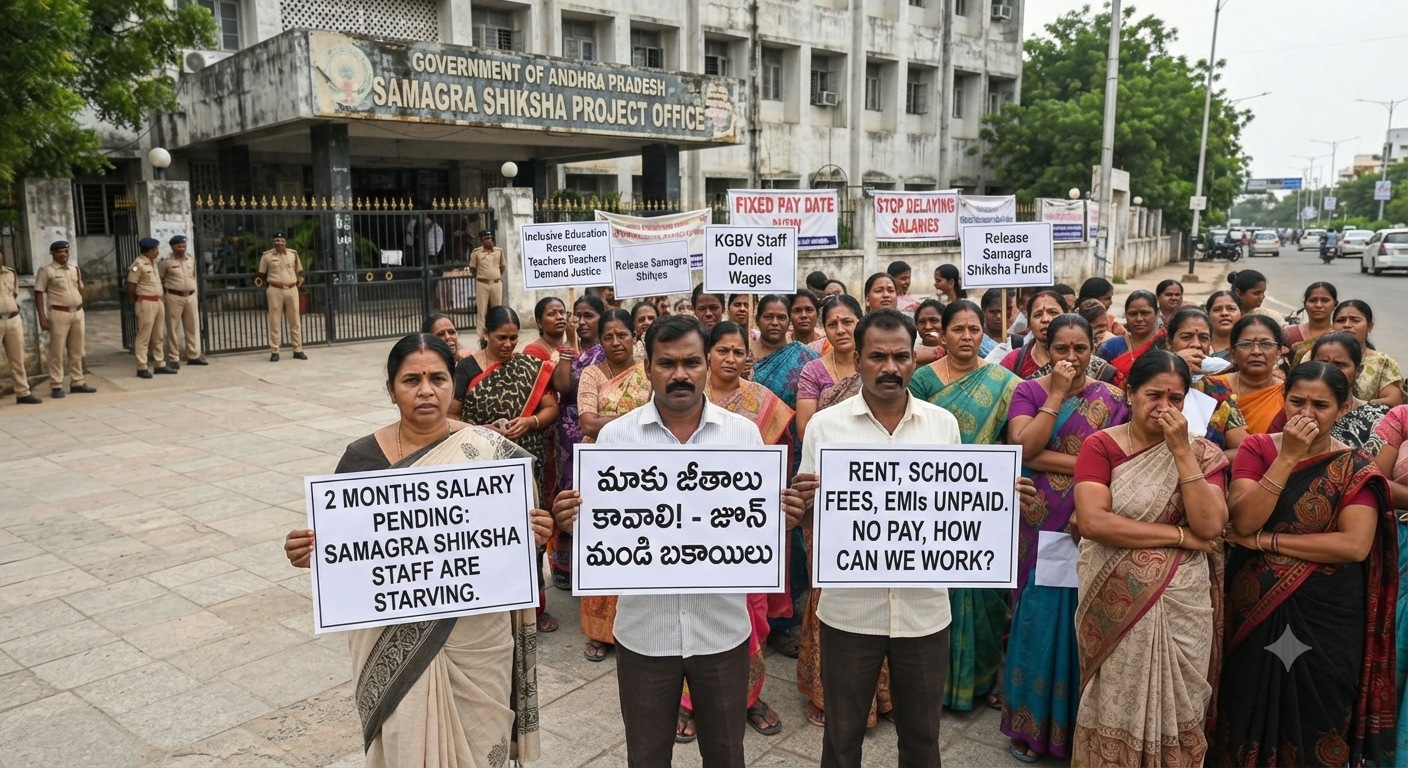
For two full months, salaries of roughly 23,000 Samagra Shiksha employees have been pending for the last two months. Cluster resource teachers, MIS coordinators, data entry operators, KGBV wardens and instructors, inclusive-education resource teachers, part-time teachers, accounts staff and project-office employees across all 28 districts have continued working without salaries. These are the people who form the backbone of Samagra Shiksha — the scheme that runs girls’ residential schools, supports children with disabilities, and keeps the education system’s data and administration moving. Since June, their wages have simply stopped.
These are not high-paid officials. They are households that live month to month. The missing salaries have translated into unpaid rent, skipped loan EMIs, children’s school fees left pending, and medical bills pushed aside. Union accounts describe staff borrowing from relatives and pawning household belongings just to keep the kitchen running. The irony is brutal: the very people who process other children’s education-related work cannot pay for their own children’s schooling.
What makes this especially damning is that two different unions — the Kasturba Gandhi Balika Vidyalaya teachers’ union and the Andhra Pradesh Primary Teachers’ Association — have been forced to raise the same basic demands: release the two months of arrears immediately, and put in place a permanent system so salaries arrive on a fixed date every month. You do not demand a fixed pay date unless chronic delay has become the norm. Under the TDP government, late pay is no longer an exception. It has become policy by default.
The government can offer the usual excuses. Samagra Shiksha is a centrally sponsored scheme, and fund releases sometimes get stuck between Delhi and Amaravati. That explanation might satisfy bureaucrats. It does not feed families. If central tranches are delayed, the state still has a responsibility to bridge the gap for the people actually doing the work. Instead, the burden has been shifted entirely onto the lowest-paid staff. The unions say they have repeatedly petitioned officials and received no resolution. The move from quiet appeals to public demand is the clearest signal that the normal channels under this administration have failed.
This is not an isolated administrative hiccup. It fits a larger pattern of the TDP government’s approach to those who keep the system running: announcements are made, schemes are celebrated, but the people executing them are left to manage uncertainty and debt. A government that claims to prioritise education and governance cannot simultaneously leave 23,000 education employee’s unpaid for two months and expect to be taken seriously.
The employees have kept schools open, data flowing, and services for vulnerable children operational. The TDP government has responded with silence and delay. On the basic test of whether those who do the work are paid on time, this administration is failing — and the cost is being paid by the families of the people who keep Andhra’s schools running.