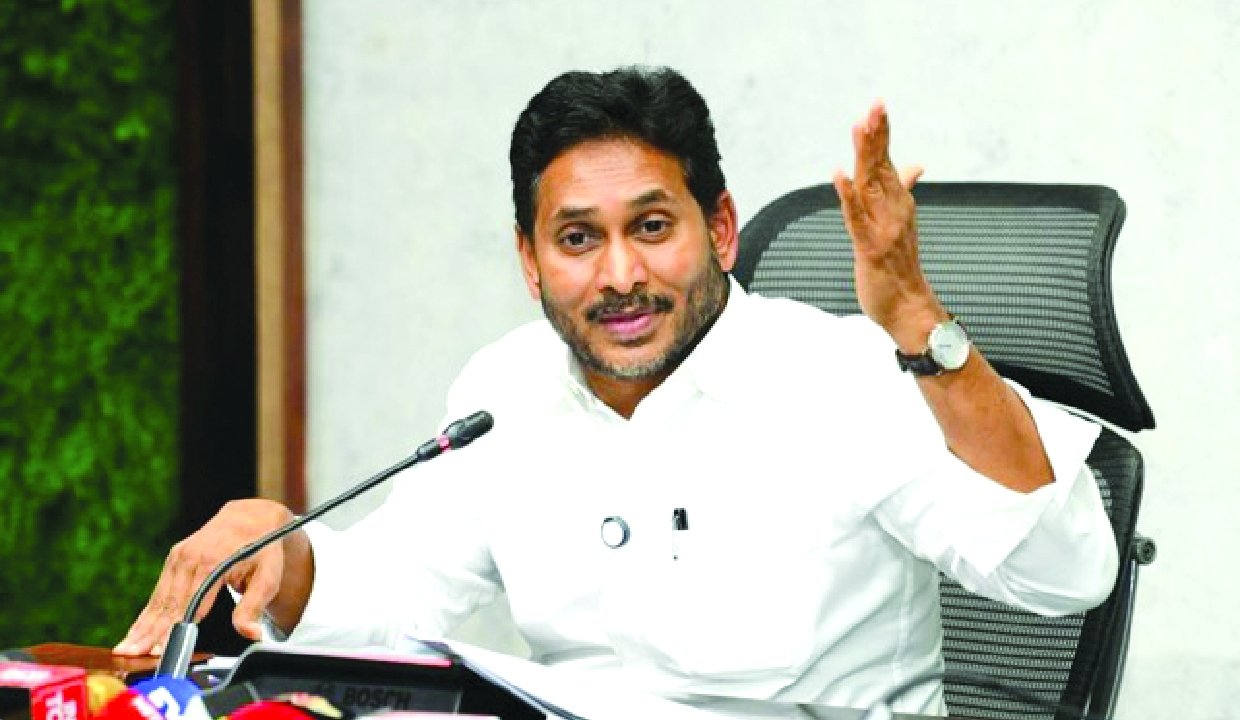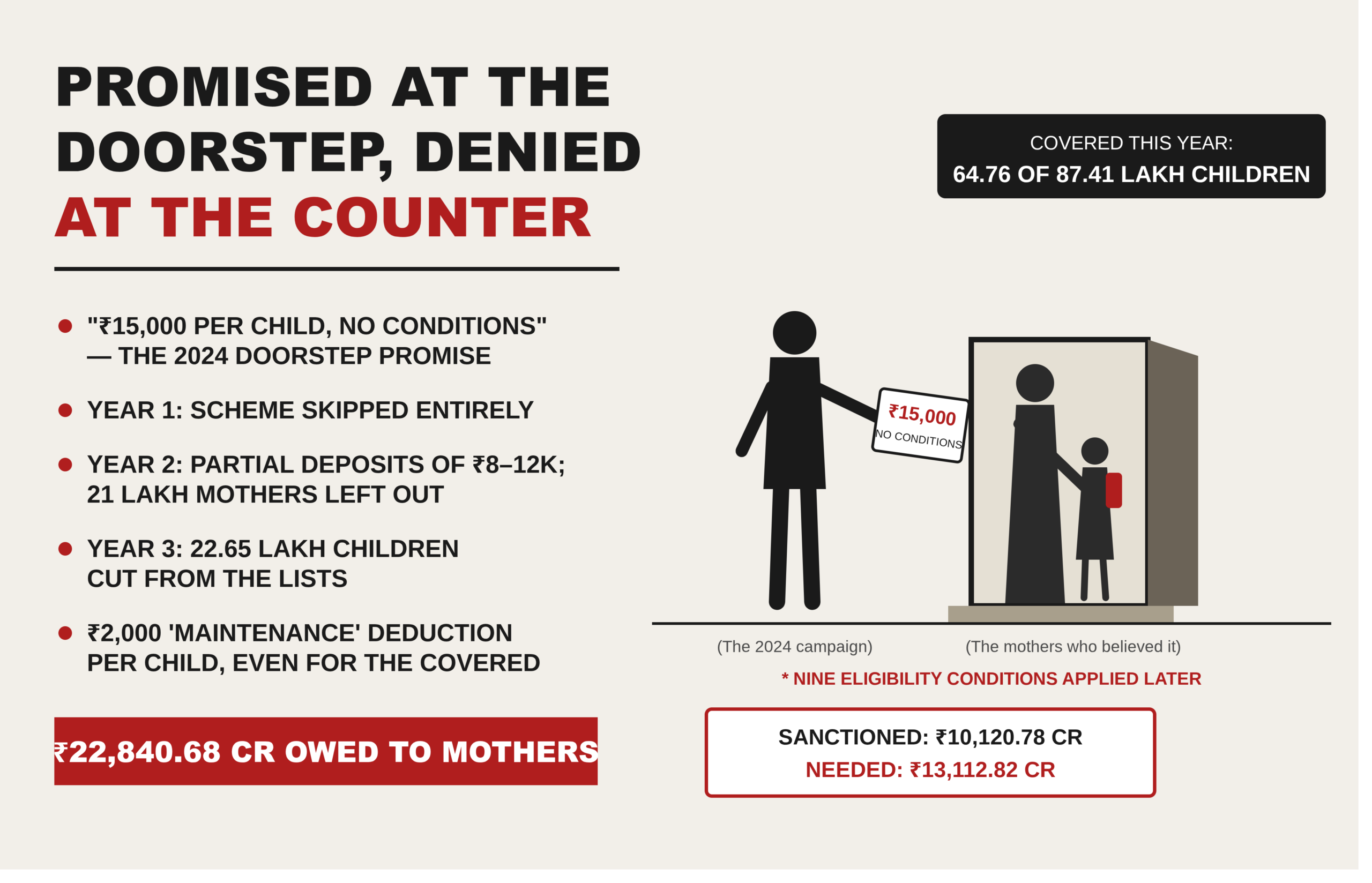
The promise was made at doorsteps, which is what makes its breach so personal. In the campaign of 2024, Chandrababu Naidu went house to house with an offer no mother could ignore: “₹15,000 for you… ₹15,000 for you… however many children are in the house, ₹15,000 for each.” No deductions, he said. No conditions. He and his son mocked the previous government for daring to trim even a rupee from its version of the scheme.
Three years later, one year skipped entirely, one year paid in fragments, and this year, the year of supposed full implementation — 22.65 lakh children struck off the rolls before a rupee moves. The running total of what mothers were promised but not paid: ₹22,840.68 crore.
The scheme that already existed
Begin with an inconvenient fact of paternity. “Thalliki Vandanam” — salute to the mother is not a TDP invention. It is Amma Vodi with the nameplate changed: YS Jagan’s scheme, conceived during his padayatra and paid from his government’s first year, ₹15,000 to every mother who kept a child in school. Whatever else is said of that government, the scheme ran, and the money landed.
Naidu’s critique in opposition was not that the scheme was wrong, but that it was insufficiently generous — that Jagan’s deductions were an insult. The remedy he promised was simple: the full amount, for everyone, with no fine print.
The fine print arrived anyway, and it is finer than anything it replaced.
Shrunk by eligibility
Consider what a mother must now prove to receive what was promised unconditionally. Her family must earn less than ₹10,000 a month in a village, ₹12,000 in a town — thresholds so low they exclude a household with a single daily-wage earner working steadily. She must hold a ration card. Her family must own no tractor, no four-wheeler, no municipal property above 1,000 square feet, no more than three acres of wet land. Her electricity meter must not cross 300 units a month a line a single air cooler in a Rayalaseema summer can breach. No one in the family may be a government employee, a pensioner, or an income-tax payer. Her older child, if drawing fee reimbursement at a polytechnic, disqualifies himself.
Each condition sounds defensible in isolation. Of 87.41 lakh children enrolled in the state’s schools by the government’s own UDISE data, only 64.76 lakh made this year’s list. The arithmetic of full implementation ₹13,112.82 crore was quietly replaced by a sanction of ₹10,120.78 crore. And from even the ₹15,000 that survivors of the sieve will receive, the government has announced it will deduct ₹2,000 per child for “school maintenance.”
The man who campaigned against a one-rupee cut has institutionalized a two-thousand-rupee one.
What the first two years bought
If year three is exclusion by design, the first two years were simpler: exclusion by inaction. In its first year, the government paid nothing at all. In the second, amid heavy publicity, ₹6,377 crore reached 55.66 lakh mothers, many of whom opened their bank messages to find not ₹15,000 but ₹8,000, or ₹9,000, or ₹12,000, partial deposits with no explanation. Twenty-one lakh mothers received nothing. Against a three-year entitlement of ₹39,338.46 crore, the state has delivered or sanctioned barely two-fifths.
A welfare scheme is a contract with the poorest, and its currency is predictability. A mother budgets a school year around that ₹15,000 — the uniforms, the notebooks, the fees that arrive in June whether the government’s funds do or not. Pay it late, pay it partially, or pay it to her neighbour but not to her, and the scheme’s value collapses even for those who eventually receive it. That is the quiet cruelty in the fragments: every partial deposit teaches every mother that the promise cannot be trusted.
The doorstep, revisited
There is a schedule now — first-phase funds on July 22, grievances from August 3, a supplementary list on August 30 and the government will point to it as proof of delivery. But a schedule for paying two-thirds of the children two years late is not the promise that was made at the doorstep. The promise was every child, the full amount, no conditions. It was specific precisely because specificity wins votes.
The mothers of Andhra Pradesh kept their side of the bargain: they voted, and they kept their children in school. The government that solicited their trust at their own front doors now asks them to produce ration cards, meter readings, and land records to prove they deserve what they were promised for free. Somewhere between the campaign doorstep and the eligibility form, “Thalliki Vandanam” — the salute to the mother became an interrogation of her.