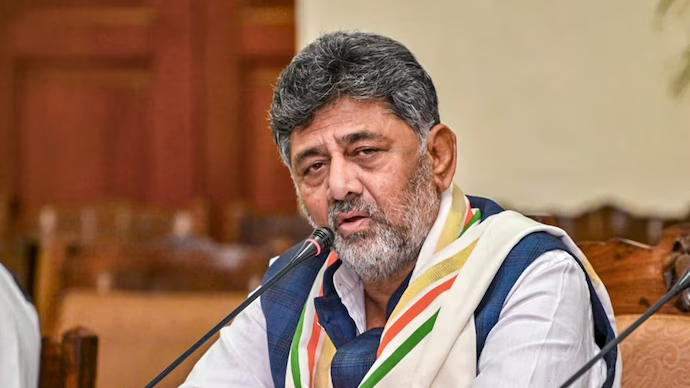
Bengaluru, Nov 4 : Karnataka Chief Minister D K Shivakumar has appealed to private school managements to adopt government schools in rural areas and support their development through partnerships. The initiative aims to improve educational facilities, strengthen infrastructure and provide better learning opportunities for rural students.
Speaking at the launch of the ‘Namma Shaale Namma Javabdari’ (Our School, Our Responsibility) programme in Bengaluru on Wednesday, Shivakumar said the government plans to connect 1,000 government schools with private institutions in the first phase. The broader target is to cover 2,000 government schools across the state.
Karnataka Government Plans to Develop 2,000 Schools
Shivakumar said the government had introduced a new Corporate Social Responsibility (CSR) policy to encourage private institutions and companies to contribute to rural education.
He urged private school managements to adopt government schools or work with the state government to improve their facilities.
The state has divided its 6,000 gram panchayats into three categories as part of the initiative. The first phase will focus on 1,000 government schools, with plans to expand the programme gradually.
The Chief Minister expressed confidence that the initiative would produce positive results within four to five years.
Private Schools Can Support Government Schools Through Teachers and Infrastructure
The Chief Minister said private school managements could select government schools for adoption and contribute according to their financial capacity.
He suggested several ways in which private institutions could support government schools, including:
- Appointing 10 experienced teachers from private schools to support government school students.
- Paying the salaries of teachers deputed to government schools.
- Providing computers, laboratory equipment and other learning resources.
- Supporting the construction and renovation of school buildings.
- Providing school buses to government school students instead of selling old vehicles.
Shivakumar said private institutions did not need to make large financial investments to participate. Even smaller contributions, such as sharing teaching expertise and educational resources, could make a significant difference.
He described the initiative as an opportunity for knowledge exchange between private and government schools.
Karnataka Has Rs 8,800 Crore in Annual CSR Funds
Shivakumar said Karnataka receives approximately Rs 8,800 crore annually through Corporate Social Responsibility (CSR) funds.
He added that he had held discussions with companies operating in the state and encouraged them to prioritise the development of rural primary schools.
The Chief Minister also said he had met Union Finance Minister Nirmala Sitharaman along with the state’s Chief Secretary to discuss CSR funding.
He requested the Centre to address the practice of companies registering in Karnataka but spending CSR funds in other states.
According to Shivakumar, some companies register their businesses in Karnataka but utilise the funds generated here elsewhere. He urged the Centre to take steps to prevent such practices.
CSR Projects Begin in Bengaluru and Ramanagara Schools
The Chief Minister said CSR-funded development works had already started in 30 government schools in Bengaluru South district.
Of these, work had been completed in 10 per cent of the schools, was underway in eight schools, and agreements had been finalised for another 12 schools.
He also highlighted Toyota’s contribution to government school infrastructure in Ramanagara district. The company has supported the construction of 23 schools, with an investment of approximately Rs 10 crore to Rs 15 crore per school.
Shivakumar said private institutions contributing to government school development would be allowed to include their names in the institutions.
As an example, he mentioned the Hegganur Government Toyota School near the Tamil Nadu border.
Karnataka Government Focuses on Improving Education Quality
Shivakumar acknowledged the challenges faced by private school managements and said the government had adopted a supportive approach towards them.
He noted that private schools charge annual fees ranging from Rs 50,000 to Rs 2 lakh, while government school teachers receive salaries between Rs 70,000 and Rs 1.5 lakh.
The state government has also borrowed Rs 2,000 crore from the World Bank to improve infrastructure in Karnataka Public Schools.
However, the Chief Minister stressed that improving teaching standards and the overall quality of education remained important priorities. He said the government was giving greater importance to teacher quality during the recruitment process.
Rural Education Can Help Reduce Bengaluru Traffic Congestion
The Chief Minister also connected the development of rural schools with Bengaluru’s growing traffic problems.
He said Bengaluru has a population of around 1.40 crore and approximately 1.20 crore vehicles. While road expansion in Bengaluru stands at around eight per cent, it is between 18 and 20 per cent in Mysuru.
Shivakumar pointed out that many children spend nearly an hour travelling to school in Bengaluru.
He said employment opportunities and the concentration of educational institutions in the city were among the major reasons for traffic congestion.
According to him, improving educational facilities in villages would allow children to study closer to home and reduce the need for families to travel to Bengaluru for quality education.
CM Calls for Public-Private Partnership in Education
Describing educational institutions as a shared responsibility, Shivakumar urged private school managements to become partners in developing government schools.
He said educational institutions should be treated as a responsibility entrusted to society, and the contributions made towards improving education would have a lasting impact.
The Chief Minister expressed confidence that the Namma Shaale Namma Javabdari programme would strengthen rural education, improve government school infrastructure and create better opportunities for students across Karnataka.