In public life, there is a difference between winning a contract and being handed one. The first requires a contest. The second only requires that the contest be carefully trimmed until the outcome is no longer in doubt.
That is why the Rs. 348-crore excavation tender for the removal of overburden and run-of-mine barytes (ROM) ore at the Mangampeta project in Obulavaripalli mandal, Tirupati district. Mangampeta is not just another mining site. It sits on one of the richest barytes deposits in the world, a mineral asset so strategic that every clause in the tender should have been designed to protect public value. Instead, the process has raised a disturbing question: was this a competition, or was it a corridor built for a preferred bidder – ‘Triveni’.
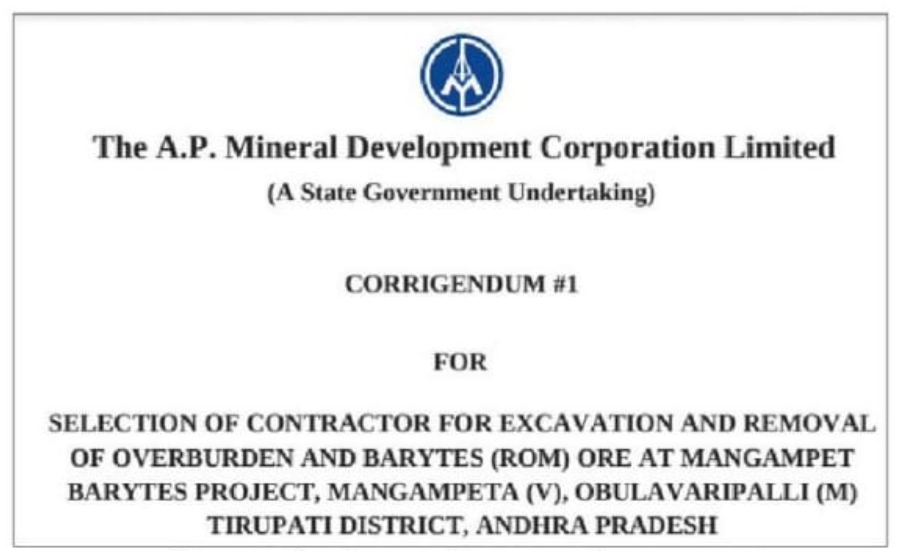
The Andhra Pradesh Mineral Development Corporation (APMDC) is facing opposition allegations that it tailored the conditions of a Rs. 348-crore excavation contract at the Mangampeta barytes mine to favour a single contractor, after it issued a corrigendum amending key eligibility and payment terms.
The story begins with procedure, or rather, the disappearance of it. Under the previous government, major contracts of this kind were not floated into the open and left to drift. They passed through a judicial-preview mechanism, with a retired judge, a public comment window, and a layer of scrutiny before commitment, a pre-bid transparency mechanism for projects above Rs. 100 crore — which the current TDP-led alliance government has since discontinued.
Some contracts are won. This one was fitted—measured and tailored like a suit —until only a single frame could wear it. A corrigendum altered the eligibility rules so that a newly demerged entity could use the track record of its parent company to qualify. The payment structure was also softened, with bank guarantee terms replacing more demanding upfront cash expectations. On their own, each change can be defended as administrative flexibility. But public procurement is not judged clause by clause. It is judged by the pattern those clauses create together.
And the pattern here is hard to ignore.
The tender was rewritten in a way that widened the doorway for one kind of bidder while narrowing it for others. Then came the most damaging provision of all: even if only a single bid was received, the techno-commercial evaluation could still proceed. In other words, the government kept the process alive even when competition had already been hollowed out. That is not how competitive bidding protects the public interest. That is how a bidding process becomes a formal costume worn by a pre-decided outcome.
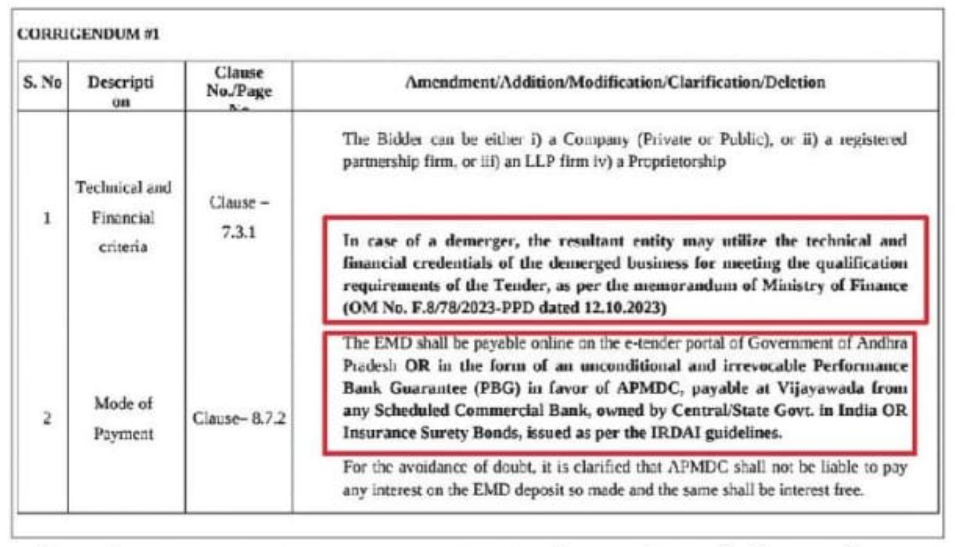
Corrigendum #1 made three changes now at the centre of the dispute.
- Clause 7.3.1 was amended to allow, “in case of a demerger, the resultant entity” to use the technical and financial credentials of the demerged parent business to meet the tender’s qualification requirements, citing a Union Finance Ministry office memorandum dated 12 October 2021.
- Clause 8.7.2 was revised so that the earnest money deposit could be furnished through a performance bank guarantee or insurance surety bond rather than an upfront cash payment.
- Separately, Clause 10.6 provides that the bids will be opened and evaluated “irrespective of the number of bids received” and that “even in case of receipt of [a] single bid,” the process shall proceed.
Critics contend that the amendments appeared shortly after the incumbent contractor sought them, that the roughly 20-day submission window was too short for a contract of this size, and that objections from rival firms were disregarded.
A tender can only be defended clause by clause and not as a whole; something has already gone wrong. The question is no longer whether the paperwork is legal. The question is whether the process was designed to deliver the best value to the public, or simply the most convenient value to someone else.
In Mangampeta, the public deserves more than a ritual. It deserves a real contest.