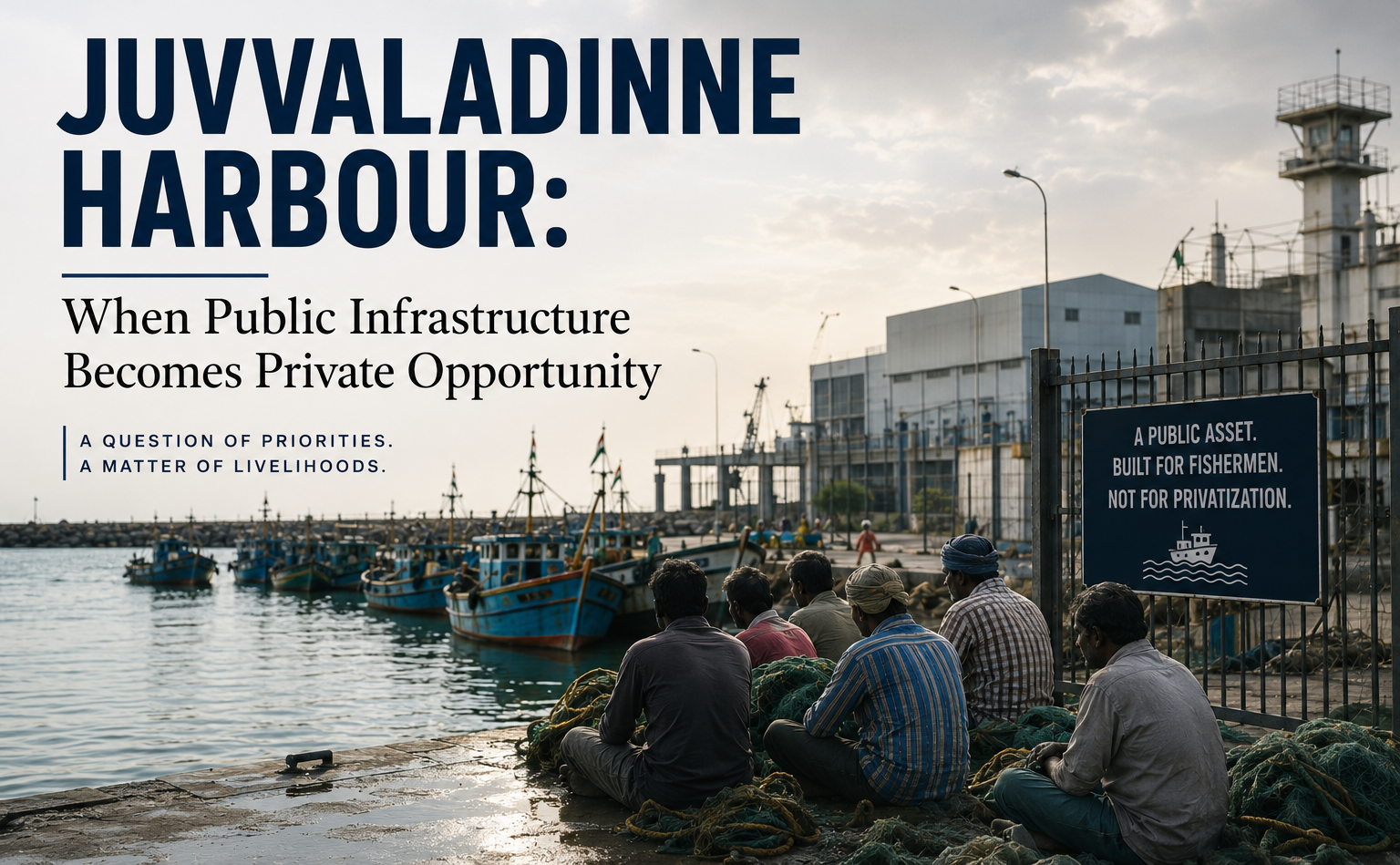
In the coastal heartlands of Nellore district, the Juvvaladinne Fishing Harbour was envisioned as a beacon of hope for thousands of fishing families. Designed with an 809-metre quay capable of berthing 1,250 mechanized boats, complete with breakwaters, fish processing zones, and boat yards, the project promised to transform the lives of local communities. Official projections estimated an annual fish landing capacity of 41,250 metric tonnes, valued at approximately ₹282.60 crore, and direct and indirect employment for around 6,100 fishermen.
Yet today, this public asset stands mired in controversy. Significant portions of harbour land, reports indicate allocations involving up to 29 acres or more within the broader complex, have been diverted to private entities, notably for defense-linked initiatives such as Sagar Defence Engineering. This move, critics argue, represents a classic case of privatization that prioritizes corporate and industrial interests over the very people the harbour was built to serve.
A Project Meant for Fishermen, Reoriented Towards Commercial Interests
Juvvaladinne was substantially completed under earlier planning, with physical progress reaching 97.98% on key components. Sanctioned at an initial ₹288.80 crore (with shared central and state funding), it was virtually dedicated before elections. The facility offered a rare opportunity: dedicated infrastructure for small and medium boat operators who form the backbone of Andhra’s capture fisheries.
Instead of handing it over fully to fishing cooperatives and the Fisheries Department for seamless operations, the current approach has introduced private players. While authorities clarify that the core harbour remains under government control and that limited land (around 7 acres inside, plus additional outside) supports technology upgrades like satellite and drone-based systems for safety, the optics and outcomes tell a different story. Fishermen fear restricted access, future user charges, and gradual commercialization that favors large operators and export-oriented activities.
This pattern extends across the coast. Similar delays and cost escalations plague projects like Kothapatnam Fishing Harbour (revised to ₹441.88 crore, targeted for December 2027 after contract cancellation due to poor progress). Broader plans for eight fishing harbours and seven landing centres (total investment ~₹2,672 crore) risk repeating the same model if privatization gains ground.
The Human Cost: Data from the Ground
Andhra Pradesh is home to roughly 2.35 lakh active fishermen across 694 villages. The sector sustains over six lakh people directly and indirectly. Yet, small-scale operators are increasingly pushed to the margins:
- Rising Operational Burdens: Diesel prices hovering near ₹105 per litre, combined with voyage costs of ₹5–6 lakh for 10–14 days, have left many boats idle. Post-fishing ban resumption in 2026 saw only about 40% of the Visakhapatnam fleet active initially.
- Safety Tragedies: The July 2026 capsizing off Gangavaram, which left six fishermen missing, highlighted critical gaps. Families received ₹10 lakh ex-gratia each, but protests demanded higher compensation and mandatory tech upgrades. Over the past decade, nearly 700 lives have been lost in similar incidents.
- Stock Depletion: Near-shore fishing has collapsed due to pollution, sedimentation from port works, and competition. Fishermen now venture 30+ km offshore, amplifying risks. Illegal intrusions from neighboring states further erode catches.
Privatization at Juvvaladinne exacerbates these issues. By allocating prime coastal land to non-fishing commercial projects, despite alternatives like Krishnapatnam Port, many fishermen fear that traditional users could gradually be displaced from prime coastal infrastructure. Women in allied processing units already face precarious employment amid export volatility, while entire villages risk losing their primary livelihood.
Privatization: A Flawed Model for Coastal Development
Advocates of privatization promise efficiency, technology transfer, and investment (e.g., ₹2,500–3,000 crore in defense-related activities). Yet evidence from Juvvaladinne and similar cases suggests otherwise:
- Profit Over Access: Private involvement typically introduces fees and priorities that disadvantage small boat owners who cannot compete with mechanized corporate fleets.
- Environmental Risks: Industrial adjacency accelerates pollution and habitat loss, as seen in fish kill events linked to algal blooms and oxygen stress.
- Delayed Public Benefits: While welfare schemes like Matsyakarula Sevalo provide short-term relief, they cannot substitute for functional public infrastructure.
Opposition leaders and fishing unions have called for de-privatization, arguing that harbours belong to the communities that have sustained them for generations. Plans floated earlier for subsidizing 1,250 mechanized boats at 90% to benefit over 25,000 families underscore what a people-centric approach could achieve.
Time for Course Correction
Juvvaladinne is not an isolated case, it symbolizes a dangerous tilt toward treating coastal commons as real estate for private gain. Andhra Pradesh’s blue economy ambitions must not come at the expense of its fishermen.
Key Demands:
- Immediate halt to further land diversions at Juvvaladinne and full operational handover to fishermen.
- Completion of remaining public harbour projects without privatization clauses.
- Mandatory community consultations and CRZ compliance for all coastal developments.
- Universal rollout of safety technologies and stronger pollution controls.
- Enhanced, transparent compensation and alternative livelihood programs that empower, rather than displace, traditional fishers.
The sea has nourished Andhra’s coastal communities for centuries. Privatizing assets like Juvvaladinne risks drowning that heritage in the name of “development.” Policymakers must choose: a resilient, inclusive fisheries sector that honors its roots, or short-term commercial gains that leave fishing families adrift. The future of lakhs depends on rejecting this privatization push before it becomes irreversible.