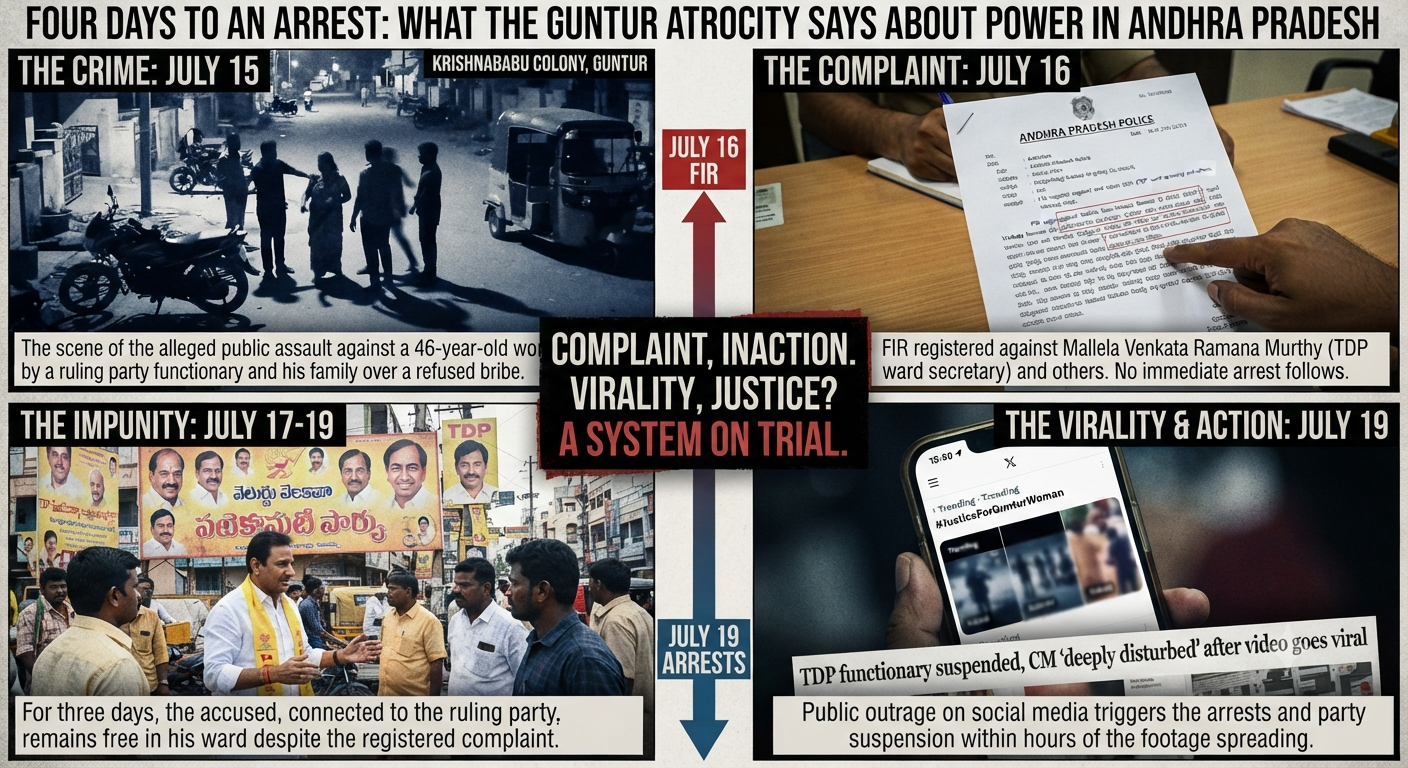
On the night of July 15, in Krishnababu Colony in Guntur, a 46-year-old woman was dragged onto the road, beaten, and stripped in full public view — by a ruling-party functionary and eight members of his family. Her husband’s offence, according to the police account, was refusing to pay a ₹10,000 bribe for the crime of repairing the water bore in front of his own house, at his own expense.
It is not a land dispute worth crores. Not a political rivalry. A household water connection — and a local TDP ward secretary, police say, who believed his party card entitled him to a cut of it, and who answered refusal with a mob and a public atrocity against a woman.
The details of what was done to her do not need elaboration to be understood; the criminal sections invoked, including assault on a woman with intent to outrage her modesty, say enough. What demands elaboration is everything that happened afterward. Because the assault reveals one man’s alleged brutality; the four days that followed reveal a system.
The timeline of impunity
The family went to the police and lodged a complaint on July 16, the day after the attack. A case was duly registered against Mallela Venkata Ramana Murthy and his relatives and then nothing happened. The accused, a ward-level functionary of the ruling Telugu Desam Party, remained free and didn’t get arrested due to his political connections.
What finally moved the machinery was not the complaint, not the criminal sections on the file, not the woman’s suffering. It was a video. When footage of the incident went viral on social media on Saturday, three days after the FIR the arrests followed within hours, and the TDP leadership hurried to announce the functionary’s suspension from party posts and the Chief Minister declared himself “deeply disturbed”.
Note the sequence: complaint, inaction; virality, action. In this Andhra Pradesh, a woman’s dignity is avenged not when she reports the crime but when the crime trends. Justice was not triggered by the law. The risk of embarrassment triggered it.
What a ward secretary believed
There is a second revelation buried in the police account, and it concerns not law and order but political culture. A ward secretary, the lowest rung of the ruling party’s ladder allegedly felt entitled to demand ₹10,000 from a citizen doing private work on private property, and felt safe enough, when refused, to return with his family and commit a public atrocity in front of the neighbourhood.
That confidence is learned behaviour. Functionaries at the bottom of a party act on what they observe about accountability at the top. When the opposition speaks of “Red Book governance” — of vendetta politics and selective law enforcement — this is the trickle-down effect they mean: an atmosphere in which the smallest local satrap concludes that the police will hesitate, the party will shield, and the victim will tire. For three days, every part of that calculation held. It failed only because a phone camera existed.
The suspension is not the answer
The government will point to its response: the accused arrested, produced in court, suspended from the party. These actions are necessary and welcome — and insufficient. A suspension announced after a video goes viral is crisis management, not accountability. The questions that matter remain open. Why did an FIR naming a ruling-party functionary in a crime against a woman produce no arrest for three days? Which officers made that decision, and at whose suggestion? Will the prosecution survive the news cycle, or dissolve the way cases against the connected so often do once the cameras move on?
And the largest question of all: how many Krishnababu Colonies never make it to a viral video? For every atrocity captured on a phone, there are the everyday extortions and intimidations that are not absorbed silently by citizens who have learned what this woman’s family learned on July 16: that a complaint against the ruling party’s man is a piece of paper until the internet notices.
A government that cannot make its own smallest functionaries fear the law has surrendered the first duty of governing. The woman of Krishnababu Colony did everything the system asks of a citizen she resisted extortion, she went to the police, she filed her complaint. The system did nothing until she became content. That, more than any single crime, is the indictment.