Betrays Women’s Safety
- Chandrababu government strikes at a women’s protection system that became a model for the entire country
- Women’s safety shield dismantled out of political hostility towards Y.S. Jagan
- A system with 1.51 crore downloads and 19 national awards dismantled
- Disha scrapped in the name of BNS, exposing the coalition government’s double standards on women’s safety
- Home Minister questions speedy justice while ignoring the suffering of women victims
- Chandrababu government sacrifices women’s safety at the altar of political vendetta
- Disha services are retained under the name ‘Shakti’, but Jagan should not get the credit?
- Under Disha, investigation time fell from 156 days to 28 days
- Investigations completed within 60 days in rape and POCSO cases rose to 95.18%
- Arrests within hours, charge sheets within days , creating fear among offenders
- Dismantling Disha is a historic betrayal of women, triggering widespread public anger
Then…
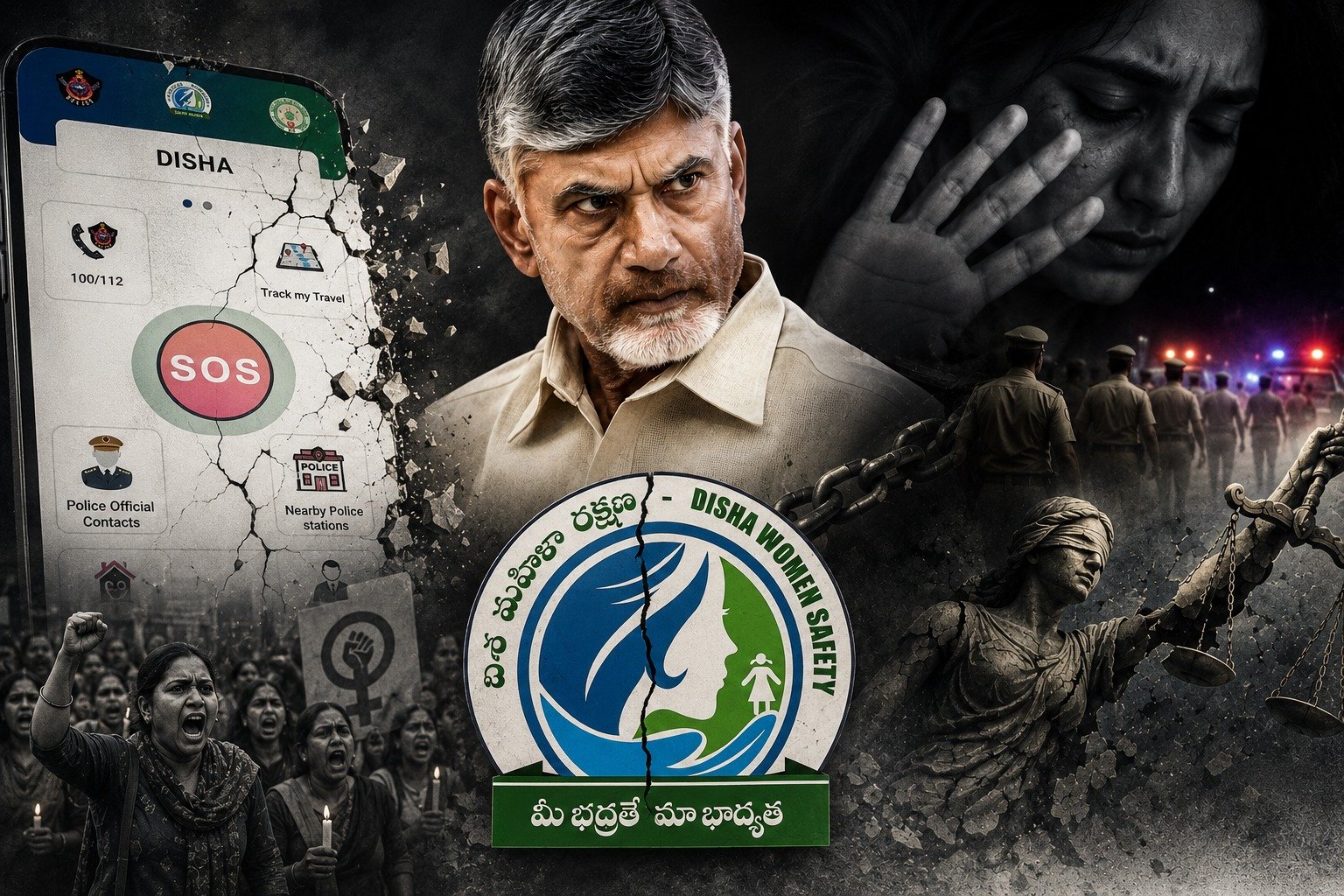
When a woman was in danger, all she had to do was shake her phone five times and the police would receive an alert. If she pressed the SOS button, a protection team would reach her within minutes. Irrespective of where the crime occurred, a Zero FIR could be registered at the nearest police station. From that point onward, every stage, investigation, forensic examination, filing of the charge sheet and trial before a special court , was monitored through an integrated system. That was Disha.
The Disha programme was introduced by the Y.S. Jagan government with the larger objective of giving women confidence and ensuring their safety. The Chandrababu government’s decision to dismantle such a system has triggered widespread anger.
A betrayal of women’s safety
The Chandrababu government has struck at the protective framework created by the Y.S. Jagan government for the safety of women and children. It has decided to dismantle the Disha system on the ground that the Disha Bill did not receive final approval from the Centre.
If there were legal shortcomings, they should have been corrected. The government could have held discussions with the Centre and secured the necessary approvals. It could have strengthened the framework in accordance with the new criminal laws.
Instead, dismantling a system that earned nationwide appreciation purely because of political hostility reflects the coalition government’s disregard for women’s safety.
Disha was not just an app , it was a complete protection system
The Y.S. Jagan government introduced Disha with the objective of ensuring speedy investigation, trial and justice in serious crimes against women and children.
Disha was not merely a mobile application. It was an integrated safety network connecting dedicated police stations, women’s help desks, patrolling teams, forensic facilities, special public prosecutors and women’s and POCSO courts.
A total of 18 Disha Police Stations were established across the State, while steps were initiated to establish another eight. Women’s help desks were made available in every police station.
Counselling rooms, separate waiting halls, crèches for women arriving with children and breastfeeding rooms were also provided so that women victims could approach the police and lodge complaints without fear.
1.51 crore people gained a powerful sense of security
More than 1.51 crore people downloaded the Disha App. If a woman in distress pressed the SOS button or shook her phone five times, an alert containing her location would immediately reach the police. Police responded to 31,607 distress calls received through Disha and provided protection to victims.
In one case, police reached a woman facing harassment within eight minutes. In Chittoor district, police reached a young woman who activated the SOS alert at midnight within nine minutes and apprehended the offender. When a pregnant woman could not get an ambulance and sought help through Disha, police shifted her to hospital and saved both mother and child. A minor girl who had been stranded at a railway station without food for two days was traced and safely reunited with her parents.
These incidents showed how profoundly a single safety application could change lives.
Investigation time fell from 156 days to 28 days
Before Disha, investigations into crimes against women took an average of 156 days to complete. With Disha tracking, forensic assistance and continuous monitoring, this fell to 67 days in 2021 and just 28 days by 2022.
In rape and POCSO cases, the percentage of investigations completed within 60 days rose from just 14.15% in 2019 to 95.18% in 2022. At a time when the national average stood at around 40%, Andhra Pradesh emerged as a national leader.
The Zero FIR system was also implemented, allowing a woman to lodge a complaint at the nearest police station regardless of where the crime occurred. Provisions were created for action against officers who turned victims away claiming that the case did not fall within their jurisdiction.
Arrests within hours, charge sheets within days
Between 2019 and 2022, 60% of offenders in rape-murder cases were arrested within 48 hours. Earlier, arrests in such cases took an average of 43 days; under Disha, the average fell to eight days.
In gang-rape cases, 51% of offenders were arrested within 48 hours. In the Repalle case, arrests were made within 12 hours, while arrests in the Duggirala rape-murder case and the attempted rape of a Lithuanian woman were made within 24 hours.
In the Ramya murder case, the offender was arrested within 48 hours and the charge sheet was filed within seven days. Following a speedy trial, the court awarded the death penalty.
From December 2019 to April 2022, convictions were secured in 214 cases. Disha was not a system that stopped after registering a case; it continuously tracked investigation and prosecution until punishment was secured.
Forensic strength for conclusive evidence
Earlier, DNA reports took five to six months. Under Disha, forensic capacity was strengthened so that reports could be delivered within one week in regular cases and within 48 hours in urgent cases.
Steps were taken to increase DNA-testing capacity threefold and cyber-forensic capacity fivefold. Forensic facilities were expanded in Anantapur, Rajamahendravaram, Tirupati, Visakhapatnam, Guntur and Vijayawada.
To ensure that investigators and forensic teams could reach crime scenes together with the necessary kits, 18 dedicated Crime Scene Management vehicles were introduced.
For round-the-clock patrolling in vulnerable areas, 900 two-wheelers and 163 four-wheelers were deployed. Special surveillance sheets were opened against 2,134 persons involved in sexual offences.
Disha was therefore designed not merely to respond after a crime occurred, but to identify risks in advance and prevent offences before they happened.
A success story recognised with 19 national awards
The Disha mobile app, dedicated police stations, women’s help desks, Cyber Mitra, patrolling system and command control room together received 19 national awards. Prestigious institutions such as SKOCH, NCRB, FICCI, Governance Now and Tech Sabha recognised the performance of Disha.
The National Commission for Women, National SC-ST Commission and national child rights bodies examined the programme, while a Parliamentary Committee also took note of the system.
As a result of the smart policing implemented through Disha, Andhra Pradesh Police ranked first in the IPF Smart Policing Index in 2021.
What flaw did the Chandrababu government find in a system that earned national recognition? Why was a model that should have been strengthened instead dismantled?
BNS as an excuse , is political vendetta the real objective?
The government’s argument that Disha is unnecessary because the Bharatiya Nyaya Sanhita has come into force is not reasonable. The BNS is a general criminal law applicable across the country. Disha, however, was a specialised operational framework that accelerated every stage in crimes against women and children , from complaint and emergency response to investigation, prosecution and judgment.
If Disha is unnecessary, why is the government continuing the same app under the name ‘Shakti’? Does it want Disha’s technology and services, but not the political credit for the system created under Y.S. Jagan?
If the only problem was that the Disha Bill had not received final approval, why did Chandrababu not secure the necessary approval from the Centre at a time when the government there depends on his political support? Why were the effective features of Disha not aligned with the BNS and strengthened through a revised law?
Instead of correcting shortcomings, why dismantle the entire system? Is this administrative failure or political vendetta?
The Home Minister who should stand with women
As a woman and as the State Home Minister, Vangalapudi Anitha is expected to stand with women. Her defence of the dismantling of Disha has therefore drawn sharp criticism.
Her remarks questioning the objective of speedy justice have angered those who believe they trivialise the suffering of victims. Should a woman who has survived a serious crime spend years moving between police stations and courts? Or should the State complete the investigation swiftly on the basis of evidence and ensure timely justice?
That is the question the Home Minister must answer.
This is not merely dismantling a system , it is a betrayal of women
The government is already facing criticism for remaining indifferent when cases of harassment against women involve ruling-party leaders. The removal of a dedicated protection system such as Disha only deepens those concerns.
Dismantling Disha risks reducing the fear of law among offenders while weakening women’s confidence in the police system. If the government is genuinely committed to women’s safety, Disha should be strengthened further , not sacrificed because of political hostility towards Y.S. Jagan.
A dark decision, a historic betrayal
Police responding within minutes when a woman shakes her phone. Investigators arresting offenders within hours. Charge sheets filed within days. Strong prosecution built on forensic evidence. A system giving victims and their families immense confidence , that was Disha.
Destroying such a system is not an ordinary administrative decision. It is a dark decision that exposes the Chandrababu government’s approach to women’s safety.
Sacrificing a protection system relied upon by millions of women merely to erase Y.S. Jagan’s legacy amounts to a historic betrayal of the women of Andhra Pradesh.