The last comprehensive survey of Andhra’s farmland was conducted under the British, and every decade since had piled errors upon it — plots subdivided by inheritance but not on paper, boundaries remembered differently by neighbouring families, records so old that the state effectively did not know who owned what. Every village carried its quota of simmering boundary feuds, and every feud carried the possibility of a court case, a broken friendship, or worse.
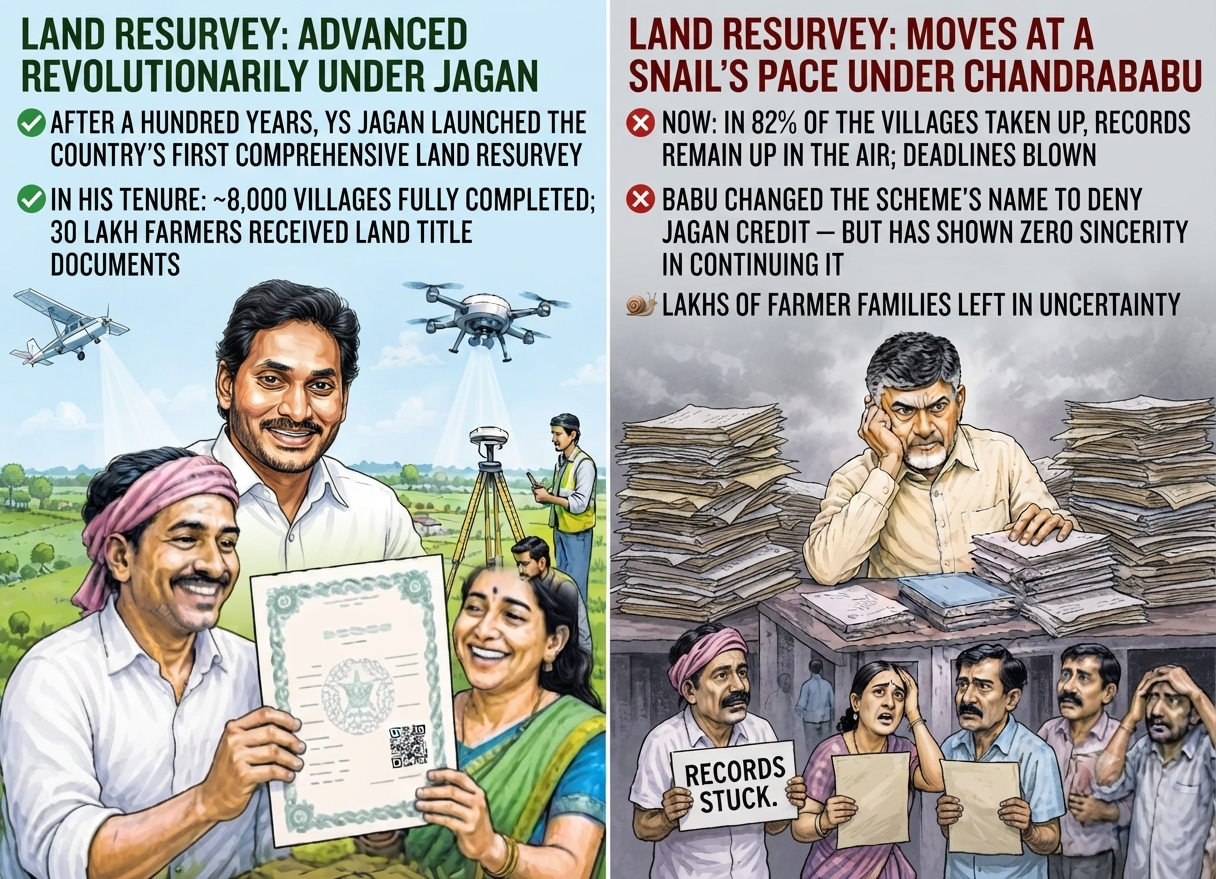
Then, for a few years, the state actually tried to fix it. YS Jagan Mohan Reddy’s government’s Jagananna bhu hakkku Scheme comprehensive resurvey — the first in independent India at this scale, run with drones, aircraft and GPS rovers completed some 8,000 villages, put QR-coded title documents in the hands of more than 30 lakh farmers, planted boundary stones free of cost, and cleared mutations that had languished for years. Whatever one’s politics, it was the rarest kind of government programme: unglamorous, structural, and genuinely transformative.
The land resurvey that advanced revolutionarily under Jagan’s tenure” — “moves at a snail’s pace under Chandrababu’s rule.
Eighty-two percent, up in the air
The numbers the article cites are the government’s own. The resurvey is nominally under way in 5,107 villages. Full records have been finalized in about 935. That leaves 82 percent of the villages taken up — thousands of communities — with their land records suspended between the old maps and the new: drafts unpublished, Joint Collector approvals pending, deadlines the government set for itself blown at every stage, files circling for months in red tape. In hundreds of villages, reportedly, not one record has been completed.
A resurvey is not a scheme that can be paused safely, like a subsidy that simply resumes when funds arrive. It is surgery. Stopping halfway leaves the patient open on the table. A village whose new records are drafted but not finalized is worse off than one never surveyed at all: the old records are now officially doubted, the new ones officially unavailable, and the farmer holds neither.
What limbo costs a farmer
New records don’t match old ones, and no official will say which governs. Sales and registrations stall because nobody can certify the title. Banks decline crop loans against land whose paperwork is “under resurvey” — and the farmer who cannot borrow from a bank borrows from the moneylender, at the moneylender’s rates. Boundary disputes, the ancient poison the survey was designed to draw out, are flaring again in villages where stones were never planted. Notices are issued; hearings never conclude; appeals pile up. The reform meant to end litigation is, half-finished, manufacturing it.
The rename that revealed the motive
The government did make one decisive intervention in the programme: it changed the name Jagananna bhu hakkku scheme as Andhra Pradesh Resurvey Project. The scheme that carried the previous chief minister’s branding was rebadged, the article says, so that whatever was completed would not be credited to him. Having claimed the signboard, the government then declined to do the work under it — surveyors posted, review meetings held, progress absent.
That sequence is worth sitting with, because it captures a governing style. A programme’s value to farmers was never in its name; it was in the boundary stone, the QR-coded deed, the loan the deed unlocked. A government that hurries to change the signboard but lets the deadlines rot is telling you what it believes governance is for: the credit, not the deed.
Finish the surgery
There is a straightforward test of good faith available to the Naidu government, and it costs nothing but effort: publish a village-by-village dashboard of resurvey status; finalize the 82 percent; plant the stones; restore the Aadhaar-linked mutation flow; and instruct banks and registration offices on which records govern in the interim so that no farmer’s loan or sale is hostage to the state’s own delay.
Until then, lakhs of farming families remain where this government’s inertia has left them — between two sets of maps, unable to sell, unable to borrow, watching old quarrels reignite along unmarked boundaries. The last time the state finished this job, it took the British. It should not take another century, or another government, to finish it again.