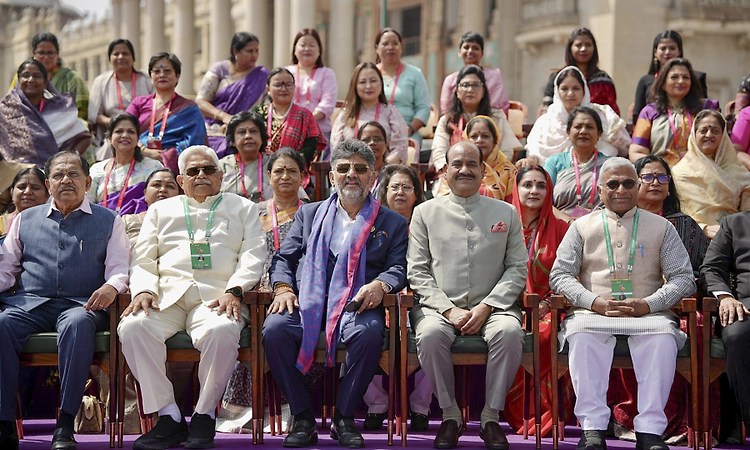
Bengaluru, Nov 17 : Lok Sabha Speaker Om Birla has called for greater participation of women in policymaking, lawmaking and governance. He stressed the need to digitally empower elected women representatives and provide them with training in Artificial Intelligence (AI) and emerging technologies to strengthen democratic institutions.
Addressing the Commonwealth Women Parliamentarians (CWP) India Region Conference at Vidhana Soudha in Bengaluru on Tuesday, Birla said women’s participation in decision-making was essential for building a stronger democracy.
He emphasised the need for an institutional framework to improve the capabilities of women representatives, from panchayats to Parliament. Such a framework would help them address public issues effectively and ensure transparency and accountability in administration.
Om Birla Highlights Role of AI in Women’s Political Empowerment
Birla said technology and artificial intelligence were transforming various sectors and could improve governance, public service delivery and communication between elected representatives and citizens.
He called for regular training programmes to help women representatives use digital platforms and modern technologies to solve public problems, strengthen monitoring systems and improve administrative transparency.
He also suggested organising a dedicated session on AI and technology for women MPs and legislators.
Highlighting the importance of parliamentary committees, Birla said they had played a significant role in addressing women’s concerns and promoting their social and economic empowerment.
Referring to India’s democratic traditions, he described the country as the “Mother of Democracy” and recalled the Anubhava Mantapa associated with 12th-century social reformer Basaveshwara, who challenged caste discrimination, gender inequality and religious orthodoxy.
33% Women’s Reservation in Lok Sabha and State Assemblies
The Lok Sabha Speaker stressed the need to strengthen women’s representation at every level of democratic governance, including panchayats, municipalities, state legislatures and Parliament.
Referring to the Nari Shakti Vandan Adhiniyam, 2023, Birla expressed hope that the provision for 33 per cent reservation for women in the Lok Sabha and state legislative assemblies would be implemented soon.
He noted that several states had already introduced 33 per cent reservation for women in local bodies, while some had increased it to 50 per cent.
Birla also called for greater cooperation among Commonwealth legislatures and the exchange of best practices. He expressed hope that the two-day conference would generate practical suggestions to make democratic institutions more inclusive, accountable and responsive.
D Purandeswari Calls for Meaningful Participation of Women
CWP India Region Chairperson and MP D Purandeswari said women’s empowerment should not be measured only by the number of women holding public positions. Their ability to influence policy decisions, participate in legislative debates and demonstrate leadership was equally important.
Speaking on the theme, “Gender-Sensitive Parliaments and Contemporary Gender-Related Issues”, she said legislative institutions must become more inclusive and responsive to women’s concerns.
Purandeswari noted that the Constitution guaranteed equal political rights to women and men. However, achieving real equality required continuous efforts and strong institutional support.
She said India’s approach to women’s empowerment had gradually shifted from women-focused development to women-led development, recognising women as equal partners in national progress.
Describing the Nari Shakti Vandan Adhiniyam, 2023, as a major step towards improving women’s political representation, she called for gender perspectives to be included throughout the legislative process.
She also stressed the importance of gender-responsive budgeting, reviewing proposed laws from a gender perspective and assessing their impact after implementation.
Purandeswari said legislatures must address emerging challenges such as cybercrime, online harassment, digital exploitation and data privacy. She also called for continuous training for women representatives in legislative procedures, public finance, policy analysis and technology.
Women Must Influence Decisions, Says Karnataka Deputy CM
Karnataka Deputy Chief Minister D K Shivakumar said women’s reservation and greater participation in decision-making were essential for strengthening democracy.
He stressed that women should not merely occupy seats in legislative institutions but should actively influence decisions, shape laws and determine the direction of governance.
Welcoming delegates from across India and Commonwealth countries, Shivakumar described Bengaluru as a major centre of talent and technology. He invited the delegates to visit the Bengaluru Tech Summit to understand India’s progress in technology and artificial intelligence.
Highlighting Bengaluru’s technological workforce, he said the city had around 2.6 million IT professionals, compared with 1.3 million in California.
He added that women accounted for approximately 42 per cent of Bengaluru’s IT workforce. Karnataka also produces around 13,940 doctors every year, of whom 42 per cent are women. Women make up nearly 80 per cent of the state’s paramedical workforce of more than 1.2 lakh people.
Karnataka Government Schemes for Women’s Empowerment
Shivakumar highlighted the contribution of the 73rd and 74th Constitutional Amendments in improving women’s political representation through reservations in local government institutions.
He urged elected representatives to encourage women who entered politics through panchayats to continue their public service instead of allowing male family members to take over their positions.
He said women entering politics often faced social, political and family-related challenges, making grassroots leadership and institutional support particularly important.
“Democracy without a woman is like a bird without a wing. It may flap, but it cannot rise to the true heights,” he said.
The Deputy Chief Minister also referred to Karnataka’s five guarantee schemes, including free bus travel for women and monthly financial assistance of Rs 2,000 to women heads of households. He said such initiatives aimed to improve women’s economic independence.
Recalling former Prime Minister Indira Gandhi’s leadership, he cited her decision to nationalise banks and her role during the 1971 Bangladesh war as examples of women’s ability to take bold political decisions.
The two-day Commonwealth Women Parliamentarians conference is expected to focus on strengthening women’s leadership, improving gender-sensitive legislation and expanding their role in policymaking and governance.