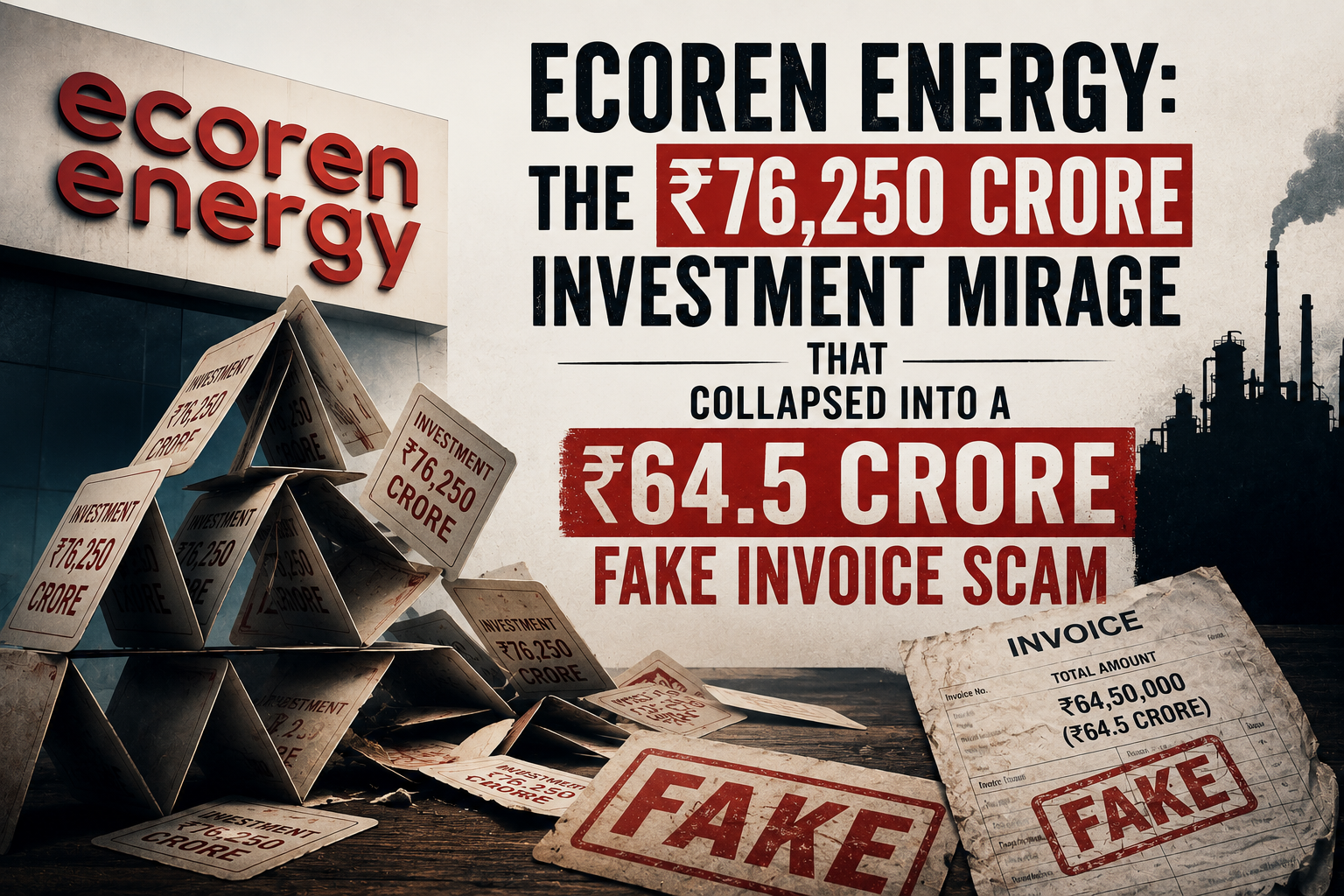
What was loudly projected as one of Andhra Pradesh’s biggest clean-energy success stories has rapidly unravelled into a textbook case of publicity-driven governance, paper companies, and outright tax fraud. The Andhra Pradesh government aggressively publicised that Ecoren Energy India Pvt. Ltd. (Ecoren Group) would bring in a massive ₹76,250 crore investment, develop 8 GW of renewable energy projects plus 1.25 MTPA of green molecules, and create 12,000 jobs. Official ceremonies, MoU signings in November 2025, and glowing media coverage painted a picture of transformative growth.
Reality has proved far different.
On 24–25 July 2026, GST authorities arrested the company’s Managing Director, Lakshmi Prasad Yerneni (56), for allegedly orchestrating a ₹64.5 crore Input Tax Credit (ITC) fraud. Investigators say the company fraudulently availed and utilised ITC by generating and using fake tax invoices without any actual supply of goods or services. The fraud was executed through a carefully constructed network of companies that created fabricated transactions and routed funds through multiple bank accounts solely to manufacture the appearance of genuine business activity. Yerneni was produced before the Economic Offences Court at Nampally and remanded to judicial custody; he was sent to Chanchalguda prison. Officials recorded that final approvals for vendor onboarding, work orders, purchase orders and advance payments rested with him. He has been booked under sections 132(1)(c) and 132(1)(i) of the CGST Act (and corresponding state provisions). Because the amount exceeds ₹5 crore, the offence is cognisable and non-bailable.
This is not an isolated tax case. It exposes the hollow core of the entire “investment” narrative.
Publicity Versus Reality
The government and the company together created an elaborate public-relations spectacle. Yet GST investigations and a close reading of the government’s own orders reveal that Ecoren had no substantial real business operations commensurate with the scale of claims being made. The company appears to have functioned largely as a paper entity whose primary activity, once the surface is scratched, was the generation of bogus documentation for tax benefits.
Government Orders: Capacity Transfers and Cheap Land for a Questionable Entity
While the MoU headlines dominated newspapers, a series of Government Orders (G.O.s) quietly moved hundreds of megawatts of wind and hybrid capacity away from Ecoren to other companies and simultaneously handed over large tracts of government land on extremely favourable long-term leases.
Key examples include:
- G.O.Ms.No.40 dated 26-11-2024 (Energy Department): Approval for a 277 MW wind power project in already demarcated boundaries at Kurubarahalli & Ralla Anantapur (Ananthapuramu District) and Gangadevipalli (YSR District). This was part of earlier larger allotments that had totalled around 1,000 MW wind (later adjusted). Capacity enhancement of 277 MW was granted so that total wind capacity in the already allotted locations stood at 1,168.70 MW against the earlier 1,000 MW sanction.
- G.O.Ms.No.14 dated 07-02-2025 (Energy Department): Transfer of 42.90 MW wind capacity at Maddelachervu village, Kanaganapalle Mandal, Sri Sathya Sai District from Ecoren to M/s. NSL Renewable CPP Pvt. Ltd., together with implementation of a 50 MW wind-solar hybrid project (42.90 MW wind + 37.20 MW AC solar) in NSL’s name. Incentives under the AP Integrated Clean Energy Policy 2024 were extended, including land lease terms, 50% exemption on transmission and distribution/wheeling charges for five years from COD, and a completion deadline of 31 March 2026.
- Multiple February–May 2025 orders recorded further large transfers out of Ecoren:
- 201.30 MW wind capacity at Ralla Anantapur (Ananthapuramu and Sri Sathya Sai Districts) to group companies of O2 Power SG2 Pte. Ltd. (with subsequent errata).
- 349.50 MW wind and solar capacities in Kurnool and Nandyal Districts to group companies of Ampin Energy Transition Private Limited.
- Approximately 300.30 MW wind project at Ralla Anantapur and Kurubarahalli locations to M/s. Deshraj Solar Energy Pvt. Ltd.
- 498.30 MW wind power project near Aspari in Kurnool District to group companies of Ayana Renewable Power Private Limited.
- 260 MW wind-solar hybrid (comprising 126 MW wind and related solar) to Amplus entities (Amplus Everest Solar and Amplus IIFA Solar).
These repeated transfers of capacity originally allotted to or associated with Ecoren raise serious questions about whether the company was ever intended to develop and operate the projects itself or was merely a conduit.
Simultaneously, the Revenue Department issued land alienation orders on highly concessional terms:
- G.O.Ms.No.209 dated 02-04-2026: Alienation of 27.83 acres (Ac.cts) in Sy.No.225/C, 342 etc., in villages of Bethamcherla Mandal, Nandyal District (M. Pendekal, RS Rangapuram, Gutupalli, Kolumulapalli, Muddavaram, Bethamcherla) in favour of NREDCAP for a 168.30 MW wind project by Ecoren, on lease at ₹31,000 per acre per year with 5% escalation every two years, maximum 30 years.
- G.O.Ms.No.210 dated 02-04-2026: Alienation of 33.91 acres in Sy.No.389, 949 etc., in Gutupalli, RS Rangapuram, Kothapalle, Malkapuram, Kocheruvu, Dhone, S.Valasala villages (Bethamcherla and Dhone Mandals) for a 210 MW wind project by Ecoren, same lease terms.
- G.O.Ms.No.242 dated 17-04-2026: Related compensation order for ₹5,90,54,636 to 547 occupants for allotment of 261.34 acres across six villages in Bethamcherla Mandal for the 168.30 MW project.
- G.O.Ms.No.345 dated 11-06-2026 and related G.O.Ms.No.347: Alienation of 176.33 acres (detailed survey numbers in Palugurallapalli and Papireddipalli villages, B. Mattam Mandal, YSR Kadapa District) for a 50 MW solar project by Ecoren, again on lease at ₹31,000 per acre per year with 5% escalation every two years, up to 30 years (one reference mentions up to 33 years). Annexures list specific extents totalling 153.07 acres in Palugurallapalli plus 23.26 acres in Papireddipalli.
Standard conditions in these land orders prohibit further alienation or transfer without prior government approval, require utilisation within three years, protect water bodies and existing roads, and allow cancellation for non-utilisation. Yet the fundamental question remains unanswered: why was valuable government land leased for three decades at a relatively modest rate to an entity whose Managing Director has now been arrested for running a large-scale fake-invoice racket and whose visible activity appears limited to paper transfers and tax claims?
The Core Problems
- Absence of meaningful due diligence: Before committing public land and projecting multi-thousand-crore investments and thousands of jobs, basic background checks on the company’s financial capacity, track record of completed projects, and tax compliance appear to have been inadequate or ignored.
- Shell-company characteristics: A firm that can generate ₹64.5 crore in fraudulent ITC through a network of fabricated transactions while simultaneously receiving and then transferring large renewable-energy capacities and securing long-term government land leases fits the classic profile of a paper or shell entity used for headline generation and intermediary gains.
- Propaganda over substance: The pattern of grand MoU announcements, high-profile signing ceremonies, and subsequent quiet capacity transfers and land allotments suggests that the primary objective was political and media optics rather than genuine, verifiable investment and employment generation.
- Public resources at risk: Hundreds of acres of government land locked up for decades and hundreds of megawatts of project capacity moved around among entities, all while the original promoter is in judicial custody for tax fraud, represents a clear failure of institutional safeguards.
The official G.O.s (Energy Department Nos. 40 and 14; Revenue Department Nos. 209, 210, 242, 345 and related orders) and the GST Department’s own investigation findings leave little room for ambiguity. What was sold to the public as a transformative ₹76,250 crore clean-energy partnership has, within months, been exposed as an investment mirage built on fake invoices, capacity transfers, and the alienation of public land to a company that could not withstand even basic scrutiny of its actual operations.
This is not merely a tax-evasion case. It is a cautionary illustration of how the pursuit of investment headlines, without rigorous verification, can turn government facilitation into an enabler of fraud.