In Proddatur, a town in YSR Kadapa district, B. Surendrachari spends his days crafting jewellery from precious metal. After a day spent shaping gold, his evenings are spent weighing out rice. For the goldsmith and his family of four, the daily cooking pot has become a site of quiet rationing.
“We are finding it difficult to buy good quality rice at the present prices,” Surendrachari told the Deccan Chronicle. “In a family of four, even one kg of rice a day is not sufficient”.
Across Andhra Pradesh, the price of staple rice has jumped up to Rs 30 a kilo since June, reaching Rs 80-90 in neighbourhood kirana stores even as wholesale rates hover around Rs 72. By November, a standard 25-kg bag of Sona Masoori that cost between Rs 1,700 and Rs 1,800 earlier in the year had shot up to Rs 2,200—a 25% to 30% jump in just 60 days.
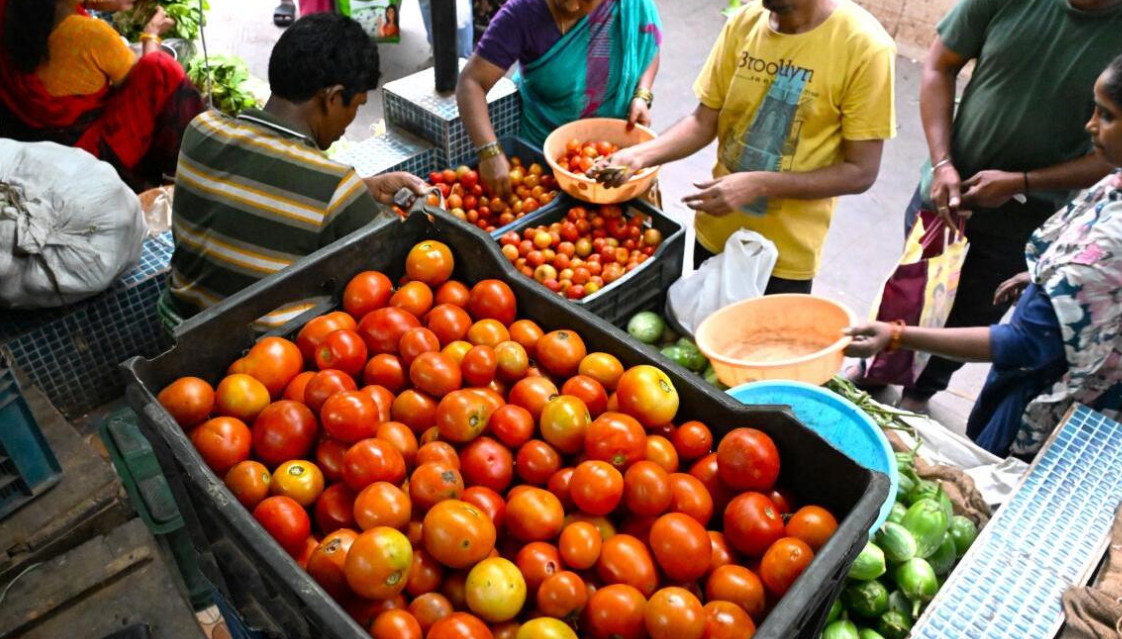
Neither the spike in rice nor Surendrachari’s household is an isolated case. Across Andhra Pradesh, the entire daily basket is slipping out of reach. Even at government-enabled Rythu Bazaars—meant to cushion consumers against price gouging—tomatoes, brinjal, green chillies, bitter gourd, and ridge gourd have all climbed past Rs 40 a kilo. In open markets, vendors are charging nearly double. With sugar reaching at Rs.65 a kilo and onion prices surging, ordinary families are finding it increasingly difficult to balance their daily food budgets.
Price data of last year from the state’s Directorate of Economics and Statistics, alongside reporting from The New Indian Express, shows that the shock runs through almost every shelf in the kitchen:
· Onions :Up 151.36%
· Ginger: Up 102.86%
· Red Chillies: Up 65.62%
· Chicken: Up 37.32%
· Redgram Dal: Up 31.44%
· Sunflower Oil (Refined): Up 15.54%
· Groundnut Oil: Up 15.31%
· Palm Oil: Up 12.48%
· Tamarind: Up 6.15%
When cooking oil, pulses, spices, and grains rise all at once, families cannot simply swap ingredients or cook something else. Instead, they water down curries, skip protein, and stretch their portions—forcing families to quietly compromise on the quality of their daily meals.
Rural Andhra takes the Hit:
The state’s inflation has more than doubled to 6.29% since January, when it was 2.83 per cent. Rural inflation, at 6.63 per cent, is higher than urban inflation, at 5.74 per cent. Food inflation in the state was 8.91 per cent, against 7.74 per cent nationally. For homemaker K. Bharati in Nandyal District, that percentage translates directly into a broken household budget. “Prices of essential commodities have shot up drastically,” she says. “From rice to pulses and even basic items like salt, everything has become expensive. Our monthly expenses have increased by Rs 1,000 to Rs 2,000”.
A higher inflation rate hurts rural Andhra Pradesh far more because of how village incomes are spent. Based on HCES data, rural households dedicate 40% to 50% of their earnings entirely to food. When food inflation nears the 9% or 10% mark in these pockets, the family’s financial buffer takes a hit. Every extra rupee forced toward rice and dal is stripped directly from healthcare or debt payments, pushing vulnerable farm laborers straight back into the debt trap of local moneylenders.
Meanwhile, middle-class families are also being squeezed from a completely different direction. While villages battle food costs, cities are seeing an explosion in the price of routine services. Across the state, personal care and everyday services have surged by a staggering 25.71% in urban centres and 24.79% in rural areas.
The cost of Education is also punishing households, with urban education inflation hitting 7.36%. “Even middle-class families are struggling to afford education,” says Poleti Bharati, a parent. “On an average, a primary school day scholar has to pay between Rs 50,000 and Rs 60,000 per year. Managing education expenses for two children has become extremely difficult”.
Oversimplification:
Whenever living costs spiral, the standard political reflex is to point fingers elsewhere—blaming global crude prices, geopolitical shocks, El Niño, or broken international supply chains.
But that excuse falls bland against the national picture. Though we are not in top 5 states of GSDP or the growth rate; Out of all of India’s states and Union Territories, Andhra Pradesh stands out: official data from the Ministry of Statistics and Programme Implementation (MoSPI) reveals the state has been locked in the top five for highest inflation month after month for eight straight months this year.
| Month (2026) | All-India CPI (%) | Andhra Pradesh CPI (%) | Gap vs. Nation | AP National Rank |
| January | 2.74% | 2.83% | +0.09% | Outside Top 5 |
| February | 3.21% | 3.45% | +0.24% | 4th Highest |
| March | 3.40% | 4.05% | +0.65% | 2nd Highest |
| April | 3.48% | 4.20% | +0.72% | 2nd Highest |
| May | 3.93% | 4.90% | +0.97% | 3rd Highest |
| June | 4.38% | 5.39% | +1.01% | 2nd Highest |
| July | 4.45% | 5.72% | +1.27% | 2nd Highest |
| August | 4.82% | 5.53% | +0.71% | 4th Highest |
| September | 5.54% | 6.29% | +0.75% | 5th Highest |
By September 2026, when national retail inflation touched 5.54%, Andhra Pradesh’s hit 6.29% ( breaching the Reserve Bank of India’s 6% upper tolerance ceiling), while state food inflation exploded into double digits at 10.18%.
Governance Factors:
a) Farm-to-Fork Logistics and Rythu Bazaar Infiltration:
Andhra Pradesh is an agricultural powerhouse. State-run market yards and Rythu Bazaars—designed to eliminate middlemen—have been hijacked by trader cartels and crippled by infrastructure neglect.
· This broken system explains why Rayalaseema farmers fear a good harvest more than a drought, as a recent The Hindu investigation revealed. In major hubs like Madanapalle and Punganur, grading facilities and cold storage for perishables are virtually non-existent. Without a place to store their crop, farmers are left at the mercy of middlemen who give crate advances[and dictate the price.
The financial whiplash is brutal. While retail consumers paid Rs 120 a kilo for tomatoes in May, a July supply glut drove farm-gate prices down to a devastating Rs 3 a kilo after transport costs. The government’s promised Rs 12 Minimum Support Price never reached the yard.
“Mr. Modi had spoken about cold storage and the tomato industry in Rayalaseema in 2014,” says Valmikipuram farmer Manjunath. “Now, there is the double-engine government. We are still waiting for the promise to be fulfilled.”
· Cartels and middlemen now run the markets. Rice vendors told The New Indian Express that state regulation is dead: “The prices are fixed by the rice millers, and we have to sell at those rates.” The same profiteering has infected Rythu Bazaars. By November, basics like tomatoes and brinjal were selling above Rs 40 a kilo because commercial traders had hijacked the stalls—a violation so blatant the state had to book 121 proxy traders. Meanwhile, the government’s highly publicized online solution, Digi Rythu Bazaar”—Quickly stumbled amid severe delivery delays and non-functional ordering lines.
b) India’s Costliest Fuel:
While the state government cannot control global Brent crude prices, it exercises total control over state Value Added Tax (VAT) and local cesses. Diesel is the lifeblood of rural logistics; every tractor harvesting paddy in Godavari and every lorry hauling onions from Kurnool runs on it.
According to the Petroleum Planning & Analysis Cell (PPAC), Andhra Pradesh imposes a punishing triple-tax:
Diesel: 22.25% VAT + Rs 4/litre flat VAT + Rs 1/litre Road Cess.
Petrol: 31.00% VAT + Rs 4/litre flat VAT + Rs 1/litre Road Cess.
By May 17, 2026, The New Indian Express reported that Andhra Pradesh had once again topped the nation in fuel prices, prompting transport unions to hike freight charges.
By November 8, 2026, retail diesel in Andhra Pradesh stood at Rs 105.61 per litre—roughly Rs 5 to Rs 7 per litre costlier than in neighbouring Karnataka (Rs 99.56/L), Odisha (Rs 100.68/L), or Gujarat (Rs 98.27/L).
Every time a rural consumer buys a bag of rice or vegetables, they are paying a compounding freight tax directly into the state exchequer.
c) Paralyzed Price Stabilisation Fund (PSF) and Token Relief
The Price Stabilisation Fund (PSF) is intended to serve as a primary buffer against sharp market fluctuations. However, analysis suggests that recent interventions in Andhra Pradesh have been largely reactive and constrained in scale.
Consequently, the measurable impact of these measures on overall retail pricing has remained limited. Following a 108% rise in onion prices in September, the government initiated sales of subsidized onions at Rs 35 per kilogram, restricted to Vijayawada. Furthermore, allocations were capped at 2 kilograms per family per month—equating to approximately 65 grams daily per household.
Similarly, the state’s rice subsidy program offered fine varieties at Rs 50 per kilogram, though open-market prices continued to reach up to Rs 85 in many areas. By comparison, neighboring Tamil Nadu addressed price pressures by distributing fine rice at Rs 30 per kilogram, highlighting differing strategies in state-level market intervention.
Closing off:
In places like Proddatur and Nandyal, policy discussions and high-level reviews have yet to ease the pressure on daily household budgets. The extra Rs 1,000 to Rs 2,000 drained from working-class budgets every single month is money that will never return to a goldsmith’s savings, a farm labourer’s healthcare, or a middle-class child’s school fees.
While economic indicators and long-term vision documents remain central to state planning, persistent price pressures present an immediate challenge for households across the region. As daily living costs continue to strain budgets in the “Rice Bowl of India,” sustained inflationary burdens risk gradually eroding public trust as citizens steadily lose patience.