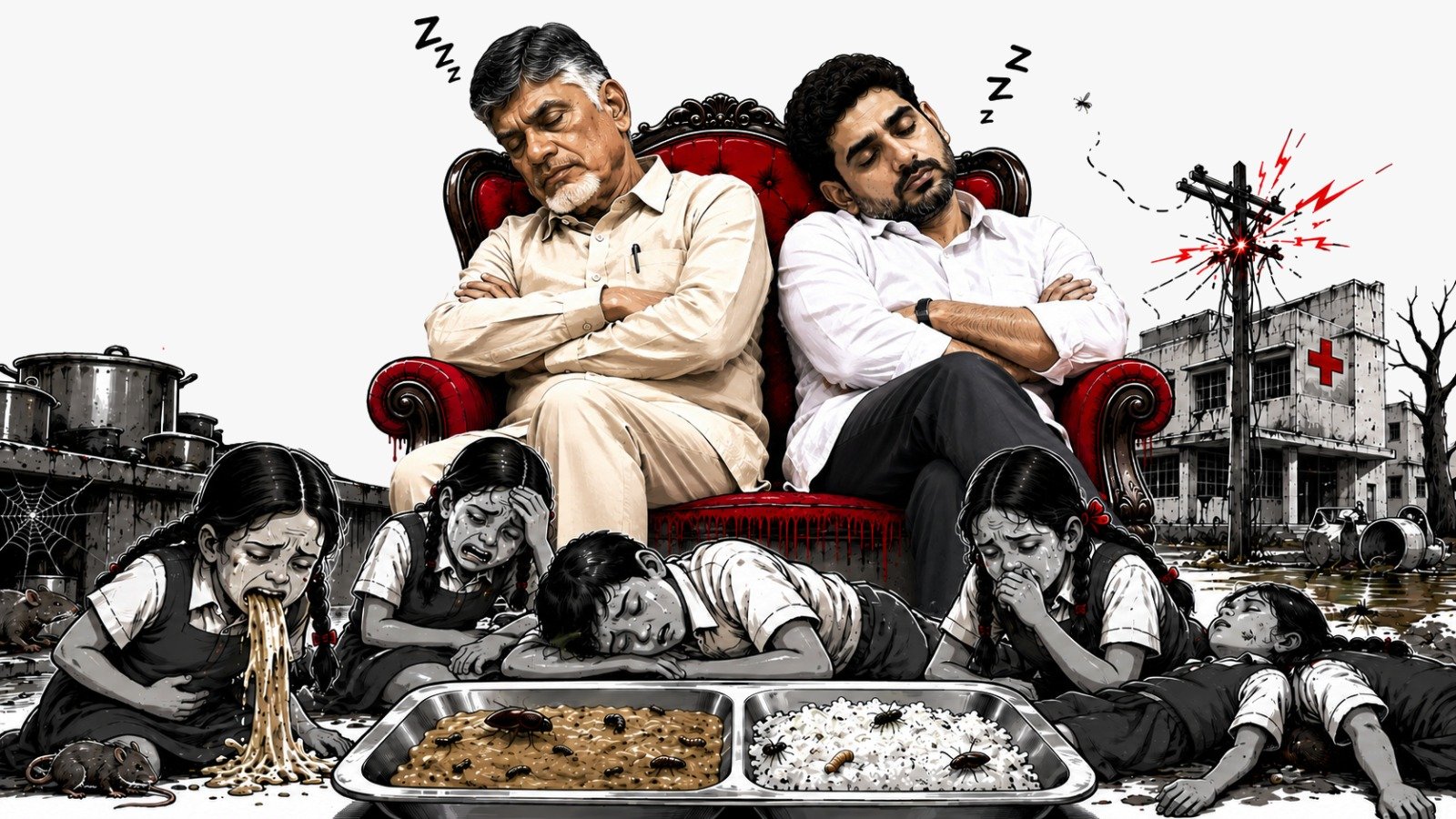
- Repeated incidents of food poisoning are being reported in welfare hostels across the State.
- Snake bites, electrocution and deaths due to lack of timely medical care are being reported from tribal residential schools.
- Students are dying from fever and malaria, yet the government remains unmoved.
- Children are being forced to live amid contaminated food, unhygienic kitchens, mosquitoes and insects.
- Welfare hostels have turned into danger zones, with students facing everything from food poisoning to viral fevers.
- As many as 71 girl students fell ill on the same day in two residential schools.
- In Tirupati, 78 students from three educational institutions were hospitalised.
- At the BC Girls’ Hostel in Dosakayalapalli, 62 students fell seriously ill.
- At the S. Kota residential school, 51 students were bedridden with fever.
- Under Chandrababu Naidu’s rule, welfare hostels have become unsafe and inhuman living spaces.
- Who will protect these children? Who will take responsibility for these deaths and repeated health emergencies?
Can any parent today confidently send a child to a welfare hostel believing that the child will receive proper food, live safely and study peacefully? The situation has become alarming. Students are being rushed to hospitals after eating food supplied in government hostels. If they develop fever, there is no certainty that timely treatment will be available. Snake bites are not being treated in time, unsafe electrical infrastructure is claiming lives, and mosquitoes, insects and unhygienic surroundings are leaving children sick.
These are not isolated incidents. Across Andhra Pradesh, welfare hostels, tribal residential schools and ashram schools are witnessing repeated health emergencies. Contaminated food, poor-quality provisions, unhygienic kitchens, unsafe drinking water and lack of regular medical supervision have together created a serious threat to the lives of poor and vulnerable students.
71 Tribal Girl Students Fall Ill on the Same Day
On July 26, as many as 71 tribal girl students fell ill after consuming contaminated food in two separate institutions. At the Tribal Girls’ Ashram School in Somulagudem, Polavaram district, 41 students suffered from vomiting, diarrhoea and stomach pain. At the KGBV in Kotavuratla, Anakapalli district, another 30 students developed similar symptoms.
Students at Somulagudem said the dal and curry prepared in the afternoon were served again at night. Unhygienic kitchens, insect-infested food and stored leftovers sent the children to hospital. In Kotavuratla too, students fell seriously ill after consuming the midday meal. Two major incidents on the same day expose the complete failure of government monitoring.
78 Students Hospitalised in Tirupati
On July 29, 78 students from three medical educational institutions in Tirupati fell ill due to food poisoning. At the SVIMS Ayurvedic College, 28 students were affected, while another 50 students from SVIMS and Padmavathi Medical College were hospitalised with vomiting and diarrhoea.
Students and parents said the same dal and curry prepared in the afternoon were served again at night. Complaints regarding poor food quality had reportedly been raised earlier, but no corrective action followed.
62 Girls Fall Ill at Dosakayalapalli BC Hostel
At the BC Girls’ Hostel in Dosakayalapalli, Korukonda mandal of East Godavari district, 62 students fell ill after eating curd rice. The girls suffered from stomach pain, vomiting and diarrhoea and had to be shifted to the Dosakayalapalli PHC and the Government Hospital in Rajamahendravaram.
When dozens of children from a single hostel are hospitalised at once, serious questions arise: Who is checking the quality of food? Where is the daily health monitoring? Why is there no effective system to prevent such incidents?
Insects Found in Rice; 19 Students Fall Ill
At a girls’ school near Hindupur in Sri Sathya Sai district, 19 students fell ill with stomach pain and diarrhoea. They were initially treated on the school premises. The students complained that insects were frequently found in the food served at the hostel and that the meals were of poor quality. Reports that students were not even being given an opportunity to communicate their problems to their parents further exposed the failure of the administration.
51 Students Bedridden with Fever
At the Tribal Girls’ Residential School in S. Kota, Vizianagaram district, 51 students suffered from fever. While 44 students were treated within the residential school, several others had to be shifted to hospitals. Despite the spread of viral fevers, there were no clear answers as to why preventive health check-ups and sanitation measures had not been undertaken.
In the same district, 30 students at the ladies’ hostel of Kadavakollu Government Dental College were hospitalised with vomiting and diarrhoea following food poisoning, while another 20 students also fell ill.
Warnings Came in April, but Nothing Changed
On April 21, 11 students from an Eklavya Model Residential School near Pedabayalu in Alluri Sitarama Raju district were admitted to hospital with vomiting and diarrhoea.
On April 22, another 11 students from an Eklavya Model Residential School in the same region became seriously ill. Around 280 students were studying at the school at the time, and complaints surfaced that spoiled food was being served to them.
On April 28, 20 children at Hanumanapalli in Agali mandal of Sri Sathya Sai district suffered food poisoning after two children brought leftover food from a function and shared it with others. The incident once again highlighted the need for stronger health monitoring of children in rural areas.
Snake Bites, Electrocution and Deaths — Are Children’s Lives Safe?
- On August 30, student Tellam Jahnavi died in Kunavaram mandal of Polavaram district after timely medical treatment was not available.
- Dinesh, aged 12, a student of the Eklavya School at Gudem Kothaveedhi in Alluri Sitarama Raju district, died of malaria. He had been suffering from fever for two days but did not receive advanced treatment in time.
- Abhi, a student of Sankesu Ashram School in Jiyyammavalasa mandal of Parvathipuram Manyam district, suffered from skin wounds and boils, with criticism that proper treatment was not provided at the initial stage.
- Anil, a student of the Tribal Welfare Residential School at Chintapalli in Alluri district, died by suicide. As questions were raised over the circumstances of his death, local residents demanded a comprehensive inquiry.
- Indu, a student of the Kasturba Gandhi Balika Vidyalaya at Kesarapalli in NTR district, died after suffering from fever. Questions were raised over why she was kept in the hostel and why timely medical care was not provided.
- Anjalidevi, aged 11, a student of Jaddangi Ashram School in Rajavommangi mandal of Polavaram district, died following illness. Criticism mounted that she was not shifted for advanced medical treatment even after her condition deteriorated.
- On June 22, student Bindu died after suffering from stomach pain at the Kasturba Gandhi Balika Vidyalaya in Bakkunayudupeta, Vepada mandal of Vizianagaram district.
- At a girls’ school in Gara mandal, another 10 students were admitted to hospital with diarrhoea and stomach pain. Food samples had to be collected and sent for laboratory testing.
- Pattika Abhi, a fifth-class student at the Tribal Welfare Ashram High School at Ravada–Ramabhadrapuram in Jiyyammavalasa mandal of Parvathipuram Manyam district, was bitten by a snake. The fact that a snake was found within the school premises itself raised serious concerns over student safety and campus maintenance.
- On July 10, Tulasi Naik, a Class IX student at the Boys’ Tribal Residential School at Ragulapadu in Vajrakarur mandal of Anantapur district, was bitten by a snake.
- Jashvi, a student of an Ashram School in the Polavaram region, died after she did not receive timely medical care. Her family said her condition worsened after she was treated locally instead of being shifted promptly to a hospital.
- At an Ashram School in Velerupadu mandal, 13-year-old Lakshmi Parvathi died due to electrocution after electricity passed through an iron wire used for drying clothes. The tragedy raised serious questions over the absence of even basic electrical safety inspections in premises where children live.
Fevers, Skin Diseases and Chickenpox
At the BC Girls’ Hostel in Peddapuram, 15 children contracted chickenpox. The students were shifted to hospital only after the infection had already spread within the hostel. Similar problems are repeatedly surfacing in tribal residential schools, including viral fevers, skin diseases, mosquito infestation, snake movement and poor sanitation.
Many of these incidents could have been prevented through basic measures such as regular health screening, mosquito-control drives, proper sanitation and safe drinking water. Instead, the government is reacting only after students fall ill, sending officials to the spot and treating each incident as an isolated episode rather than addressing the systemic failures behind them.
Tribal Child Dies After Medical Negligence
At Gullaguppa in Polavaram district, seven-year-old tribal girl Jamuna died after serious lapses in medical treatment. Chloroquine tablets were distributed without conducting malaria diagnostic tests and in violation of Central guidelines. As a result, 41 tribal girl students and 16 villagers fell ill.
Jamuna’s condition deteriorated and she later died, while several others required hospital treatment. The incident raises serious questions: Who authorised the distribution of such medicines to children without proper diagnosis? Who will take responsibility for the death of an innocent tribal child? Those responsible must be identified and subjected to strict action.
Does the Government Have No Responsibility to Feed Children Safely?
Providing nutritious and safe food to children from poor and vulnerable communities is a basic responsibility of the government. Yet the repeated incidents across welfare hostels show a complete breakdown in monitoring.
There appears to be no effective supervision over whether the prescribed menu is being followed, whether provisions are of acceptable quality, whether kitchens are hygienic, whether drinking water is safe, or whether regular medical examinations are being conducted.
After every incident, officials arrive, collect food samples, visit students in hospitals and announce inquiries. But there is no lasting corrective mechanism. When the same failures recur across districts, they can no longer be dismissed as accidents. They point to a systemic failure of governance.
How Many More Children Must Suffer?
These are not incidents involving one or two students. In individual cases, 20, 30, 51, 62, 71 and even 78 students have been hospitalised at a time. Some children have lost their lives due to illness, malaria, fever, electrocution and failure to receive timely medical care.
Parents send their children to welfare hostels so that they can study in safety and dignity. They do not send them to eat substandard food, fall ill, face snake bites, unsafe electrical wiring, mosquito-borne diseases and medical neglect.
Yet the Chief Minister and the concerned welfare departments have failed to demonstrate accountability despite the repeated incidents.
A Government Unable to Feed and Protect Children
Can a government that cannot provide children with basic food, medical care and safety call itself a welfare government?
Does a government that cannot ensure minimum standards in hostels have the moral authority to continue ignoring these failures?
Until responsibility is fixed for the repeated incidents and systemic corrective measures are put in place, the Chandrababu government cannot escape accountability for the deteriorating conditions in welfare hostels and residential schools.