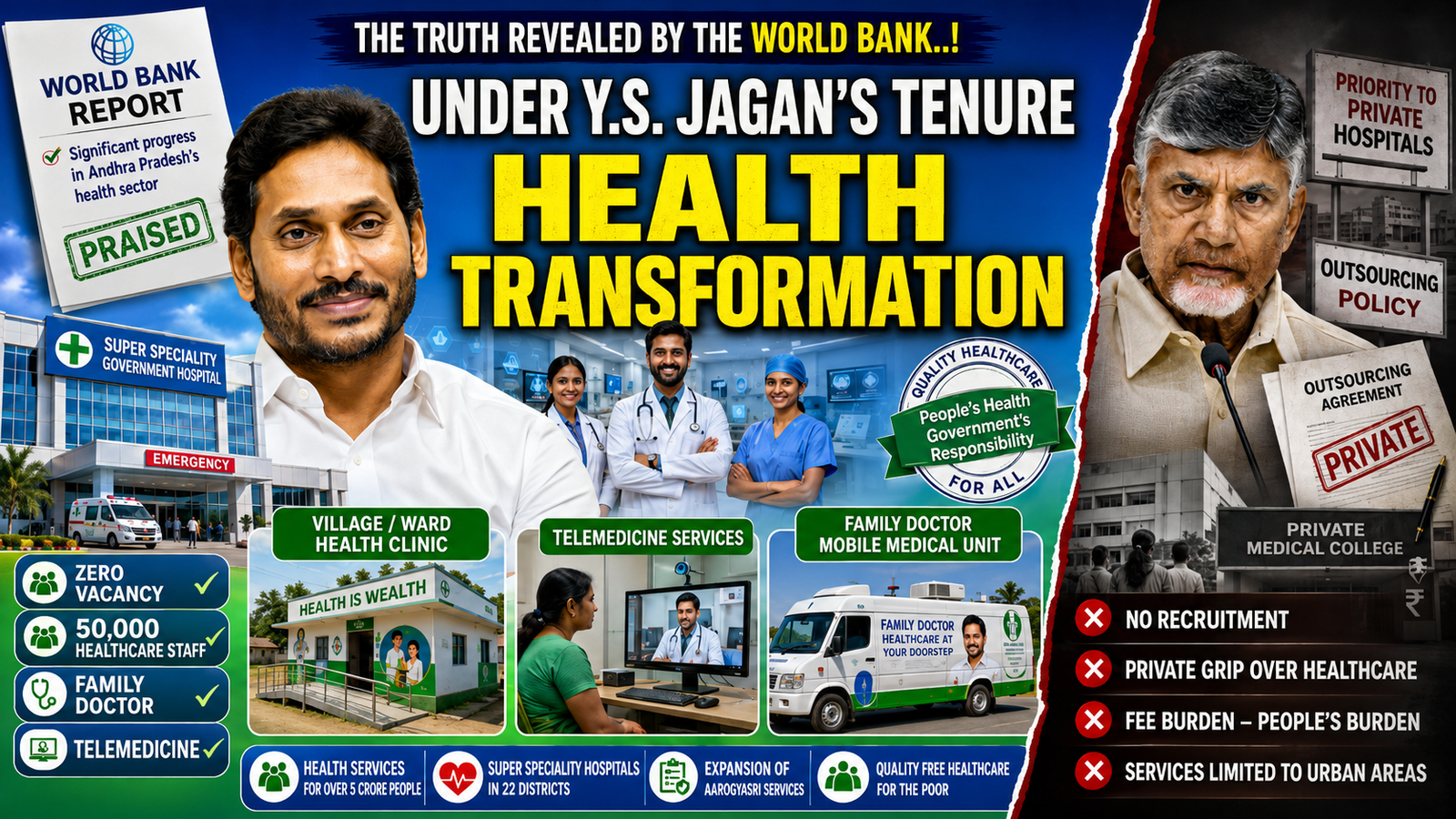
From nearly 50,000 health recruitments and the Family Doctor Programme to telemedicine, village-level care, NCD screening and digital health systems, the World Bank’s completion report records a major strengthening of Andhra Pradesh’s public healthcare architecture.
Andhra Pradesh’s healthcare story between 2019 and 2024 was not merely about adding schemes or constructing buildings. It was about attempting to rebuild the public health system from the ground up — strengthening primary care, filling vacancies, bringing doctors closer to villages, expanding diagnostics, digitising health records and making government facilities more reliable.
A recent World Bank Implementation Completion and Results Report on the Andhra Pradesh Health Systems Strengthening Project places many of those changes on record.
One of the most significant observations in the report is the policy choice made after the change of government in 2019. The newly elected government reviewed the health-sector strategy and chose to place greater emphasis on strengthening public-sector healthcare and reducing dependence on private-sector contracting. The project was accordingly restructured to focus more heavily on improving government facilities and expanding public health services.
That distinction is important.
The World Bank itself notes that the government that assumed office in 2019 preferred quality improvement and expanded access within the public system, rather than relying predominantly on private contracting.
Political priority translated into implementation
The report does not describe the project as an administrative exercise functioning in isolation.
It records that the Government of Andhra Pradesh was strongly committed to achieving the project objectives. It refers to a dedicated project leadership structure, support from departmental heads, regular briefings to the Chief Minister, priority from the top political leadership, continuous monitoring and systematic review meetings.
According to the Bank, these factors contributed directly to the achievement of results.
The report also points to Andhra Pradesh’s ability to cut through traditional administrative barriers when necessary, particularly in recruitment and staffing.
Nearly 50,000 healthcare workers recruited
Perhaps no reform illustrates the scale of the intervention more clearly than recruitment.
Andhra Pradesh adopted a “Zero Vacancy” policy, established a Medical Recruitment Board, rationalised staffing patterns, revised salaries and incentives and introduced measures to attract medical professionals to remote and difficult areas.
The World Bank records that around 50,000 healthcare personnel were recruited within two years.
The Bank later cites this approach as a lesson in how health systems can challenge long-accepted staffing constraints. It refers to the huge recruitment drive, streamlined hiring, additional incentives for remote postings and special measures to attract professionals with scarce skills.
This was not simply recruitment for recruitment’s sake. The objective was to ensure that newly created and upgraded public facilities actually had the doctors, nurses and paramedical personnel required to function.
Healthcare moved closer to the village
The transformation was most visible at the primary-care level.
The World Bank records a comprehensive restructuring of primary health infrastructure. Each PHC was mapped to a network of Village Health Centres, with population coverage adjusted according to local conditions, including tribal areas.
During the project period, 4,345 new Village Health Centres and 88 new PHCs were established, while 977 rural PHCs and 184 urban PHCs were renovated. The HWC network expanded dramatically and facilities were equipped to provide a broader package of services covering hypertension, diabetes, common cancers, maternal and child health, family planning, oral health, mental health and emergency obstetric care.
The idea was straightforward but consequential: a citizen should not have to travel to a district hospital for every basic health need.
Family Doctor Programme brought doctors to the doorstep
The Family Doctor Programme, formally launched in April 2023 after a pilot beginning in October 2022, became one of the most distinctive reforms of the period.
Under the programme, doctors and Mobile Medical Units visited Village Health Centres on a fixed schedule twice every month, combining facility-based care with outreach to households.
What makes this programme particularly noteworthy is that the World Bank report cites an evaluation of its actual outcomes.
In the districts studied, the proportion of diabetes patients whose blood sugar was within the normal range rose from 19% to 63%. Among hypertension patients, normal blood-pressure control increased from 36% to 63%.
Full antenatal-care coverage increased from 51% to 71%. Identification of high-risk pregnancies increased from 11% to 17%, while follow-up of those high-risk pregnancies rose sharply from 9% to 52%.
The evaluation estimated the cost of a consultation at roughly ₹50 for salaries and MMU costs plus ₹9 for drugs and diagnostics, and concluded that significant outcomes were achieved with a relatively modest increase in inputs.
That is an important distinction: the programme was not merely launched; it produced measurable outcomes in the areas studied.
Andhra Pradesh emerged as a telemedicine leader
Digital healthcare became another pillar of the system.
The World Bank records the rollout of a large-scale telemedicine platform that particularly benefited rural and tribal populations.
More than 75,000 teleconsultations and associated prescriptions were being generated every day, while Andhra Pradesh accounted for nearly one-third of national teleconsultations during the project period.
The Bank also notes that Andhra Pradesh demonstrated how specialist consultation could be extended down to the primary-care level through fully staffed eHubs.
This meant specialist advice was no longer confined entirely to major hospitals and cities.
Digital health moved from experiment to system
The state also built a wider digital-health architecture.
Standardised Electronic Medical Records were introduced, while a statewide Integrated Patient Management System was operationalised in 1,042 facilities, integrating outpatient, inpatient, pharmacy and laboratory functions.
The World Bank describes Andhra Pradesh’s rapid rollout of digital health IDs and medical records as “good practice” and notes that interoperability and compliance with national standards were built into these systems.
Andhra Pradesh also received three National Digital Health Mission awards in 2022 — for the highest percentage of health records linked with ABHA IDs, high saturation of its public healthcare registry and performance as a state-government integrator of health data.
A massive NCD screening effort
The health strategy also recognised that Andhra Pradesh’s disease burden was changing.
The 2022–23 NCD 2.0 exercise screened roughly 80% of the state population covered by the survey and linked surveyed households to unique health identities.
The World Bank records that more than one million people with hypertension and nearly 600,000 people with diabetes were diagnosed through NCD screening. Nearly 8.5 million women were screened for symptoms of breast or cervical cancer.
By project completion, screening and risk stratification for hypertension and diabetes had exceeded project targets, including separate targets for men and women.
Government facilities began meeting national quality standards at scale
The report is particularly strong on quality certification.
The project had targeted 198 CHCs and PHCs for National Quality Assurance Standards certification. The World Bank records 526 certified CHCs and PHCs, along with additional district hospitals, Area Hospitals, Urban PHCs and Health and Wellness Centres.
Even more significantly, it says that since 2020 Andhra Pradesh had the highest percentage of NQAS-certified public facilities in the country — roughly twice the share of the next-ranked state.
That is not a political assessment. NQAS certification involves external assessment against detailed national quality parameters.
Drug availability and equipment management were overhauled
The reforms also addressed two persistent problems in government hospitals: unavailable medicines and non-functional equipment.
A “smart” pharmaceutical management system was introduced to monitor stocks, warn about medicines nearing expiry, trigger reordering and enable redistribution between facilities.
The World Bank cites results including a 70% reduction in drug stock-outs, 60% reduction in prescription errors, laboratory turnaround time falling from 24 hours to four hours, and 95% accuracy in drug dispensing.
Biomedical equipment maintenance was similarly reorganised.
Of 14,847 pieces of equipment found non-functional, 12,843 were repaired within six months, while unusable equipment was decommissioned. QR codes, maintenance databases, response deadlines and contractual penalties were introduced.
These are the less visible reforms that determine whether a hospital merely exists on paper or actually functions.
Maternal and infant health improved
The report also records significant improvement in maternal and infant-health indicators.
Andhra Pradesh’s Maternal Mortality Ratio declined from 58 in 2017–19 to 30 in 2021–23. Infant Mortality Rate declined from 29 in 2018 to 19 in 2023, while neonatal mortality also decreased.
Perhaps more strikingly, Andhra Pradesh was one of only four states in India where antenatal-care registrations increased during the COVID disruption relative to 2019, despite declines nationally. The report links this resilience to extensive outreach and communication efforts.
COVID tested the system — and forced it to scale
The public-health system faced its harshest test during COVID-19.
The report records procurement of 10,000 oxygen concentrators, ventilators, PPE and infection-control material; creation or upgrading of dedicated COVID wards, oxygen-supported beds and critical-care facilities; and expansion of COVID testing capacity to more than 100 laboratories, alongside mobile testing units for remote areas.
By March 2023, more than 43 million vaccine doses had been administered, with adult vaccination coverage exceeding 90%, according to the project report.
The ultimate test: people returned to public hospitals
Infrastructure, staff numbers and software matter. But one of the most revealing indicators is whether citizens actually use government hospitals.
The World Bank notes a substantial increase in utilisation of the public system, particularly PHCs. Its field mission described facilities it visited as well-run, well-functioning and well-used.
The report concludes that new primary-care facilities, mobile health services, telemedicine and recruitment reforms brought healthcare to previously underserved households, particularly in tribal areas, and resulted in substantial improvements in equitable access, quality and responsiveness.
A public-sector choice
Perhaps the most consequential message from the World Bank report is not any single statistic.
It is the direction of policy.
The government that took office in 2019 deliberately chose to strengthen the public health system itself — its doctors, clinics, diagnostics, digital infrastructure, medicines and village outreach.
The World Bank’s final assessment gave the project High relevance, Substantial efficacy, Substantial efficiency and an overall “Satisfactory” outcome rating.
The report also notes that the administration that returned to office in mid-2024 had begun moving again toward greater reliance on private-sector outsourcing, including in medical colleges and urban PHCs.
That contrast gives the report significance far beyond a project-completion exercise.
It documents two competing approaches to healthcare governance.
One asks how much government healthcare can be strengthened.
The other asks how much of it can be outsourced.
And in documenting what happened in Andhra Pradesh during the previous five years, the World Bank has placed a substantial record of the state’s public-health transformation in the public domain.