Silencing Voices. Manufacturing Fear
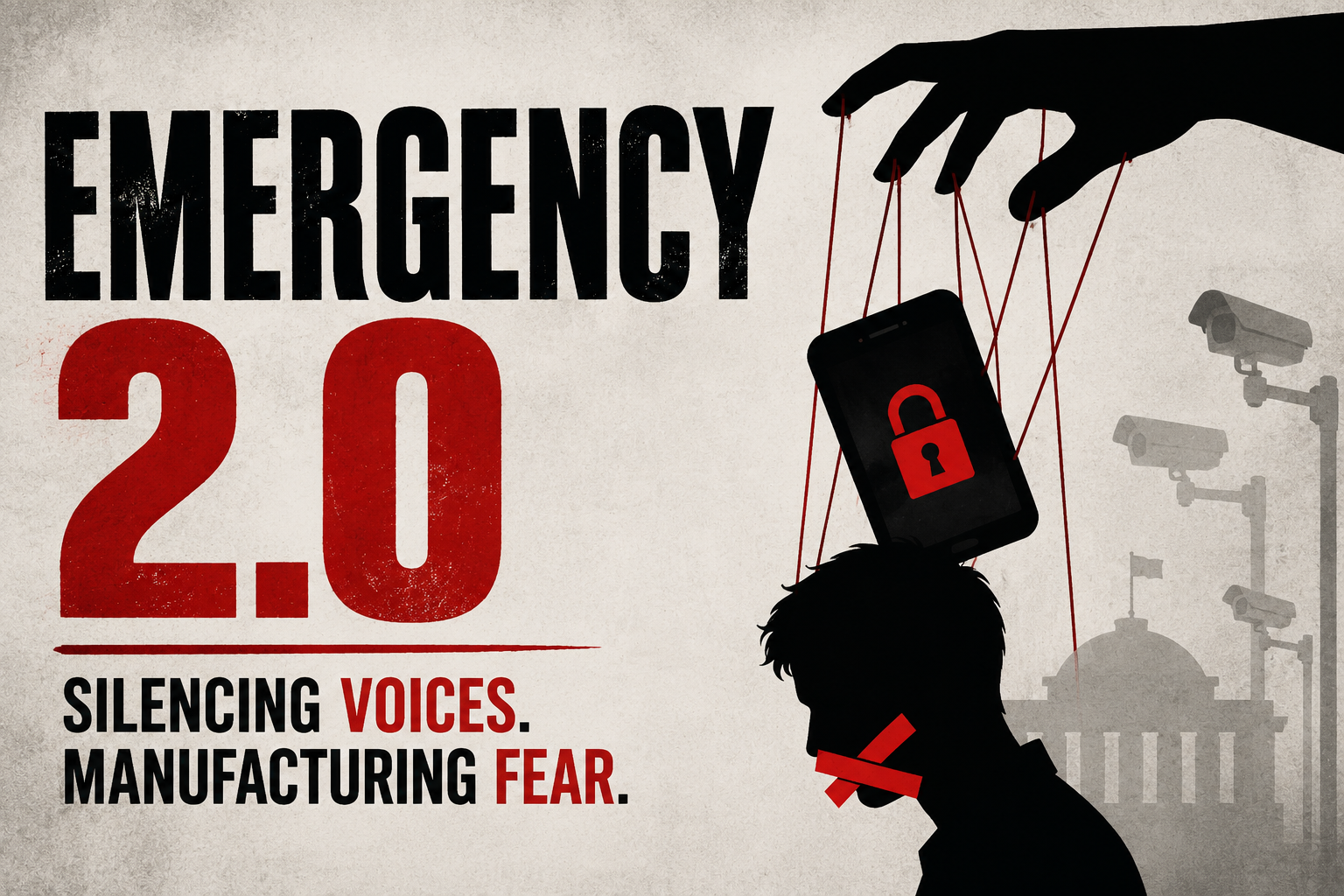
- Chandrababu’s objective is not to curb character assassination, but to silence voices questioning his government’s failures.
- Anyone who questions the Chandrababu government is subjected to coordinated digital attacks from pro-government social media accounts.
- Government posts and salaries funded by public money are being used to reward loyalists.
- Those who spread misinformation and false propaganda in support of the government are rewarded with positions.
- Those who question the government, however, are slapped with illegal cases.
- While ignoring public issues, the government is devising strategies to control social media.
- TDP-backed social media trolls are encouraged to carry out character assassination campaigns against YS Jagan.
- Under the banner of ITDP, an organization functioning like a terrorist outfit has been allowed to operate with impunity.
- Instead of answering questions about its failures, the government is resorting to diversionary politics in the name of social media.
- Chandrababu’s approach is like that of a thief shouting, “Thief! Thief!”
There has been a wave of criticism over the diversionary politics being pursued by Chief Minister Chandrababu Naidu and his Cabinet in the name of social media. It is being alleged that Chandrababu’s real objective is not to prevent character assassination on social media, but to suppress the voices of citizens, youth, and YSRCP workers who are questioning the government’s failures. Chandrababu’s modus operandi on social media is nothing new to the people of the state. Crores of rupees have allegedly been spent to create hundreds of YouTube channels and thousands of social media accounts to spread lies, morphed content, and malicious propaganda within moments.
Digital Attacks on Those Who Question
Anyone who questions the Chandrababu government is immediately subjected to coordinated digital attacks through social media accounts that operate in his support. Chandrababu’s method has been to use his loyal social media network to carry out character assassination against political opponents and then shield those responsible through the power of the government. The same social media network is now allegedly being further strengthened through government appointments and salaries paid out of public funds. Those who spread lies in support of the government are rewarded with posts and salaries, while a young person who questions the government through a social media post is met with criminal cases, rowdy sheets, arrests, and harassment. This, it is said, has become Chandrababu’s version of digital justice.
Like a thief shouting “Thief! Thief!” Chandrababu is now speaking about poisonous propaganda on social media. Those who filled social media with venom are now claiming they will cleanse it, a claim that is being compared to demons preaching the Vedas.
A Cabinet at War with Social Media While Ignoring Public Problems
Two years have passed since this government came to power. There is no development. There is no welfare. The Super Six and Super Seven promises made during the elections have vanished into thin air. People continue to wait for the implementation of schemes such as Aadabidda Nidhi, unemployment allowance, pensions at the age of fifty, new pensions, and new housing. Yet, the Cabinet spends hours discussing social media posts.
Farmers are struggling to obtain seeds and fertilizers. Unemployed youth are waiting for jobs. Women are anxious about their safety. But the issue that appears most urgent to Chandrababu is social media. A government that has failed to devote its full attention to the problems of the people is directing the police to give “complete attention” to social media. A Cabinet Sub-Committee is reportedly being constituted to deal with social media. Then why is no sub-committee being formed to examine custodial deaths, police excesses, illegal detentions, or attacks by coalition leaders?
If the government is genuinely performing well, why should it fear social media posts?
The government has become rattled because information about unfulfilled promises, corruption, and the misuse of the police is reaching the people. Instead of functioning as a Cabinet meant to govern for the welfare of the people, it has been turned into a platform for political vendetta, digital surveillance, and the suppression of dissenting voices.
Chandrababu’s Social Media modus operandi:
Repression on one hand, Propaganda on the other
Chandrababu first creates a false narrative. He then ensures that the same falsehood is amplified through newspapers and television channels that support him. The next step is to spread the very same narrative across social media using hundreds of YouTube channels and thousands of social media accounts. By pushing identical content simultaneously through numerous accounts, an illusion is created that the entire public is speaking with one voice. This has become the TDP’s social media strategy.
Whenever anyone questions government corruption, the failure to fulfil election promises, or police excesses, they are immediately subjected to personal attacks. Instead of responding to the issues raised, the focus shifts to attacking the individual. Their family, caste, personal life, profession, and appearance become the target, while the actual issue is deliberately sidelined. Trolling those who raise public issues, hurling abusive language, creating fabricated videos, and damaging their reputation have all become part of Chandrababu’s digital offensive.
The Chandrababu system creates hundreds of social media accounts to spread falsehoods. The very same Chandrababu government then files criminal cases against those who question those falsehoods. The same people who create the wrongdoing are the ones who protect those responsible. The same people who encourage such activities reward them with positions and opportunities. Finally, when criticism becomes unavoidable, they project one individual as a scapegoat while attempting to portray themselves as heroes.
In public, they speak about maintaining decency on social media. Behind the scenes, however, they deploy their own social media network to carry out the most abusive and degrading attacks. This is Chandrababu’s anti-hero style of politics.
Government Posts for Those Who Carry Out Digital Attacks?
How did social media personalities such as Kirak RP, Seema Raja, Swathi Chowdary, and Yash emerge? Who promoted them? Whose political interests did they serve? There are serious allegations that several individuals who actively campaigned in favour of the TDP on social media were later rewarded with government positions. The government must disclose the complete details. It should release the list of social media personalities who have been appointed to government institutions, corporations, advisory positions, and media-related assignments. How much are they being paid? On what qualifications were they appointed? What exactly are their responsibilities? These details must be placed before the public.
Chandrababu must remove the suspicion that government positions were awarded as rewards for carrying out digital attacks against political opponents. Is it not an abuse of power to use taxpayers’ money, not for public service, but to pay salaries to those who engaged in political propaganda?
How can those who post content supporting the government be rewarded with government positions and salaries running into lakhs of rupees, while young people who question the government are prosecuted with criminal cases? If the government is genuinely committed to promoting civility on social media, would it reward those who engaged in abusive online campaigns with government appointments? If the government has the courage, it should make public the names, salaries, and appointment orders of everyone who has been given government positions on the basis of their social media background during the past two years.
One standard for TDP’s Fake News and another for the Opposition and Activists?
How many cases have been registered against those who circulated morphed videos, obscene posts, and fabricated stories targeting YS Jagan, his family members, and YSRCP leaders? Hundreds of complaints have been submitted regarding posts targeting YSRCP leaders, women, and their family members. How many of those complaints were converted into FIRs? Throwing YSRCP complaints into the dustbin while registering an FIR within hours whenever a TDP leader files a complaint is not the rule of law. It is political vendetta. When the Chief Minister himself makes personal and derogatory remarks against YS Jagan, does that not amount to character assassination? Does the law apply only to the opposition? Does it not apply to the Chief Minister?
Are the vulgar skits performed by paid artists ridiculing YSRCP leaders and their families considered entertainment, while a video questioning the government is treated as a criminal offence? When Chandrababu is questioned, it is described as character assassination. When YS Jagan is insulted, it is dismissed as political satire. Is this Chandrababu’s idea of justice? It is Chandrababu who allows character assassination to be carried out through social media accounts that support him while using the power of the government to shield them.
The abusive propaganda carried out by his supporters goes unnoticed. But a simple question raised by an opposition activist is treated as a major crime. If the government is truly serious about preventing offences on social media, then the same law and the same standards must be applied equally to everyone. Does the government have the courage to take action without distinguishing between the ruling party and the opposition?
ITDP, hundreds of YouTube channels, thousands of accounts
A Machinery of Digital Propaganda
Chandrababu Naidu and Nara Lokesh must answer the allegations that ITDP functioned as the nerve centre of a well-organized digital propaganda network on social media. Official and unofficial social media accounts were allegedly established at the state, district, constituency, and mandal levels to amplify a single political narrative through thousands of coordinated accounts. Hundreds of YouTube channels were reportedly created to circulate fabricated stories, morphed content, personal attacks, and obscene skits.
- Will the proposed Special Task Force investigate these allegations?
- Will it investigate the allegations that individuals who promoted TDP on social media were paid money through Google Pay and other financial incentives?
- Have the police examined the videos in which several social media personalities themselves spoke about receiving encouragement and payments from TDP leaders?
- Does the government have the courage to expose the financial transactions behind the social media accounts that spread false propaganda against political leaders and their family members?
- If the proposed Special Task Force is truly impartial, it must begin its investigation with ITDP’s social media accounts, its affiliated YouTube channels, and the alleged payment network behind them.
- Protecting TDP’s social media ecosystem while registering criminal cases only against YSRCP activists exposes the real purpose of the proposed Task Force.
A Special Task Force to Silence Truth, Not to Fight Crime
The proposed Special Task Force on social media is not being created to prevent crime. It is being established to bury the truth, suppress freedom of expression, and undermine democracy. There is growing suspicion that its real objective is to identify, monitor, and hunt down social media accounts that question the government. The Chief Minister’s direction to recruit personnel from outside the existing police force raises serious questions. Is the government creating a parallel political surveillance mechanism alongside the regular police system?
- Will this Task Force investigate fake news, morphed videos, and obscene content originating from TDP’s own social media ecosystem? Or has it already prepared a list of YSRCP activists to target?
- Chandrababu’s statement that the Task Force should ensure there are “no legal complications” is deeply suspicious. Instead of directing the police to act strictly according to the law, why is the emphasis on avoiding legal complications while filing cases?
- Does this indicate that individuals will first be identified as targets, and only afterwards will legal provisions be searched for to fit those cases?
- Who decides what is true and what is false? Chandrababu Naidu and his ministers, or independent investigating agencies and the courts?
- When allegations are made against the government, the proper response is to answer them with facts and evidence, not to use the police to send critics to prison.
Rowdy sheets and Midnight arrests for those who question
The pattern remains the same. Supportive social media networks are encouraged to launch coordinated digital attacks. But when the victims respond or question the government, criminal cases are registered against them instead. Young people who question the government are subjected to rowdy sheets, illegally summoned to police stations, and their family members are intimidated. Those who spread false propaganda in support of the government receive protection. Opposition activists who speak the truth are met with midnight arrests. Whether then or now, Chandrababu’s policy remains unchanged. People who are clearly seen in videos attacking opposition workers or vandalizing their homes are rarely arrested. Yet the police arrive at midnight at the home of a young person simply for posting a message on social media.
- The responsibility of the police is to protect the lives, property, and constitutional rights of the people, not to safeguard the image of the Chief Minister, his ministers, or coalition leaders. Illegal detention in the name of social media posts, prolonged interrogations lasting for hours, seizure of mobile phones, and intimidation of family members pose a serious threat to democracy.
- Is the police system accountable to the people of Andhra Pradesh, or has it become an extension of the TDP functioning for its political interests?
- Is Chandrababu Naidu prepared to order an independent inquiry into the allegations that the police are being used as instruments of political vendetta?
Linking Youth to “Organized Crime” is Dangerous
Linking a young person to “organized crime” merely for posting on social media is an extremely dangerous and unconstitutional practice. The first step in any criminal case should be to determine whether an offence has actually been committed. Instead, the objective appears to be to imprison the individual first by searching for non-bailable sections that can be invoked. That is not the rule of law.
Directing the police in advance to invoke non-bailable sections amounts to the government imposing punishment even before a court has delivered its judgment.
When exaggerated criminal provisions are invoked against a young person, the damage extends far beyond the individual. Their education, career, family, and entire future are put at risk. Who has given the Chandrababu government the right to play with the lives of young people in pursuit of political vendetta?
By portraying social media criticism as organized crime, the government is attempting to create an atmosphere of fear across the state.
After Managing the Mainstream Media, the Government Is Now Targeting Social Media
A large section of the state’s mainstream newspapers and television channels has been turned into a propaganda machinery supportive of Chandrababu. As government failures, unfulfilled promises, and police excesses found little or no space in mainstream media, people began using their own social media accounts as their personal news platforms.
Chandrababu has been unable to tolerate the fact that corruption, abuse of power, and government excesses are being exposed through this one platform that remains in the hands of ordinary citizens.
- First, the mainstream media was brought under control. Now, an attempt is being made to control social media through the police.
- Controlling social media is not merely about shutting down a few accounts. It is about suppressing the people’s right to receive information and their fundamental right to freedom of expression.
- What Chandrababu wants is not an independent media, but a propaganda machinery that never questions him.
- If the media praises him, it is called journalism. If it questions him, it is treated as a crime.
The Ravan Case: a warning to every Government critic through the use of UAPA
YSRCP does not support the objectionable remarks made by Ravan. It is clearly stated that he has no connection whatsoever with YSRCP.
Anyone who makes objectionable remarks should be investigated and proceeded against under the applicable provisions of ordinary law. No one is above the law.
However, invoking the Unlawful Activities (Prevention) Act (UAPA), an anti-terror law, against a YouTuber is intended not merely to target that individual, but to intimidate every person who dares to question the government.
UAPA is a law meant to deal with terrorists and individuals who pose a grave threat to the security of the nation. Using it in response to political commentary amounts to a misuse of the law.
The case is being used to send a clear message to social media activists: “If you question the government, the same will happen to you.”
Ravan’s earlier videos and social media posts contain instances where he criticized YSRCP and Y.S. Jagan Mohan Reddy. In that context, attempting to portray him as being associated with YSRCP is nothing but a political conspiracy.
If action was not taken when those remarks were originally made, why has the issue suddenly been revived now under the guise of religion?
After criticism mounted over the invocation of UAPA, the focus of the case was deliberately shifted towards religion in an attempt to divert public attention.
This, too, is part of Chandrababu’s politics of diversion.
A Presentation on Social Media Posts, Silence on Human Lives
The Director General of Police reportedly gave a PowerPoint presentation on social media during the Cabinet meeting. Why, then, was no presentation made on the Sai Krishna case?
Why was there no discussion in the Cabinet about the serious allegations surrounding Sai Krishna’s disappearance, the disappearance of his body, the alleged secret cremation, and the deletion of CCTV footage?
Sai Krishna’s family pleaded with senior police officials, saying that their son was being killed, yet the government failed to respond. A government that remained silent when a life was at stake is now convening emergency meetings over social media posts. It is a matter of shame.
Why did the DGP not present a comprehensive report on the allegations that Kranthi Kumar died by suicide as a result of police harassment?
Why were the incidents involving Gangamma, Kalavathi, and Tirupatamma never discussed in the Cabinet?
Is a social media post more important than a human life?
A government that refuses to discuss police excesses, custodial deaths, and illegal detentions is, at the same time, constituting special task forces against those who question them.
Social Media Cases as a Tool of Diversionary Politics
The controversies surrounding social media are being manufactured to divert public attention from the government’s failures to implement the Super Six promises, the distress faced by farmers, rising unemployment, women’s safety, and allegations of police excesses.
At the very moment when the government should be answering questions about the deaths of Sai Krishna and Kranthi Kumar, it has instead shifted the narrative towards Ravan, religion, and social media posts.
Whenever it needs to hide its failures, the government changes the subject. One day, it pushes Pawan Kalyan to the forefront. The next day, it creates a controversy in the name of religion. On another day, it registers criminal cases against social media activists.
Creating controversies instead of answering public concerns, shifting blame onto the opposition, and using the police to silence dissent has long been Chandrababu’s political method.
The very people who built a machinery to spread falsehoods on social media are now branding those who speak the truth as criminals.
Like a thief shouting, “Thief! Thief!”, Chandrababu now lectures others about character assassination on social media.
Hundreds of YouTube channels can be created to spread propaganda. Thousands of social media accounts can be operated to amplify false narratives. Government positions and salaries running into lakhs of rupees can be awarded to those who work in support of the government. Criminal cases can be registered against those who speak the truth. Rowdy sheets can be opened against them. Midnight arrests can be carried out. Families can be intimidated.
But the truth that exists in the minds of the people cannot be erased.
People are watching as the very individuals who institutionalized abusive social media campaigns now speak about civility and decency on social media.
History has delivered the same verdict against every government that has tried to suppress the voice of its people. The Chandrababu Naidu government will be no exception.