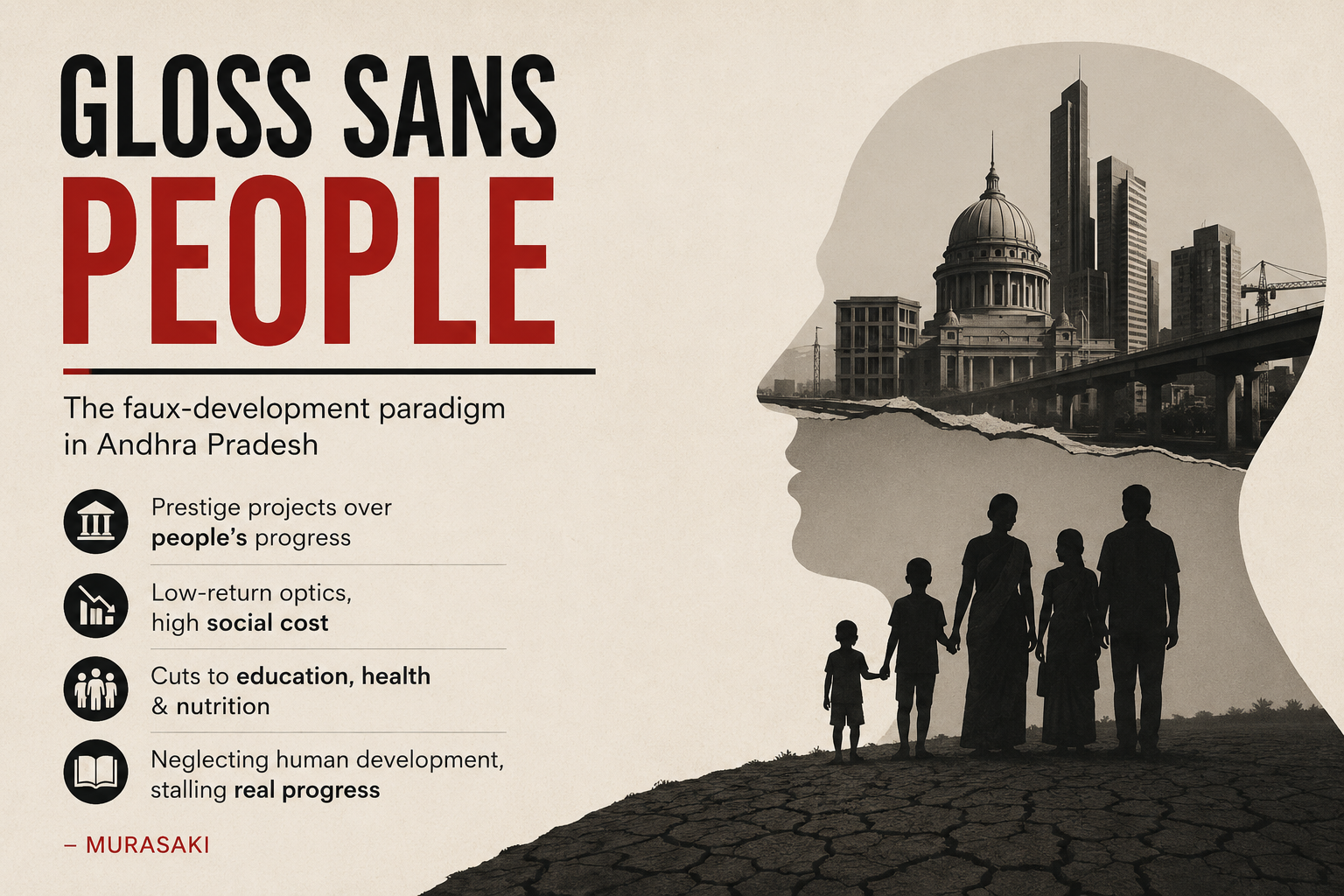
Ever since the “Shining India” campaign unleashed by the NDA government in the early 2000s in which the current Chief Minister of Andhra Pradesh, Chandrababu Naidu was a critical player, economists have pointed to the troubling paradox of how in the absence of an informed media critique, narratives can easily become substitutes for reality and completely derail policy priorities and real imperatives. What gets promoted is a discourse around development that completely obscures what constitutes actual material progress as opposed to optical developmentalism that just spotlights certain symbols and tokens – most often prestige projects without any significant return on investment. This has particular resonance in a state like Andhra where real parameters of progress around GDP, HDI and other critical metrics have really lagged under what can only be termed as a faux-developmentalism.
There is a well researched analytical article put out by Sri Jaya Krishna, one of my colleagues and an informed citizen that delves into great depth as to how the developmental narrative has prioritized low-return investments like redundant buildings and low return investments like “flyovers to nowhere”, while neglecting real drivers of economic activity like ports, rail links and sustainable energy. Most of the low return projects end up favoring crony capitalists who in turn are able to influence political contests by ploughing back the rents that get aggrandized.
While failing even around creating economically viable critical infrastructure, there is an even bigger failure that faux-developmentalist regimes like the current Andhra government are responsible for – and that is the complete lack of focus on Human Development Indicators (HDI), which measure progress based on the actual increase/decrease in people’s human capacities (typically education, health, nutrition and democratic participation). As many development economists have shown and as the late Dr. Amartya Sen demonstrated through his emperico-theoretical works, “Development” in a real sense is meaningless without enhancement of human capacities. Human development is often times in the modern world a critical precursor to material development and not the other way round – particularly in economies where inequalities of access to opportunities are persistent. This is where the YCP government under YS Jaganmohan Reddy sought to bring in institutional frameworks that sought to prioritize bulk of the governments focus on areas like primary and secondary education particularly in areas inhabited by rural and marginal communities, primary health care through an extensive network of public health centers and support for child nutrition through a thoroughly revamped mid-day meal scheme that even critics agreed was one of the best run schemes in the country with its emphasis on everyday nutrition and providing incentives to students to attend school regularly. Now all this was a major break from the 24X7 TV driven developmental paradigm which suddenly saw that funds were not spent anymore on showy symbols like iconic buildings in Amaravati ( a capital city deeply flawed just by virtue of its selection in a geologically unsuitable zone) to areas that the Government felt were needed for creating long-term, sustainable capacities in the population. All of these programs that had Human Capability enhancement and Social Security for the marginalized have seen deep cuts by the current government in order to fund the insatiable appetite of the Amaravati beast – real money being spent to generate speculative returns for a select few (The cuts and their attendant effects have been well documented in the media as well as in academic commentary).
Take the important case of school level education. Again according to developmental economists, investments in secondary and primary education are far more productive that returns in tertiary education in a country like India (not to say that tertiary education needs to be deliberately neglected), but the primary levels lay the foundation for not only a productive but also a democratically engaged citizenry with high levels of civic sensibilities. And contrary to the popular perception of a “developed” south, Andhra actually has literacy levels comparable to BIhar – one of India’s most backward states. And the reasons are not far to seek. For four decades now, governments have been slowly decreasing their commitments to public education. Private education cliques have emerged as big power players and have from the time of the TDPs foundation – especially since Chandrababu Naidus turn at the helm, have been its most consistent supporters (probably the telugu film industry is the only other one which has been steady in support for the TDP) . One of the most powerful members of the current administration actually leads a private school/college cartel that has been castigated by educationists for unprecedented commercialization/roteization of an already weak education system in the state. No wonder if the powers that be are the gatekeepers, the edifice is so prone to loot. The YCP government did make a very serious effort to change the education system by its prestigious Nadu-Nedu (Today-Tomorrow) program which focused on improving the quality of physical infrastructure in schools (buildings, classrooms, toilets) and was uniquely successful in streamlining facilities in atleast 70% of primary and secondary schools across the state. Enrollment numbers started going up and parent indebtedness on account of social pressure to send their wards to private schools significantly decreased.
But for our media and commentariat, increasingly conditioned by a McKInseyite discourse on what constitutes governmental priorities, none of this seemed to matter. When the TDP government which came back to power in 2024 started rolling back commitments to social security and put privatization of primary health and education back on the center stage, there was no systematic questioning or debate – instead a steno like compliance to what the government was putting out. Leaving aside the shortcomings of the commentariat, the real losers in this are people in the bottom half of the population whose aspirational desires have been frequently stymied by vested interests.
As the poet-laureate of Andhra Pradesh, Gurajada Apparao said “Desamante matti kadoi, desamante manusholoyi” (the Nation is not a physical fragment, it is a collective of peoples). But sadly the current regime seems to put people completely out of its administrative and developmental paradigm – at what cost!
MURASAKI