Two decades of analyzing land administration and urban revenue systems in Telangana teaches a foundational truth: real estate governance is rarely defined by simple title ownership. The true measure of a property’s legitimacy lies at the intersection of environmental statutory mandates and spatial reality. When high-profile leadership assets face public and legal scrutiny, relying strictly on a patta (legal title) often exposes a fundamental misunderstanding of regulatory frameworks.
The ongoing discourse surrounding the asset footprint in Janwada specifically linked to modern political leaders like Pawan Kalyan serves as an important case study in land management lapses. Incorporating on-the-ground visual footage, audio recordings, and secondary digital evidence regarding his structural installations, the physical layout reveals critical deviations from optimal land governance. When an influential public figure, whose platform centers on transparency and structural reform, faces a title versus environmental compliance conflict, it highlights significant regulatory and strategic oversights.
1. The Fallacy of the Document Shield: Overlooking ‘Shikham’ Dynamics
A primary administrative error in complex asset acquisitions is treating a registered title deed as an absolute defense against environmental classifications.
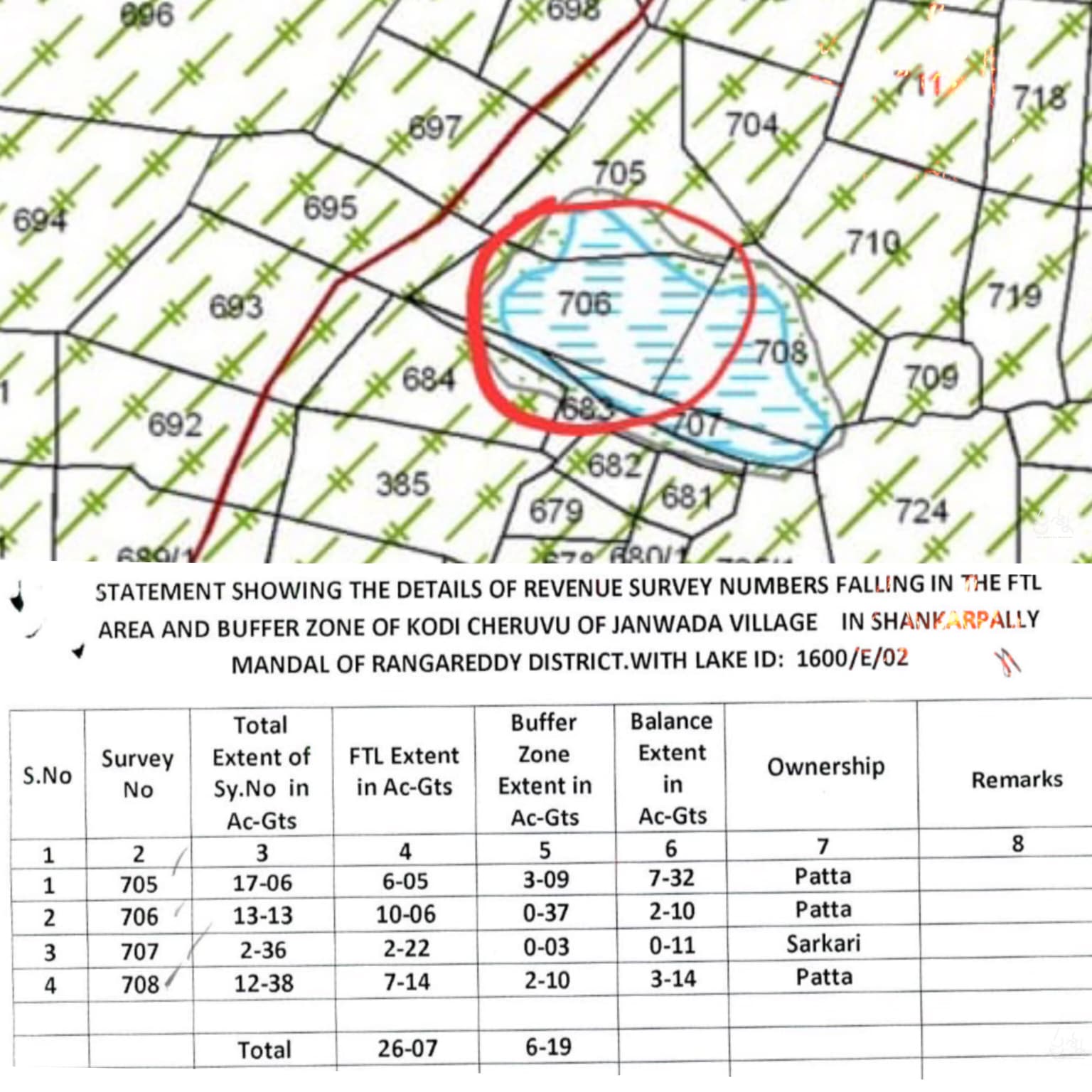
- The Historical Classification Lapse: Land parcels in peri-urban Hyderabad, particularly around the Shankarpally and Janwada belts, frequently contain historical Shikham classifications denoting the maximum water level (MWL) or bed of a local minor irrigation tank (cheruvu).
- The Legislative Reality: Under standard Indian jurisprudence and land revenue administration, no private title deed can supersede the public trust doctrine governing natural water bodies. If an asset trail includes historically appended Shikham or lake-bed land, completing a transaction without verifying physical topography represents a significant due-diligence failure.
To audit or track land transactions, encumbrance certificates, and partition histories for properties in this region, public records are verified via the Telangana Registration and Stamps Department Portal. For an experienced asset manager or a public figure with access to top-tier legal advisory, overlooking the historical registration status of water-body catchments remains a critical misstep.
2. Structural Footprints Within Sensitive Eco-Zones
The technical friction in this specific micro-market centers heavily on compliance with long-standing environmental decrees. Emerging digital evidence and site documentation demonstrate a clear footprint of human intervention ranging from extensive heavy-shed infrastructure to decorative horticulture right up to protected boundaries.
GO 111 Boundaries and the WALTA Framework
The property footprint in question sits within the 84-village cluster historically regulated by GO 111, designed to safeguard the catchment areas of major reservoirs. Concurrently, the Telangana Water, Land, and Trees Act (WALTA) strictly prohibits permanent structural interventions within the Full Tank Level (FTL) boundaries or natural inflow channels of local lakes.
| Regulatory Parameter | Standard Compliance Expectation | Observed Governance Vulnerability |
|---|---|---|
| Environmental Buffer Norms | Zero permanent, heavy concrete, or commercial-scale structures inside designated lake beds or inflow channels. | The presence of heavy structural components (such as permanent sheds or extensive farmhouse fencing) near water body contours. |
| Due Diligence Pre-requisite | Complete spatial mapping via modern GIS coordinates prior to structural development. | Proceeding with construction based solely on revenue documents, ignoring the physical FTL boundaries. |
With enforcement agencies like HYDRAA (Hyderabad Disaster Response and Asset Protection Agency) actively correcting decades of regulatory oversight in these exact zones, maintaining a permanent physical asset over an ecologically sensitive perimeter is an administrative risk that should have been proactively mitigated. Official tracking of survey numbers, boundaries, and land-use maps can be analyzed directly through the Telangana Chief Commissioner of Land Administration (CCLA) Dharani Portal.
3. The Policy-Practice Paradox in Modern Leadership
From an institutional standpoint, the primary failure here is the disconnect between political philosophy and administrative execution.
- The Diligence Gap: Leaders who advocate for environmental protection, anti-corruption, and systemic reform cannot afford to maintain blind spots in their personal real estate portfolios. Securing temporary single-year titles (Ek Saal Patta) or historical titles without verifying if the land encroaches on a public utility or lake ecosystem creates an immediate policy-practice paradox.
- The Precedent: When public figures utilize administrative loopholes or rely on historical systemic oversights to shield assets from environmental scrutiny, it inadvertently dilutes the integrity of the broader reformative agenda they champion. Legal precedents and challenges concerning property definitions in these eco-zones can be explored further via the Supreme Court of India and the Telangana High Court portals.
Conclusion: Institutional Cleanliness Demands Absolute Compliance
In the modern framework of land governance, a clean title deed is no longer enough to establish full regulatory compliance. The ultimate lesson from the Janwada asset scrutiny is that spatial and environmental realities will inevitably catch up with historical paper transactions. For leadership to remain credible, asset portfolios must be held to an absolute standard of ecological and structural compliance proving that the rules governing public assets apply equally to those who hold the highest offices.
The spatial context of how these rural properties are utilized is further highlighted in this Pawan Kalyan Farm House Video, which provides archival ground-level footage of the compound layout and agricultural activities associated with his personal estate.