
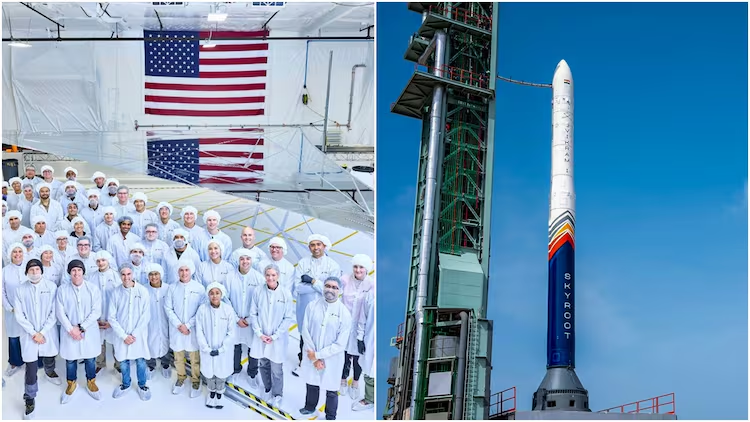
Washington, Oct 16: US-based space technology startup Reflect Orbital plans to provide sunlight at night by deploying large reflective mirrors in space. The California-based company has signed a launch contract with India’s Skyroot Aerospace to send its satellites into orbit using Vikram rockets.
The project aims to deliver on-demand sunlight to specific locations on Earth for applications such as disaster relief, search and rescue operations, and extending the operating hours of solar farms.
Reflect Orbital Partners with Skyroot Aerospace
Reflect Orbital has signed a contract with Hyderabad-based Skyroot Aerospace for two satellite launches. The first mission will use the Vikram-1 rocket, while the second will use the company’s Vikram-1U launch vehicle, which is currently under development.
Reflect Orbital said the agreement would provide additional launch capacity and help maintain its planned launch schedule alongside missions from US launch sites.
Skyroot Aerospace CEO Pawan Chandana welcomed the partnership, describing the project as an innovative application of space technology that could create new possibilities on Earth.
How Will Satellites Provide Sunlight at Night?
Reflect Orbital plans to deploy a constellation of satellites equipped with large mirrors that reflect sunlight towards selected locations on Earth after dark.
According to the startup, its technology is designed to provide adjustable illumination across a five-kilometre-wide area. The company also aims to allow users to switch the light off whenever required.
Potential applications include illuminating disaster-hit areas during search and rescue operations, supporting industrial activities in remote locations, and providing additional lighting for selected infrastructure and public events.
The company also hopes the technology could help solar farms extend their power generation hours. However, the actual benefits for electricity production will depend on the system’s performance and the amount of usable light it can deliver.
Reflect Orbital Receives FCC Approval
In July, Reflect Orbital received approval from the US Federal Communications Commission (FCC) to construct, launch and operate a demonstration satellite.
The company said it would continue working with astronomers, local communities and regulators as it develops the technology and evaluates the possibility of expanding its satellite network.
Co-founder and CEO Ben Nowack said the partnership with Skyroot Aerospace would help the startup secure access to space for its planned missions.
Skyroot Aerospace to Use Vikram Launch Vehicles
Skyroot Aerospace is developing its Vikram series of rockets to serve the commercial satellite launch market.
Under the agreement, the first Reflect Orbital satellite launch will use Vikram-1. The second mission is planned to use Vikram-1U, which the company says will feature additional first-stage boosters and improved performance.
The partnership represents a potential international commercial opportunity for India’s private space sector, as global companies explore new applications for satellite technology.
Russia Tested Space Mirrors in 1993
The concept of reflecting sunlight from space is not entirely new. In 1993, Russian scientists and engineers conducted the Znamya experiment, deploying a 65-foot reflective structure in orbit to direct a moving beam of sunlight towards Earth.
Although the experiment demonstrated the basic concept, the programme was eventually abandoned because of funding constraints.
Reflect Orbital is now pursuing a commercial approach to the idea, with plans to provide targeted illumination as a service.
Environmental Concerns Over Sunlight Satellites
Reflect Orbital’s plans have attracted criticism from environmental organisations, which have urged the FCC to withdraw the permissions granted for the demonstration satellite.
Critics warn that artificial sunlight at night could disturb wildlife, affect human circadian rhythms and interfere with astronomical observations.
Astronomers have also raised broader concerns about increasing satellite activity and its potential impact on night-sky observations.
These concerns could influence the development and expansion of the technology. Reflect Orbital has said it intends to work with scientists, communities and regulators as it moves forward.
Conclusion
Reflect Orbital’s partnership with Skyroot Aerospace highlights an emerging application of commercial space technology: delivering sunlight to selected locations on Earth after dark. While the project could offer new options for emergency lighting and other specialised applications, its commercial viability and environmental impact remain important questions as the technology develops.





