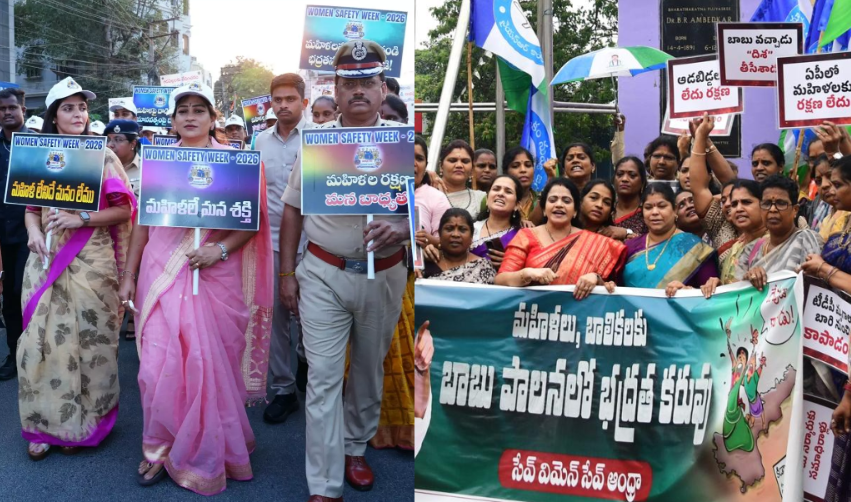
Amaravati, Oct 8: Andhra Pradesh is facing growing concerns over women’s safety following reports of violent crimes, sexual assaults and harassment across several districts. The incidents have intensified the debate over police accountability, crime prevention and the state government’s approach to protecting women and children. The ruling Telugu Desam Party (TDP)-led coalition government and the opposition YSR Congress Party (YSRCP) have taken opposing positions, particularly over official crime statistics and the repeal of the Disha Act framework.
While the government highlights a decline in registered crimes against women and promotes digital safety initiatives such as the SHAKTHI application, the opposition questions whether these measures are sufficient to address public safety concerns. The debate has also renewed attention to specialised courts, investigation timelines and the effectiveness of the current legal framework.
Recent Crimes Raise Concerns Over Women’s Safety
Several reported incidents across Andhra Pradesh have brought women’s safety into focus. In Vijayawada’s New Rajarajeshwaripet, a 19-year-old woman named Mahalakshmi was reportedly stabbed to death by a 22-year-old man following a personal dispute. The accused later died by suicide after jumping from a nearby building. The incident has added to concerns about violent crimes against women.
In Guntur, public outrage followed an incident in which a woman was allegedly stripped and assaulted in public over a borewell dispute. According to the supplied report, local TDP worker Mallela Murthy was linked to the controversy and was reportedly suspended from the party following the incident. The case triggered criticism and renewed demands for accountability.
Visakhapatnam has also reported several incidents involving public safety. These include seven chain-snatching incidents in a single day across Kancharapalem, One Town and Gajuwaka. In a separate incident, an elderly woman was reportedly tied up during a midnight robbery, with the perpetrators escaping with 12 sovereigns of gold and cash.
POCSO Cases and Child Protection Under Scrutiny
Concerns about the safety of minors have further intensified the debate. In Ongole, police reportedly registered a case under the Protection of Children from Sexual Offences (POCSO) Act after two minor girls from a BC Welfare Hostel were allegedly taken to the residence of a retired employee. The State Commission for Protection of Child Rights subsequently sought a report on the incident.
Other reported cases include the alleged sexual assault of a 10-year-old girl in Railway Kodur and an assault on a woman in Vijayawada’s VAMBAY Colony. A woman sub-inspector has also reportedly raised harassment concerns relating to a family outing.
Questions have additionally been raised over the investigation into a girl’s death in Anakapalli, reported sexual violence in Hindupur and incidents within the constituency of Home Minister Vangalapudi Anitha. In September, a woman in Mylavaram reportedly accused a Jana Sena leader of obscene behaviour, threats and verbal abuse.
Andhra Pradesh Crime Statistics for 2025
Figures attributed to Andhra Pradesh Director General of Police Harish Kumar Gupta indicate a decline in registered crimes against women in 2025 compared with the previous year. According to the figures cited in the supplied report, registered cases fell from 16,994 in 2024 to 16,347 in 2025, a decrease of approximately 3.8%. Registered POCSO cases reportedly declined from 2,120 to 1,879 over the same period.
Police authorities also reported 510 convictions in cases involving crimes against women and children during 2025. These figures form a central part of the government’s position that the state has made progress in addressing such offences.
However, YSRCP spokesperson Nagamalleswari challenged this interpretation, arguing that more than 16,000 registered crimes against women and nearly 1,900 POCSO cases in a year remain a serious concern. The opposition maintains that the government should focus on preventing offences and improving law enforcement rather than presenting a decline in registered cases as sufficient evidence of success.
Disha Act Repeal Triggers Political Row
The state government’s decision to repeal the Disha Act framework and rely on central criminal law provisions has become a major point of political disagreement. Former Chief Minister and YSRCP president Y.S. Jagan Mohan Reddy strongly criticised the decision, describing it as a “black day for AP women and children.”
Introduced during the previous YSRCP government, the Disha framework aimed to strengthen the response to crimes against women and children through specialised policing, dedicated courts and faster investigations. The programme was presented as an effort to improve police accessibility and reduce delays in the criminal justice process.
Figures highlighted by the previous administration included more than 1.51 crore app downloads, 31,607 emergency SOS calls reportedly resolved, 18 dedicated women’s police stations and approximately 13,500 women police personnel positioned in village and ward secretariats. The administration also cited 13 specialised POCSO courts, 12 specialised courts dealing with cases involving women and a database reportedly tracking 217,467 individuals. The previous government further stated that the average investigation period declined from 156 days in 2017 to 28 days in 2022.
Meanwhile the TDP-led coalition government has highlighted the SHAKTHI system operated by the Andhra Pradesh Police’s Women and Child Safety Wing. The system reportedly allows emergency SOS alerts to be routed to local police stations and includes travel-tracking features intended to assist women in emergencies.
Conclusion
Andhra Pradesh’s women’s safety debate involves more than annual crime statistics. Reports of violent deaths, sexual assaults, harassment and offences involving minors have raised questions about prevention, police responsiveness and public confidence in the justice system.
Although the figures cited for 2025 indicate a decline in registered crimes against women and POCSO cases, they do not provide a complete picture of safety across the state. The repeal of the Disha Act framework has also prompted debate over specialised policing, investigation timelines and the support available to victims.
Ultimately, the government must demonstrate that its policies are delivering effective protection through timely police action, transparent reporting and reliable judicial outcomes. Women’s safety should be measured by the effectiveness of these protections and the ability of women and children to seek justice, regardless of political differences.