
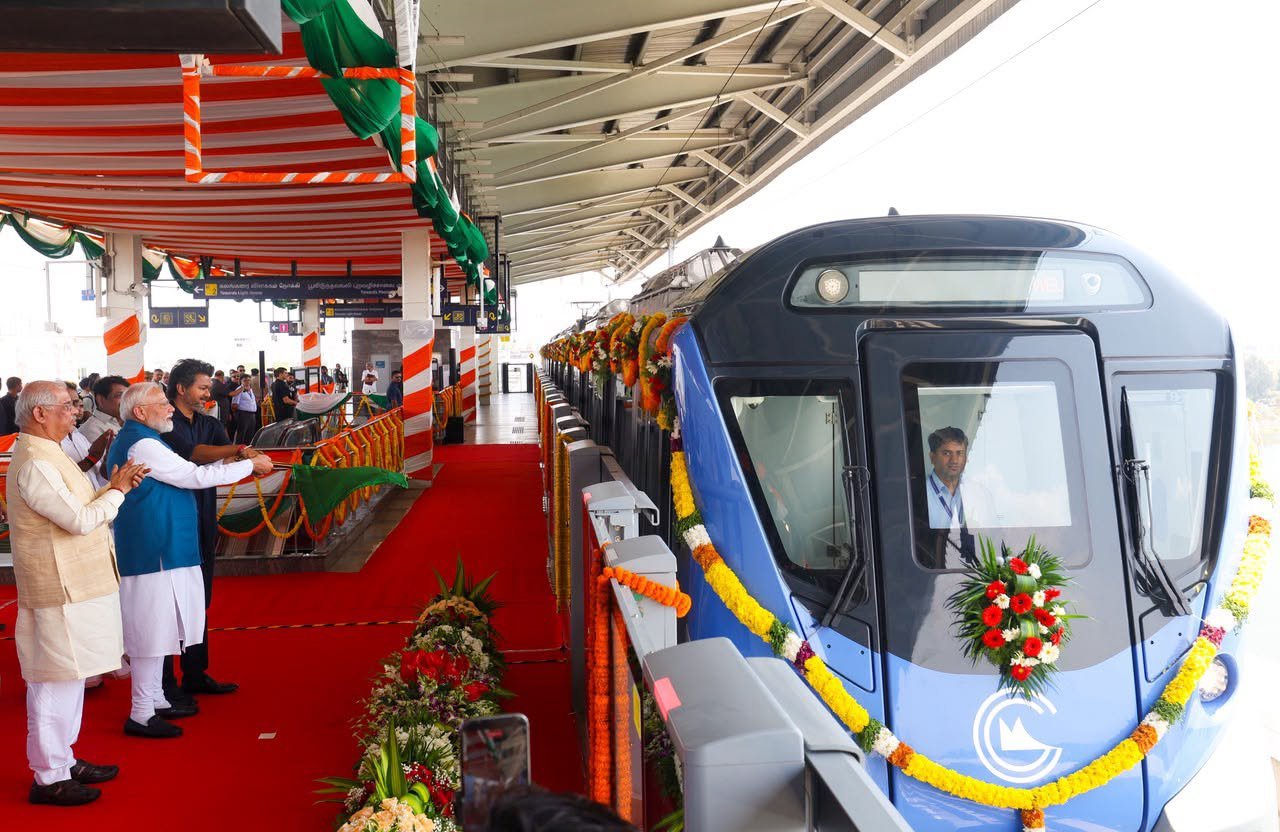
Chennai, Oct 11: Prime Minister Narendra Modi on Sunday inaugurated the Poonamallee–Vadapalani stretch of the Chennai Metro Rail Phase 2 project, built at an estimated cost of ₹4,900 crore. Tamil Nadu Chief Minister C Joseph Vijay joined the Prime Minister to flag off the new Metro services, and both leaders travelled on the train.
The newly opened stretch is part of Corridor 4 of Chennai Metro Phase 2 and is expected to improve public transport connectivity between the city’s western suburbs and central areas. The service includes 11 elevated Metro stations across approximately 15 kilometres.
Poonamallee–Vadapalani Metro Route and Stations
The newly operational section connects Poonamallee Bypass with Vadapalani, offering commuters a new travel option across Chennai’s western suburbs.
The 11 elevated Metro stations on the route are:
- Poonamallee Bypass
- Kumananchavadi
- Iyyappanthangal
- Porur Junction (Porur Bypass)
- Alapakkam
- Karambakkam
- Valasaravakkam
- Alwarthirunagar
- Saligramam Warehouse
- Saligramam
- Vadapalani
Metro fares on the newly opened stretch range from ₹10 to ₹40, according to the information released for the service.
Chennai Metro Phase 2 to Improve Connectivity
The Poonamallee–Vadapalani stretch is an important section of Corridor 4, also known as the Yellow Line. The full corridor is planned to extend approximately 26.1 kilometres to Lighthouse, near Marina Beach.
The connection at Vadapalani Metro Station will allow passengers to transfer to the existing Corridor 2. This will improve access to important locations, including Chennai Egmore, Chennai Central, Alandur and Chennai Airport, through the wider Metro network.
The new route will also strengthen transport links to the Chennai–Sriperumbudur industrial corridor, benefiting workers and businesses in the region.
Chennai Metro Phase 2: Project Details
Chennai Metro Phase 2 is one of India’s largest metro infrastructure projects undertaken as a single phase. The project covers approximately 118.9 kilometres across three corridors—Corridors 3, 4 and 5—with a total of 128 stations.
The project is being opened in stages as construction work is completed. The Poonamallee–Vadapalani section represents a significant step towards expanding Chennai’s urban transport network.
The Phase 2 project is being implemented jointly by the Central and Tamil Nadu governments.
Driverless Technology and Passenger Safety
The newly inaugurated stretch incorporates advanced technologies designed to improve operational efficiency and passenger safety.
These include Unattended Train Operation (UTO), which supports driverless train operations, along with Automatic Train Control (ATC) and Automatic Train Protection (ATP) systems.
The line also uses Communication-Based Train Control (CBTC) technology for advanced signalling. Platform Screen Doors (PSDs) have been installed at all stations on the stretch to improve passenger safety.
These technologies are intended to support reliable train operations and enhance the overall commuting experience.
Double-Decker Metro Section: A Key Engineering Feature
A notable engineering feature of Chennai Metro Phase 2 is a double-decker section where the Corridor 4 tracks run beneath the Corridor 5 tracks for approximately 3.70 kilometres.
The section also includes crossover facilities between the two corridors, enabling operational flexibility within the Metro network.
In addition, the project provides for a four-lane highway grade separator spanning approximately 1.2 kilometres. This infrastructure is intended to improve the integration of road transport with the Metro system.
PM Modi and CM Vijay Share Public Platform
The inauguration marked a notable public appearance by Prime Minister Narendra Modi and Tamil Nadu Chief Minister C Joseph Vijay since Vijay assumed office as Chief Minister in May.
The two leaders jointly flagged off the new Metro services, highlighting cooperation between the Central and Tamil Nadu governments on major infrastructure projects.
Tamil Nadu Governor Rajendra Vishwanath Arlekar also attended the event.
New Metro Route Expected to Benefit Daily Commuters
The Poonamallee–Vadapalani Metro service is expected to benefit thousands of commuters, students and industrial workers travelling across Chennai’s western suburbs and central areas.
By offering an alternative to road transport, the new stretch is expected to reduce travel times, ease traffic congestion and help limit vehicle-related pollution.
Improved connectivity is also expected to support economic and industrial development in western Chennai by providing better access to employment centres, educational institutions and major transport hubs.
The inauguration marks another stage in the expansion of Chennai Metro Phase 2, with further sections expected to open as construction progresses.





