
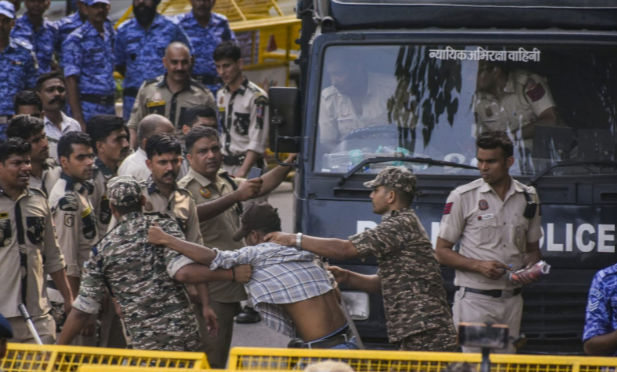
New Delhi, Oct 10: Delhi witnessed an unprecedented security crackdown on Saturday as police detained more than 7,000 protesters ahead of a planned demonstration at Jantar Mantar demanding the resignation of Chief Election Commissioner Gyanesh Kumar over alleged vote theft. The United Nations human rights office expressed concern over the mass detentions and called on Indian authorities to respect the right to peaceful assembly.
CJP leader Abhijit Dipke, four former chief ministers, YouTuber Dhruv Rathee, opposition leaders, lawyers, activists and journalists were among those detained during the protest-related security operation.
Despite the large mobilisation planned by the Cockroach Janta Party (CJP), Jantar Mantar remained largely deserted throughout the day. More than 30,000 police and paramilitary personnel were reportedly deployed across the national capital to prevent protesters from reaching the designated demonstration site.
UN Human Rights Office Raises Concern Over Mass Detentions
The UN human rights office expressed concern over reports of mass detentions involving protesters, protest leaders, civil society members, lawyers and journalists in Delhi.
In a social media post, the office called on Indian authorities to ensure that the right to peaceful assembly was fully respected and protected.
The statement added an international human rights dimension to the controversy surrounding the police action and restrictions imposed ahead of the planned demonstration.
The call came as opposition parties and civil society groups questioned the scale of the security deployment and the detention of people attempting to participate in the protest.
Abhijit Dipke, Four Former Chief Ministers Detained
CJP leader Abhijit Dipke and party leaders Saurav Das and Ashutosh Ranka were detained by Delhi Police inside an aircraft shortly after their flight from Mumbai landed in the national capital.
In a video shared by the party, Dipke was heard telling police officers, “We are here to be arrested, come and arrest us.”
Police reportedly informed the CJP leaders that they did not have permission to hold the demonstration at Jantar Mantar.
Dipke criticised the police action, alleging that party leaders were being treated like criminals. He described the detentions as an example of dictatorship.
Former chief ministers Arvind Kejriwal, Mamata Banerjee, Pinarayi Vijayan and Manik Sarkar were also among the opposition leaders detained at different locations while attempting to join the protest.
Other prominent figures detained included CPI(M) general secretary M.A. Baby, veteran Left leader Brinda Karat, activist Yogendra Yadav, lawyer Prashant Bhushan and AISA president Neha.
YouTuber Dhruv Rathee, who had travelled to participate in the demonstration, was detained from his residence in Gurugram’s Sector 56, according to reports.
Jantar Mantar Turns Into a Security Zone
Delhi was placed under heavy security ahead of the planned CJP demonstration. Police and paramilitary personnel were deployed at key locations, while multiple layers of barricades restricted movement across central Delhi.
According to police sources cited in reports, more than 7,000 people were detained across the capital, including over 2,000 in the New Delhi area.
Authorities also reportedly closed 45 metro stations as part of the security arrangements and conducted intensive checks at railway stations, bus terminals, hotels and border entry points.
Police personnel made repeated announcements at Jantar Mantar, asking people and media representatives not to gather in large groups.
Several protesters who managed to reach the designated protest site were also detained.
The extensive security arrangements disrupted traffic and affected movement across several parts of the capital.
Clashes Reported Near Akashwani Bhawan and Connaught Place
The protest witnessed clashes between demonstrators and security personnel at two locations in Delhi.
Around 1 pm, a group of protesters allegedly crossed barricades and threw stones at security personnel near Akashwani Bhawan on Imtiaz Ali Marg. Two police personnel were injured in the incident, and the protesters were detained.
A similar incident was reported near Hanuman Temple in Connaught Place later in the day. Police said several personnel sustained injuries during the operation to detain protesters.
Deputy Commissioner of Police (South) Anant Mittal also reportedly suffered a hand injury while detaining Left leaders, including AISA president Neha.
A senior police officer said multiple FIRs were likely to be registered in connection with the alleged attacks on security personnel.
Meanwhile, some journalists alleged that they were detained despite displaying their press identity cards. They also claimed that police seized their official phones before taking them to detention buses.
Rahul Gandhi and Kejriwal Criticise Police Action
Opposition leaders strongly criticised the security restrictions and mass detentions.
Trinamool Congress chief Mamata Banerjee described the situation as going beyond the Emergency, calling it a “Super Emergency.”
Arvind Kejriwal also criticised the crackdown, describing the restrictions as worse than the Emergency. Before his detention, the AAP leader had called on young people across the country to reach Delhi and demand the resignation of the Chief Election Commissioner over alleged vote theft.
Congress leader Rahul Gandhi, who was in Chennai for his Chhatron Ki Goonj event, urged young people to continue protesting. He said the opposition would work to defeat the government and those he accused of attacking the Constitution.
However, the Congress maintained its distance from the CJP-organised demonstration, despite its separate campaign demanding the resignation of Gyanesh Kumar over alleged electoral irregularities.
Congress president Mallikarjun Kharge also criticised the Modi government over the detentions, accusing it of undermining democratic freedoms.
CJP Says Protest Will Continue Nationwide
Following his detention, Dipke released a pre-recorded video message stating that CJP’s in-charge, Ajinkya Shinde, would lead the demonstration at Jantar Mantar.
The party maintained that its campaign would continue across the country, even if its prominent leaders remained in detention.
Police also informed Dipke about the death of his 85-year-old paternal grandmother, Savitribai Shankarrao Dipke, in Maharashtra’s Hingoli district. Authorities reportedly offered assistance to facilitate his journey home on humanitarian grounds.
Activist Sonam Wangchuk said he would consider launching a peaceful protest, including a hunger strike or march in Leh or Delhi, if the detainees were not released within 24 hours.
BJP Calls Protest a Failure
The BJP defended the police action and described the planned demonstration as a failure.
Party leaders accused Rahul Gandhi, Kejriwal and the CJP of attempting to create instability and disrupt public order. BJP leaders also alleged that the opposition was trying to turn Delhi into a battleground.
BJP president Nitin Nabin criticised the opposition leaders, while party spokesperson Sambit Patra described the detentions as a victory for democracy over what he called mob rule.
Delhi Chief Minister Rekha Gupta said the capital would not be allowed to be held hostage by political protests.
The BJP held several press conferences to counter the opposition’s allegations and defend the government’s response.
Security Agencies Monitor Online Mobilisation
More than 120 companies of Central Armed Police Forces reportedly assisted Delhi Police in managing the security situation.
Authorities conducted mock drills at several locations and deployed personnel at strategic points across the capital. Police also monitored social media activity linked to the proposed gathering.
According to reports, more than 200 content creators were under scrutiny as authorities examined online posts and messages related to the demonstration.
Liquor shops across Delhi were also closed as a precautionary measure, while security restrictions affected major transport hubs and several public areas.
Questions Over Democratic Rights and Peaceful Assembly
The mass detentions, heavy security deployment and reported detention of journalists have intensified the debate over democratic freedoms and the right to protest in India.
While the government and the BJP defended the security measures as necessary to maintain public order, opposition leaders alleged that the restrictions were excessive and aimed at preventing dissent.
The UN human rights office’s call to respect peaceful assembly rights has added to the scrutiny of the police action.
The central issue now extends beyond the demand for the Chief Election Commissioner’s resignation to questions about the protection of peaceful protest, freedom of expression and the treatment of demonstrators, activists and journalists.
As the CJP says it will continue its campaign nationwide, attention remains on the fate of those detained and the authorities’ response to concerns raised over the restrictions imposed in Delhi.





