
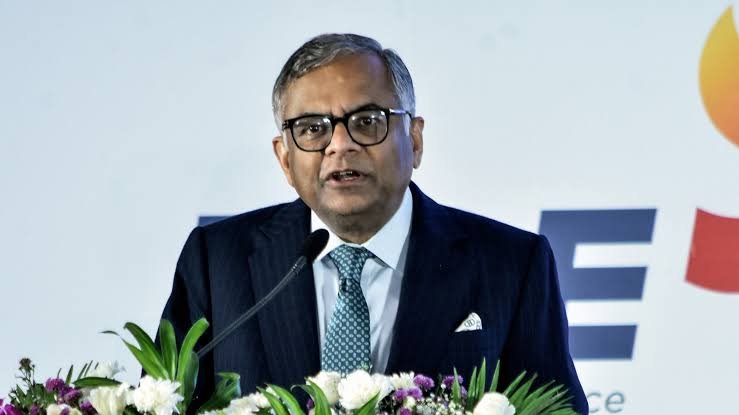
New Delhi, Oct 5: India’s economy remains strong despite global uncertainty, with domestic demand, services exports and supportive government policies driving growth, Tata Sons Chairman N Chandrasekaran said on Monday.
Speaking at the Indian Foundation for Quality Management (IFQM) Symposium 2026, Chandrasekaran said India is in a stable economic position and has consistently performed better than expectations in recent years.
He said energy security, advanced manufacturing jobs and investment in human capital will be critical for sustaining India’s economic growth over the long term.
India’s economy remains strong
Chandrasekaran said several economic indicators show that India is in a strong position. He pointed to rising demand in sectors such as automobiles, credit, electricity and cement.
He also highlighted India’s strong services exports, foreign exchange reserves and relatively healthy banking sector.
According to Chandrasekaran, India’s current account deficit has remained consistently below 1 per cent of GDP, while services exports account for around 11 per cent of GDP.
“These indicators show that India is in a stable and strong position,” he said.
He added that strong domestic consumption, growing services exports and an enabling policy environment have been important drivers of India’s economic growth.
Energy security and manufacturing jobs
Chandrasekaran said maintaining high economic growth for many years will require India to focus on key areas, particularly energy security, advanced and precision manufacturing, and human capital development.
He said India needs to create more high-quality manufacturing jobs while strengthening its industrial capabilities.
The Tata Sons Chairman also stressed the importance of building world-class infrastructure, institutions and intellectual property to support the country’s Viksit Bharat 2047 vision.
He said development must be inclusive and sustainable to achieve the long-term goals set under the vision.
Quality can drive innovation and competitiveness
Chandrasekaran cited Toyota as an example of how quality can become more than just a measure of the final product.
According to him, Toyota used quality as a driver for innovation, productivity and competitiveness.
He also pointed to Germany, where a strong focus on engineering, product standards, precision manufacturing and supplier networks helped create a competitive industrial ecosystem.
India, he said, needs a similar transformation in its manufacturing sector.
“We need such a transformation in India,” Chandrasekaran said, stressing the importance of improving manufacturing quality and competitiveness.
Push for sustainable manufacturing
Chandrasekaran also called on Indian manufacturers to make sustainable production an integral part of their manufacturing strategy.
He said sustainability, quality and productivity should be embedded in India’s broader manufacturing ambitions.
A stronger manufacturing ecosystem, he added, can create leadership not only among large companies but also among small and medium-sized businesses and other parts of the supply chain.
He said India should also develop a larger pool of experts who can contribute to domestic growth and become a global voice in shaping how products are manufactured.
Viksit Bharat 2047 and India’s long-term growth
Chandrasekaran said the Viksit Bharat 2047 vision has gained importance across different areas of the economy.
He said achieving the vision will require India to combine economic growth with sustainable and inclusive development.
Strong infrastructure, better institutions, intellectual property, skilled human capital and competitive manufacturing will play an important role in helping India achieve its long-term economic ambitions.





