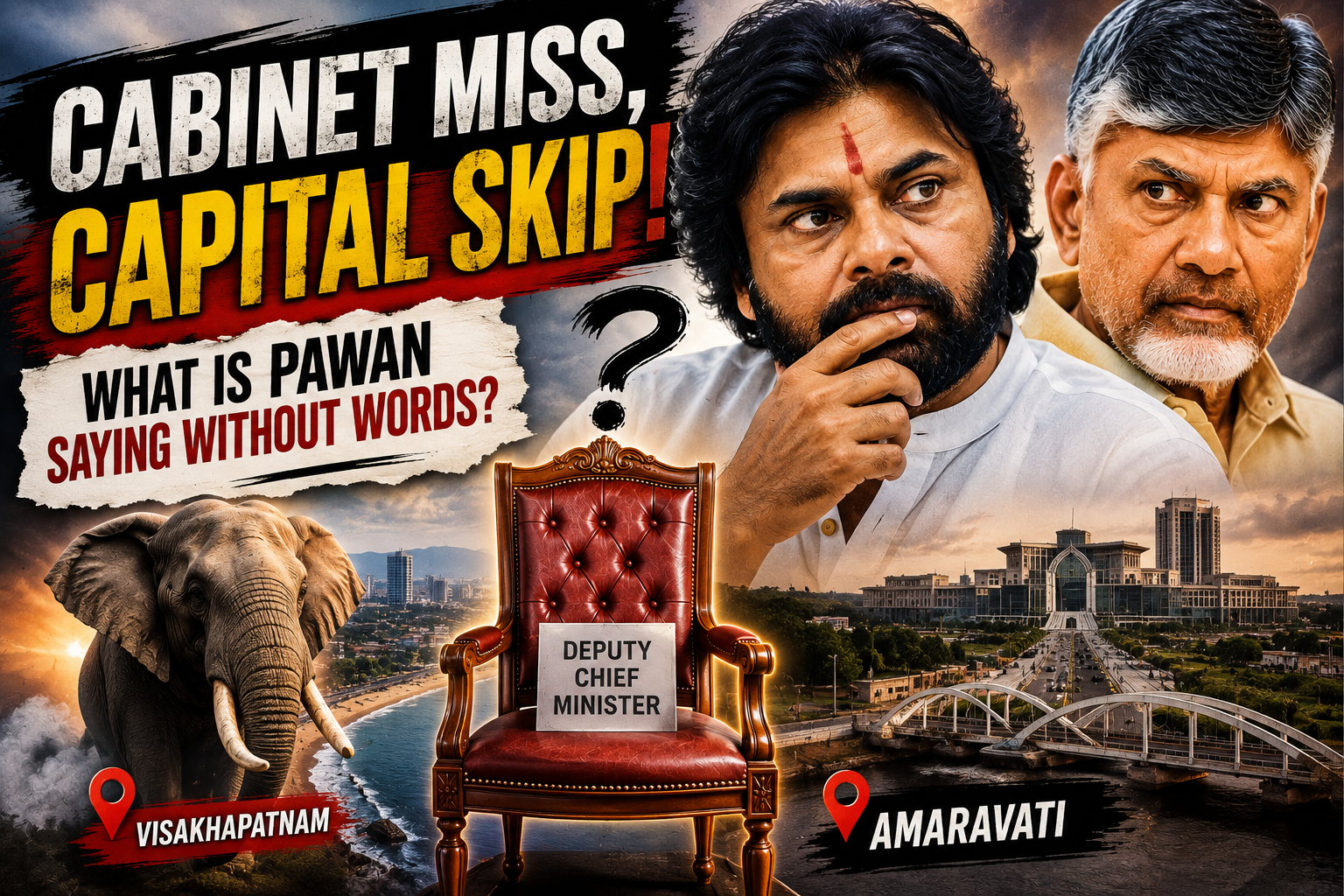
First, it was the Cabinet. Now, it is the Capital.
Every time Chief Minister N. Chandrababu Naidu appears to expect Deputy Chief Minister Pawan Kalyan beside him, it is increasingly the empty chair that seems to make the louder political statement.
Pawan Kalyan’s absence from Cabinet meetings had already become a subject of animated discussion in Andhra Pradesh’s political corridors. He has stayed away from three Cabinet meetings and, on two other cabinets, left meetings midway. Individually, each instance could perhaps be explained by schedules, departmental commitments or political engagements. Taken together, however, they have begun to look like a pattern.
Now Amaravati has entered the story.
For Chandrababu Naidu and the TDP, Amaravati is not merely another government project. It is the political centrepiece of the coalition government, an issue closely identified with Naidu himself and one that the government wants to project as the symbol of Andhra Pradesh’s future.
Yet, when Naidu inaugurated key Amaravati infrastructure, including the Seed Access Road, Steel Bridge and legislators’ quarters, his Deputy Chief Minister was nowhere around.
Pawan had chosen Visakhapatnam instead, where he participated in a programme connected with World Elephant Day.
In ordinary circumstances, a minister attending one official programme while missing another would hardly qualify as political drama. But nothing about the present sequence is quite ordinary.
What has particularly set tongues wagging is the political backstory to Pawan’s absence. Municipal Administration Minister P. Narayana reportedly went personally to Pawan Kalyan’s residence a day earlier to invite him to the Amaravati programme.
In other words, this was not an invitation lost somewhere in the bureaucracy.
Narayana knocked. Naidu waited. Pawan skipped.
And just like that, what should have been a day devoted entirely to showcasing Amaravati became another day of speculation over coalition chemistry.
The obvious question doing the rounds is: What exactly is Pawan trying to say?
Perhaps there is nothing more to it than competing engagements. But Andhra Pradesh politics rarely allows repeated coincidences to remain coincidences for very long.
One theory gaining currency concerns Nara Lokesh’s steadily expanding political profile. With Lokesh increasingly projected within TDP circles as the next-generation leader and political heir to Chandrababu Naidu, questions are naturally being asked about where that leaves Pawan Kalyan—the man whose Jana Sena played a crucial role in stitching together the coalition that came to power.
Is Pawan comfortable watching Lokesh occupy more and more of the political spotlight?
Or has Jana Sena begun to discover that there is a difference between having ministers in government and having real political space within a coalition dominated by the TDP?
Pawan holds the prestigious title of Deputy Chief Minister. But political titles acquire their real meaning from influence, access and participation in decision-making. If the Deputy Chief Minister repeatedly keeps himself away from the Cabinet table and now stays away from one of Chandrababu Naidu’s most symbolic Amaravati events, the inevitable question is whether the title is carrying less political weight than expected.
There is another layer too.
The inauguration of the legislators’ quarters comes amid charges over the sharp escalation of construction estimates and questions over expenditure. Pawan’s absence from a programme associated with a project facing such criticism has therefore generated its own whispers: was he merely unavailable, or did he prefer not to be politically associated with the occasion?
There is no definitive answer yet. That is precisely why the gossip refuses to die.
Pawan continues to discharge his departmental responsibilities. He attends programmes, conducts reviews and remains politically active. He has not disappeared from governance.
He simply appears to be missing with remarkable frequency from events where Chandrababu Naidu would most visibly expect him to be present.
That distinction is what makes the story politically interesting.
The occasional Cabinet absence can be dismissed. A second can be explained. A third attracts attention. Add midway departures, followed by a conspicuous absence from a flagship Amaravati programme despite a personal invitation from a senior minister, and even the most loyal coalition watcher begins reaching for the political calculator.
Then there is the mischievous version circulating in political gossip: is some “package” still awaiting delivery?
There is, of course, no evidence to establish such political banter as anything more than a taunt. But gossip flourishes precisely where official explanations leave space.
For now, neither Pawan nor the coalition leadership has publicly supplied a dramatic explanation capable of ending the speculation.
And so the empty chairs continue doing the talking.
Cabinet miss, Capital skip; coalition chemistry losing its grip.
Chandrababu Naidu is busy building Amaravati.
Nara Lokesh is busy building his political profile.
And Pawan Kalyan appears to be building suspense.
Perhaps, on this particular day, elephants simply proved more attractive than Amaravati.
Or perhaps those empty chairs are beginning to tell a much bigger political story.