When the Class Ten results were announced across Andhra Pradesh, something remarkable happened in the government school corridors that the TDP government would prefer the public not examine too closely. Students from government schools — the children of agricultural labourers, of daily wage workers, of families for whom private school fees are an impossible dream — were scoring 596 marks out of 600. They were outperforming expectations so dramatically that even habitual cynics about public education were forced to pause.
The TDP government, predictably, rushed to claim credit as another achievement, another proof of visionary governance and another foundation stone, this time laid not in concrete but in examination results.
But the foundation of these results was laid not by this government but by the one before it — and the evidence is written in every classroom, every school bag, every meal plate, and every digital board that the YSRCP Government installed, funded, and operationalised during its five-year tenure.
A government school student scoring 596 out of 600 in the Class Ten examination is not a statistical footnote. It is a civilisational statement — a declaration that the child of a poor family, educated in a government school that the establishment has spent decades dismissing as a last resort for those who cannot afford better, is intellectually equal to any child in any private school in the state.
That equality does not happen by accident. It does not happen because a government issued a press release. It happens because someone, at some point, decided that government school children deserved modern laboratories, digital classrooms, good food, good books, and teachers who were supported and trained properly. It happens because an education system was transformed, not announced as transformed, but actually transformed over a sustained period of investment and reform.
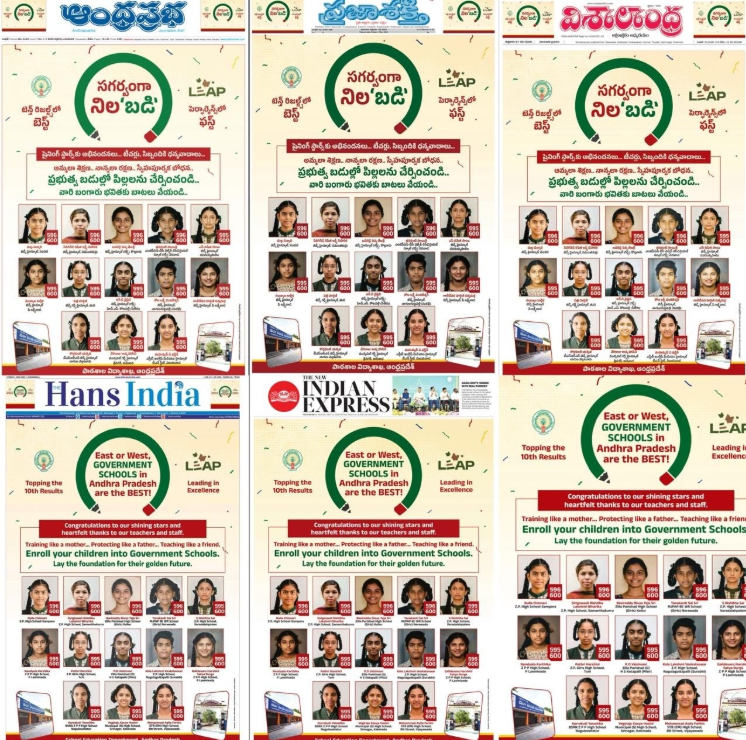
That sustained period was the YSRCP government from 2019 to 2024 and the 596-mark students of 2026 are its most eloquent testimony.
What YSRCP Actually Built: The Infrastructure of Excellence
To understand what YSRCP transformed, it is necessary to understand what it inherited. The 2014-19 TDP government presided over government schools in a condition that the newspaper describes plainly: basic facilities were absent, infrastructure was deteriorating, and the educational outcomes reflected this neglect. Government schools were losing students to private schools at an accelerating pace — not because parents preferred private education ideologically, but because government schools had failed to provide the basic quality that made them a credible option.
The results from that period tell their own story. The correlation between the TDP years and declining government school outcomes, and between the YSRCP years and improving outcomes, is no coincidence. It is a consequence.
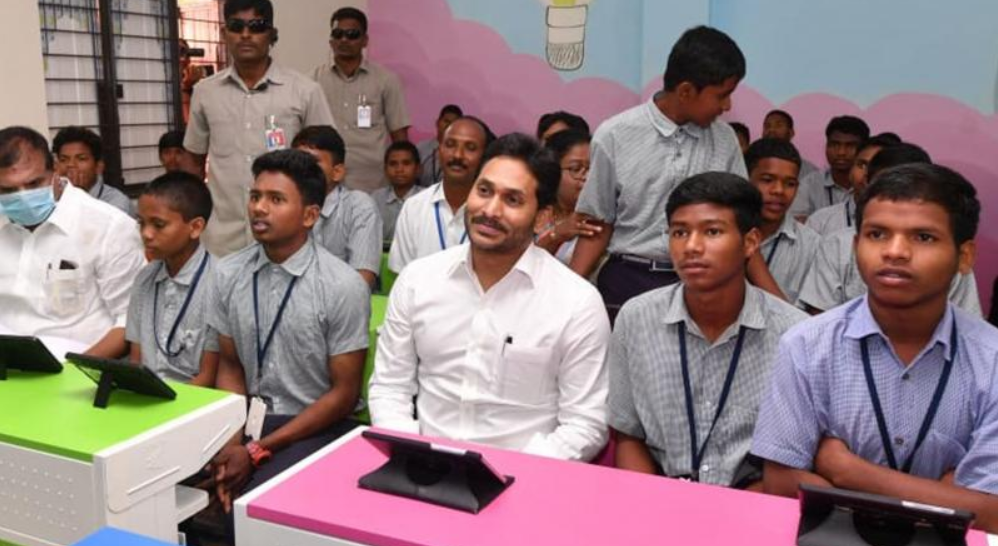
Modern laboratories and digital boards: Government schools across Andhra Pradesh received state-of-the-art laboratories and digital smart boards during the YSRCP tenure. The student who scored 596 did not do so by reading from a crumbling blackboard in a leaking classroom. She did so in a school that had been physically transformed — new infrastructure, functional equipment, technology that made abstract concepts visible and engaging.
English medium, CBSE and IB syllabi, tablets: The YSRCP government introduced English medium instruction, aligned syllabi with CBSE and IB standards, and provided tablets to students — decisions that were controversial when announced but whose educational dividend is now visible in the examination results. Children from government schools are no longer studying from a curriculum designed to produce functional literacy. They are studying from curricula designed to produce competitive excellence.
Gorumudda mid-day meal programme: The connection between nutrition and learning outcomes is one of the most robustly established findings in education research. A child who is hungry cannot concentrate. A child who eats a nutritious, hot midday meal — freshly prepared and served with dignity — can. The Gorumudda programme, which provided quality midday meals to government school children, was not merely a welfare scheme. It was an educational investment whose returns show up in examination performance.
Jagananna Vidya Kanuka — the school kit: Every government school student received a complete school kit under this programme — bag, books, stationery, uniform, shoes. The significance of this is not merely material. It is psychological. A child who arrives at school with a complete, new kit feels that the system has invested in her. That feeling of being valued — of being seen as worthy of investment — translates into engagement, attendance, and performance.
₹15,000 under Amma Vodi: Mothers of school-going children received ₹15,000 directly into their bank accounts to support their children’s education. This direct cash transfer addressed one of the primary reasons children drop out of government schools: the economic pressure that pulls them toward work rather than study. By putting money directly into mothers’ hands, the scheme created a tangible financial incentive for school attendance and completion.
Results: 596 marks. Not despite government education but because of it.
The 596 Marks Belong to the Student — And to Those Who Invested in Her
Let us be clear about one thing above all others. The 596 marks belong first and foremost to the student who earned them — to her intelligence, her discipline, her hours of study, and her determination to excel despite the economic circumstances into which she was born.
But they also belong, in a very real sense, to the system that supported her. To the teacher who taught in a properly equipped classroom. To the midday meal that kept her focused through the afternoon. To the kit that meant she arrived at school with everything she needed. To the Amma Vodi payment that meant her mother could keep her in school rather than sending her to work. To the digital board that made the periodic table comprehensible rather than abstract.
That system was built between 2019 and 2024. It was built by a government that is now in opposition. And the current government, which has been busy renting offices in Amaravati, giving away prime land to corporations, arresting comedians, and borrowing ₹523 crore every single day, did not build it. The 596 marks are YSRCP’s educational legacy, expressed in a child’s examination score.
Results Are the Most Honest Testimony
Political credit is always contested. Every government claims the achievements of its predecessor, minimises its failures, and attributes current problems to those who came before. This is the universal grammar of incumbency.
But examination results have a quality that makes them resistant to spin. They are produced by specific children, in specific schools, under specific conditions that were built over specific years. The teacher who taught with the digital board knows when it arrived. The student who ate Gorumudda knows whose name was on the programme. The mother who received ₹15,000 under Amma Vodi knows whose government sent it.
596 marks, 596 reasons to ask the current government: what exactly did you contribute to this?
596 reasons to acknowledge what the YSRCP government built — in labs, in digital boards, in midday meals, in school kits, in Amma Vodi payments that made this possible.
The children of Andhra Pradesh’s government schools are succeeding. They deserve a government that will build on what works rather than rebrand it and an honest public record that credits those who actually did the building.