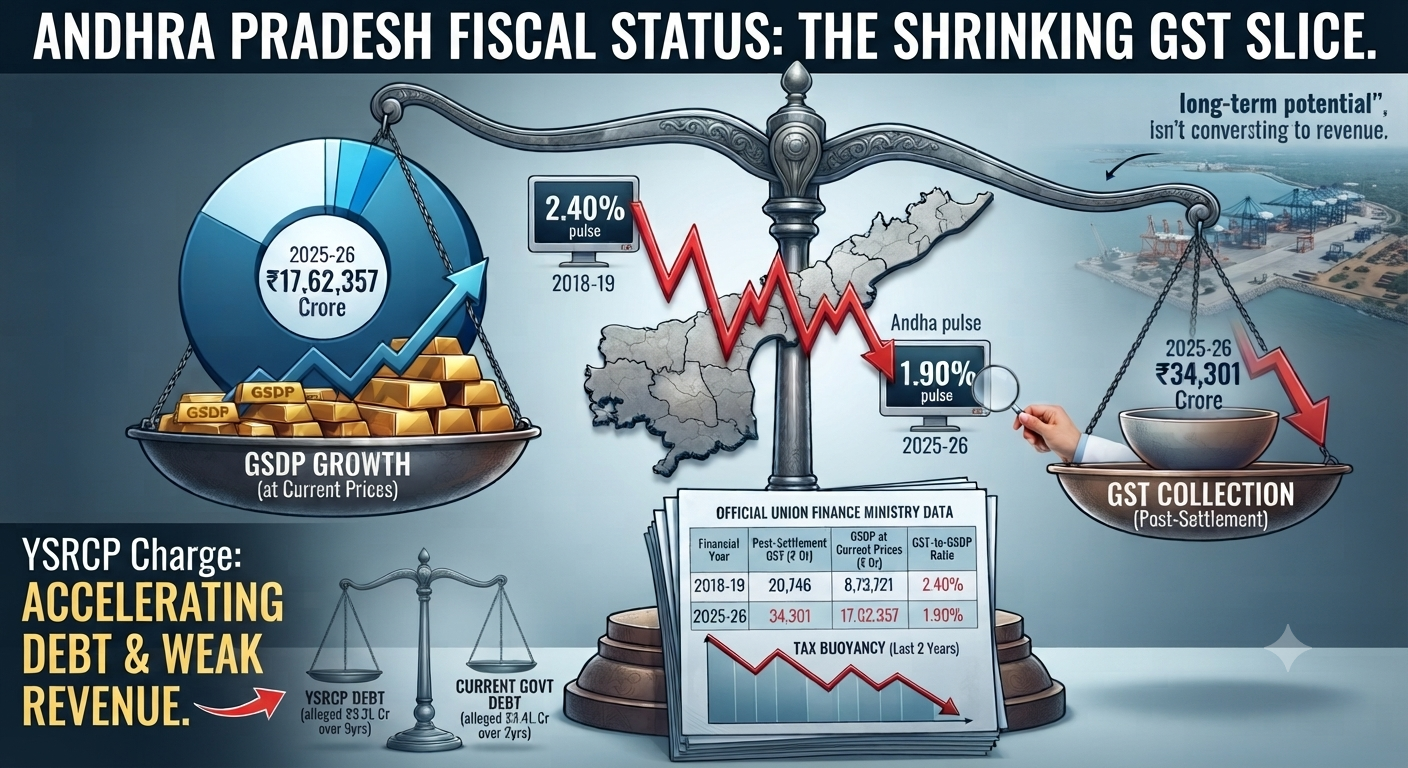
There is a number that finance officials watch the way a doctor watches a pulse: the share of a state’s economy that actually shows up as tax. For Andhra Pradesh, that pulse has weakened.
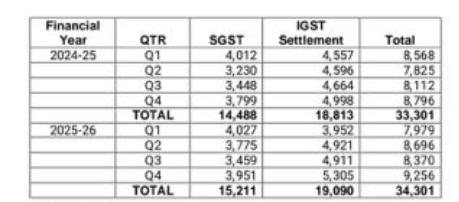
According to a written reply the Union Finance Ministry placed before the Lok Sabha this week, the state’s post-settlement GST-to-GSDP ratio has slipped from 2.40 percent in 2018-19 to 1.90 percent in 2025-26. In absolute terms the GST collection has risen from ₹20,746 crore to ₹34,301 crore — but the economy on paper has grown faster. A thinner slice of a larger pie is reaching the treasury.
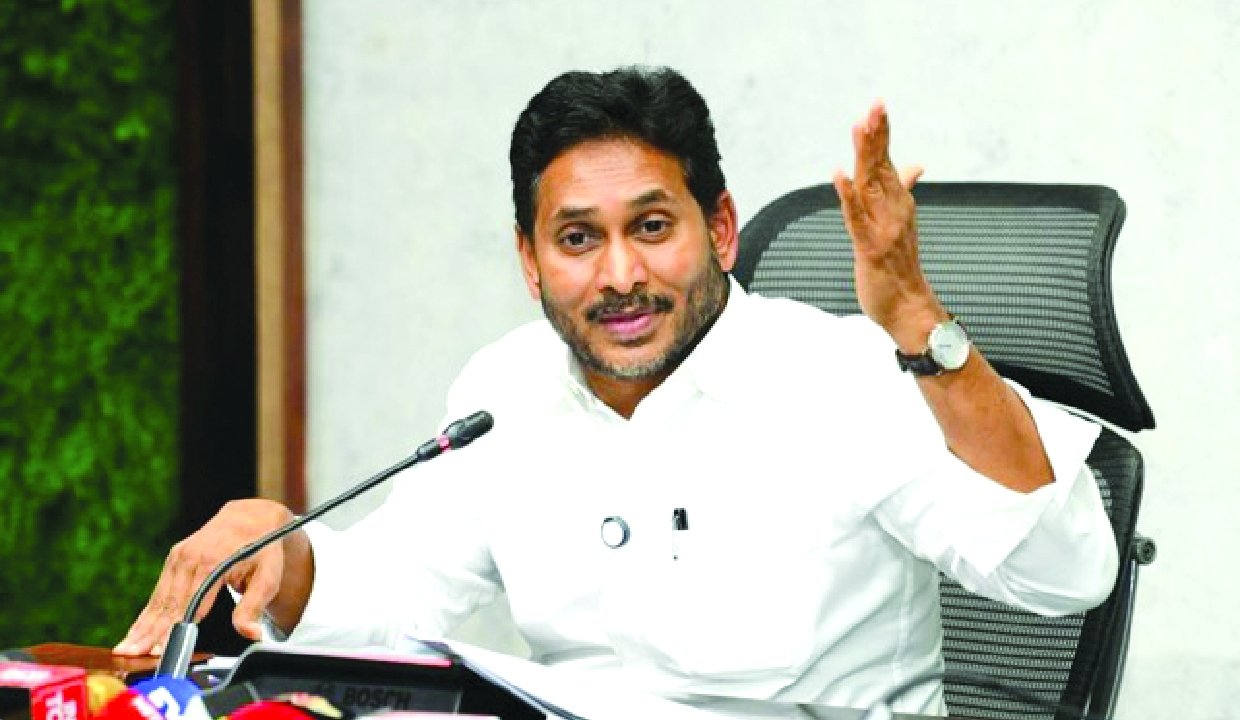
The question was asked by YSRCP MP YS Avinash Reddy. The answer, from Minister of State Pankaj Chaudhary, has become political ammunition.
The Opposition’s Charge
YSRCP leaders, led by former Finance Minister Buggana Rajendranath Reddy, have turned the figure into a political weapon. Their case rests on three pillars:
- Weak tax buoyancy — Own tax revenue growth has slowed to around 1.97%, ranking Andhra Pradesh 22nd among states, behind even smaller economies such as Sikkim and Meghalaya.
- Negative revenue growth — Between 2024-25 and 2025-26, the state’s own tax revenues are claimed to have contracted by approximately 3.22%.
- Accelerating debt — The current government is alleged to have borrowed nearly ₹3.4 lakh crore in just two years almost equal to the ₹3.3 lakh crore accumulated by the YSRCP government over five years.
- By contrast, he says, the YSRCP kept the average fiscal deficit at 2.5–2.6 percent even through Covid, and debt grew at a compound annual rate of only 13.5 percent between 2019 and 2024 far below the 22.6 percent he attributes to the TDP’s 2014-19 tenure.
The story he tells is simple and damning: an economy that looks impressive in headline GSDP numbers but leaks where it counts a widening gap between the size of the economy and the tax it yields, revenue going backwards, and borrowing racing ahead to fill the hole.
The Numbers in Full
| Financial Year | Post-Settlement GST (₹ Cr) | GSDP at Current Prices (₹ Cr) | GST-to-GSDP Ratio |
|---|---|---|---|
| 2017-18 | 10,826 | 7,86,135 | 1.40% |
| 2018-19 | 20,746 | 8,73,721 | 2.40% |
| 2019-20 | 20,346 | 9,25,839 | 2.20% |
| 2020-21 | 19,181 | 9,78,581 | 2.00% |
| 2021-22 | 24,333 | 11,31,629 | 2.20% |
| 2022-23 | 28,589 | 13,07,976 | 2.20% |
| 2023-24 | 31,606 | 14,23,900 | 2.20% |
| 2024-25 | 33,301 | 15,91,226 | 2.10% |
| 2025-26 | 34,301 | 17,62,357 | 1.90% |
The ratio peaked early, held relatively steady for several years, and has now slipped to its lowest level since the first full year of GST.
What the Decline Actually Means
A falling GST-to-GSDP ratio is not automatic proof of failure. It can result from:
- Faster nominal GSDP growth outpacing tax collections
- Structural shifts toward less GST-intensive sectors
- Changes in the tax mix or compliance patterns
- Genuine shortfalls in collection efficiency
Yet the trend is unmistakable. When a smaller share of economic activity reaches the treasury, the state becomes more dependent on borrowings. High debt service then crowds out capital expenditure and developmental spending — precisely the opposite of what a high-growth state needs.
The Larger Fiscal Picture
Andhra Pradesh’s challenges do not stop at GST. Outstanding liabilities hover around 35–36% of GSDP, fiscal deficits have repeatedly exceeded 15th Finance Commission targets, and revenue deficits remain elevated. These indicators, taken together, point to a fiscal structure under strain.
Infrastructure strengths particularly the port assets developed in earlier years continue to offer long-term potential. But potential does not automatically convert into revenue. Without stronger tax buoyancy and tighter expenditure control, the state risks growing larger on paper while remaining fiscally constrained in practice.
Conclusion
The declining GST-to-GSDP ratio is not a technical curiosity. It is a warning light on the dashboard of Andhra Pradesh’s public finances. Yet the core anxiety remains legitimate. When the share of the economy that turns into spendable tax keeps shrinking, the state becomes more dependent on borrowing. And when borrowing accelerates while revenue growth stalls, the fiscal space for genuine development narrows.
An economy that grows without converting that growth into reliable tax revenue is not an engine that revs without delivering power to the wheels. The numbers do not yet pronounce a final verdict. They do, however, demand urgent attention before the pulse weakens further.