
A World Bank delegation recently visited construction sites and labour camps in Amaravati and laid bare glaring negligence by contracting agencies. Inspectors discovered an inadequate workforce deployed across projects under the Andhra Pradesh Capital Region Development Authority (APCRDA) and the Amaravati Development Corporation Limited (ADCL).
The conditions they found at labour camps were not the conditions of a government committed to worker welfare. The World Bank team identified the following major issues: lack of minimum facilities for migrant workers from other states; labourers made to stay in tin-shed shelters during peak summer; shortage of drinking water, toilets and shaded areas; and delayed payment of wages.
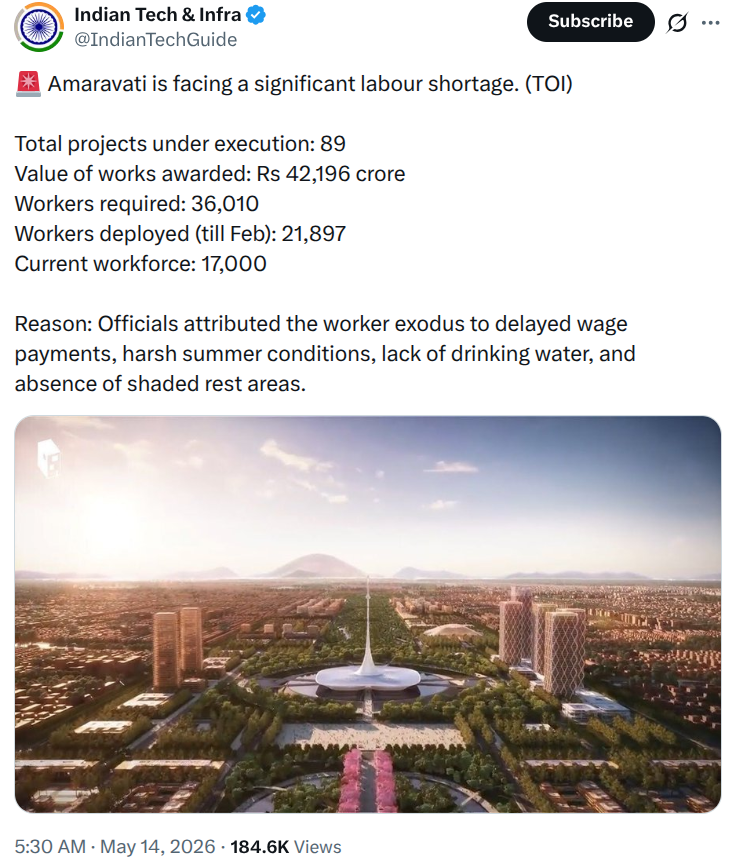
The delay in wage payments has further added to workers’ frustration, forcing several labourers to leave the project sites. The consequences are already showing — workers are reportedly falling sick and walking off sites, while fresh labourers are expressing reluctance to step in and fill the void.
This is the human cost behind Amaravati’s construction numbers. Workers, most of them migrant labourers from other states, many from economically distressed communities sitting in tin sheds in the Andhra summer without adequate water, without shade, without toilets, and without the wages they were promised. In a state where the Chief Minister speaks of worker welfare at international forums, this is what workers at his signature project are actually experiencing.
The Numbers That Don’t Add Up
A total of 89 projects are currently under execution in Amaravati, with the value of works already awarded standing at ₹42,196 crore. For these projects, around 36,010 workers are required. However, only 21,897 workers had been deployed till February — and the current workforce has since dropped further to around 17,000, creating a serious gap between requirement and availability.
Contract conditions mandate a minimum of 22,000 workers, with some estimates suggesting the actual requirement, including technicians and skilled labourers, is closer to 30,000. The contractors had claimed in their reports that more than 20,000 workers had been deployed. But representatives of the World Bank and APCRDA reportedly found that the actual number was not even 17,000.
The machinery situation is equally alarming. While reports indicate that 3,600 vehicles and pieces of equipment are needed, only around 1,100 are currently operational — less than a third of the required capacity, directly contradicting contractor claims and exposing the gulf between what is being reported and what is actually happening on the ground.
These are not minor discrepancies. They represent a systematic pattern of misrepresentation by contracting agencies — agencies that are executing projects worth tens of thousands of crores of public and borrowed money, and that appear to be filing inflated workforce figures while running sites at a fraction of required capacity.
The World Bank’s Warning and Its Leverage
The World Bank is not merely an observer of this crisis. It is a creditor with conditions attached to its money, and it has begun using those conditions as leverage.
Under the loan terms, strict monitoring is being enforced across labour welfare, occupational health and safety, and labour influx management. Fund releases through Disbursement Linked Indicators are directly tied to progress and adherence to worker welfare standards. Through this review mechanism, the World Bank has effectively pressured the contractors, pushing for improved facilities for labourers and skill-training opportunities for local workers.
In plain terms: if contractors do not fix the labour camps, improve worker conditions, and bring workforce numbers up to contracted levels, the World Bank can withhold disbursements. For a project that depends critically on this funding, that is not an abstract threat. It is an existential one.
The government has reportedly asked contractors to boost local recruitment. Whether those instructions are being followed — or whether they will join the long list of Amaravati commitments that have been made and not enforced remains to be seen.
What Is at Stake
The stakes are high. If left unaddressed, impediments such as work delays, escalating costs and slipping quality standards risk undermining Amaravati’s larger ambition of generating 50,000 jobs in construction, agro-processing and service sectors.
A capital city built on the back of exploited migrant workers, unpaid wages, and falsified workforce reports will not be the Singapore that Chandrababu Naidu promised. It will be a monument to the gap between what this government says and what it does — between the brochure and the reality, between the investor summit and the tin shed in the summer heat.
The only long-term solution lies in providing skill training to local youth, women and landless labourers and integrating them into the construction sector. But skill training takes time, commitment, and funding that must be consistently prioritised — not announced at press conferences and forgotten in implementation.
The World Bank has delivered its warning. The sites have delivered their verdict in the form of empty boots and abandoned tools. The question now is whether the Andhra Pradesh government has the will to treat the workers building its dream capital as human beings deserving of fair wages, safe conditions, and clean water — or whether Amaravati will continue to rise on the invisible suffering of the people the government has chosen not to see.