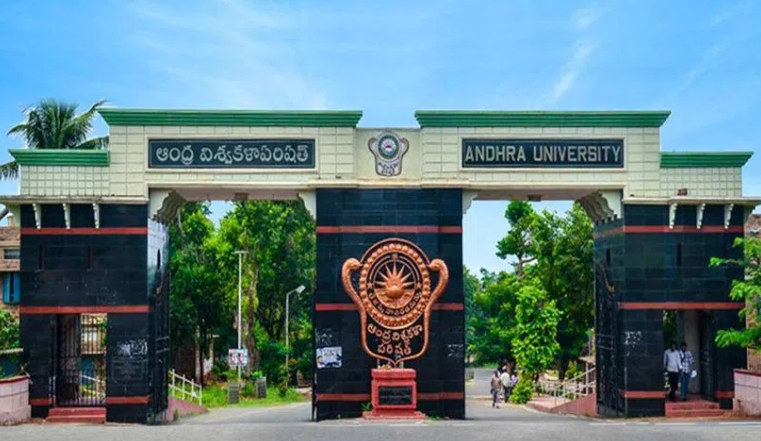
When the institutions that are meant to protect fail, it falls to constitutional bodies to act. That is precisely what has happened at Andhra University, Visakhapatnam — one of Andhra Pradesh’s oldest and most prestigious academic institutions, where a Dalit research scholar has been subjected to what the National Commission for Scheduled Castes (NCSC) has formally described as harassment and caste-based discrimination, prompting the Commission to directly intervene with a strongly worded notice to the university’s Vice Chancellor.
The case has sent shockwaves through academic and Dalit rights circles, with Dalit organisations and student groups expressing deep outrage. The National Commission for Scheduled Castes — a constitutional body established under Article 338 of the Constitution of India has now entered the field, making the matter a national-level concern that the university and the Andhra Pradesh government can no longer afford to brush aside
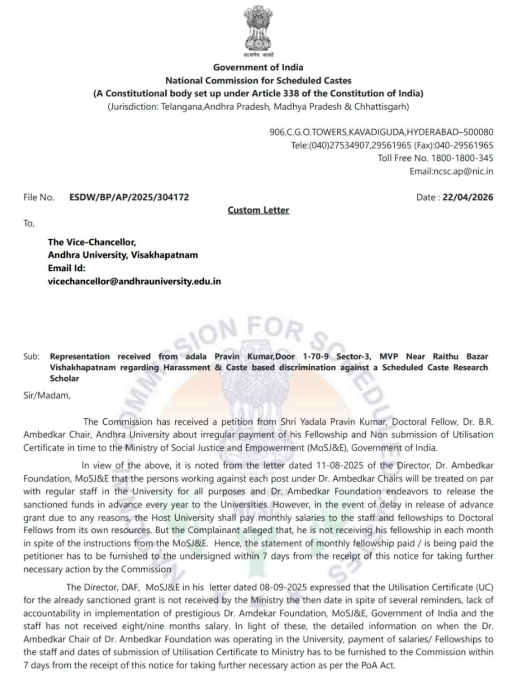
The complainant is Yadala Pravin Kumar, a Doctoral Fellow conducting research under the Dr. B.R. Ambedkar Chair at Andhra University, Visakhapatnam. His residential address is listed as Door No. 1-70-9, Sector-3, MVP Near Raithu Bazar, Visakhapatnam.
The complaint, filed with the NCSC, documents two interconnected failures by the university:
First, the irregular and delayed payment of his monthly fellowship, which is funded by the Dr. Ambedkar Foundation under the Ministry of Social Justice and Empowerment (MoSJ&E), Government of India, and is meant to be paid every month without fail.
Second, the non-submission of the Utilisation Certificate by the university to the Ministry — a bureaucratic failure that has cascading consequences, directly blocking the release of funds and leaving the scholar unpaid for extended periods.
According to the NCSC’s formal letter dated April 22, 2026, addressed to the Vice Chancellor of Andhra University, the scholar has not been receiving his fellowship each month despite clear instructions from the MoSJ&E. The Ministry’s own letter dated August 9, 2025, reportedly expressed that the Utilisation Certificate for the already sanctioned grant had not been received despite several reminders. As a result, the staff and doctoral fellows under the Dr. Ambedkar Chair had not received eight to nine months of salary.
Caste Discrimination in Academia: A Systemic Failure
This case at Andhra University is not isolated. It is part of a documented pattern of caste discrimination in Indian higher education institutions that has claimed lives — from Rohith Vemula at the University of Hyderabad in 2016 to numerous cases since — and continues to deny Dalit scholars the dignity, safety, and financial security that their non-Dalit peers take for granted.
The specific mechanism here — the deliberate or negligent withholding of fellowship payments, the failure to submit Utilisation Certificates, the refusal to bridge-fund from university resources as required is a form of institutional violence. It does not require a slur or a physical act to constitute caste discrimination. When a university systematically fails to implement protections specifically designed for Scheduled Caste scholars, while those scholars watch their non-SC peers receive their salaries on time, the discrimination is structural, pervasive, and real.
Dalit organisations and student groups have expressed strong outrage and are calling for immediate action. The university’s failure to respond to the Ministry’s reminders over months suggests not oversight but indifference — an institutional culture in which Ambedkar’s name on a chair is acceptable, but his community’s rights in practice are not.
The NCSC has given Andhra University seven days to provide a full account. The state government, which oversees this institution, has a much longer reckoning ahead.
A thorough inquiry into all unpaid fellowship periods and immediate release of all pending dues to Pravin Kumar and any other scholars in similar situations. Strict action against university officials responsible for the non-submission of Utilisation Certificates — a dereliction that directly caused the Ministry’s funding delays. Registration of a case under the SC/ST (Prevention of Atrocities) Act, as the NCSC’s letter to the Police Commissioner recommends. Systemic review of how all Dr. Ambedkar Chair scholars are being treated at Andhra University and across Andhra Pradesh’s universities.
The NCSC’s intervention is constitutionally significant and institutionally necessary. But it is also, in its own way, an indictment — because a Dalit doctoral scholar at one of AP’s premier universities should not need a national commission’s letter to receive a fellowship he was promised, for research conducted under a chair named after the father of India’s Constitution.