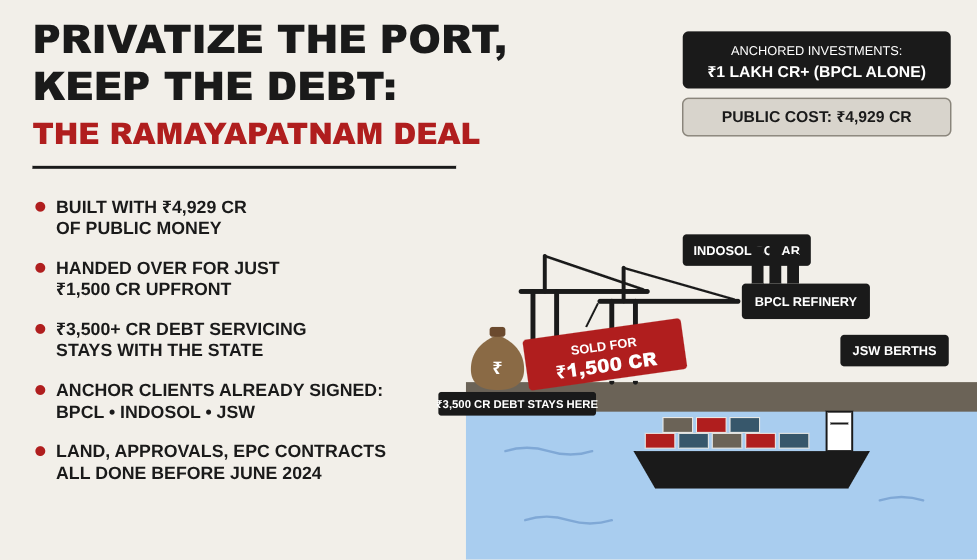
Every once in a while a government transaction can be captured in a single arithmetic sentence, and the proposed Ramayapatnam deal is one of them: Ramayapatnam is one of the four new ports being developed by the Andhra Pradesh government to expand capacity to 400 MT a year from 110 MT a year. The state spent ₹4,929 crore of public money building a deep-water port; it now proposes to hand that port to private parties for an upfront payment of ₹1,500 crore; and it will continue to service more than ₹3,500 crore of the debt raised to build what it no longer controls.
The public paid to build it. The public will keep paying for it. And a private operator will collect the revenues from it. If a household sold its house for a third of the construction cost while volunteering to keep paying the builder’s loan, no one would call it disinvestment. They would call the family a victim — or ask who in the family arranged the deal, and what they got for arranging it.
A port that was already working
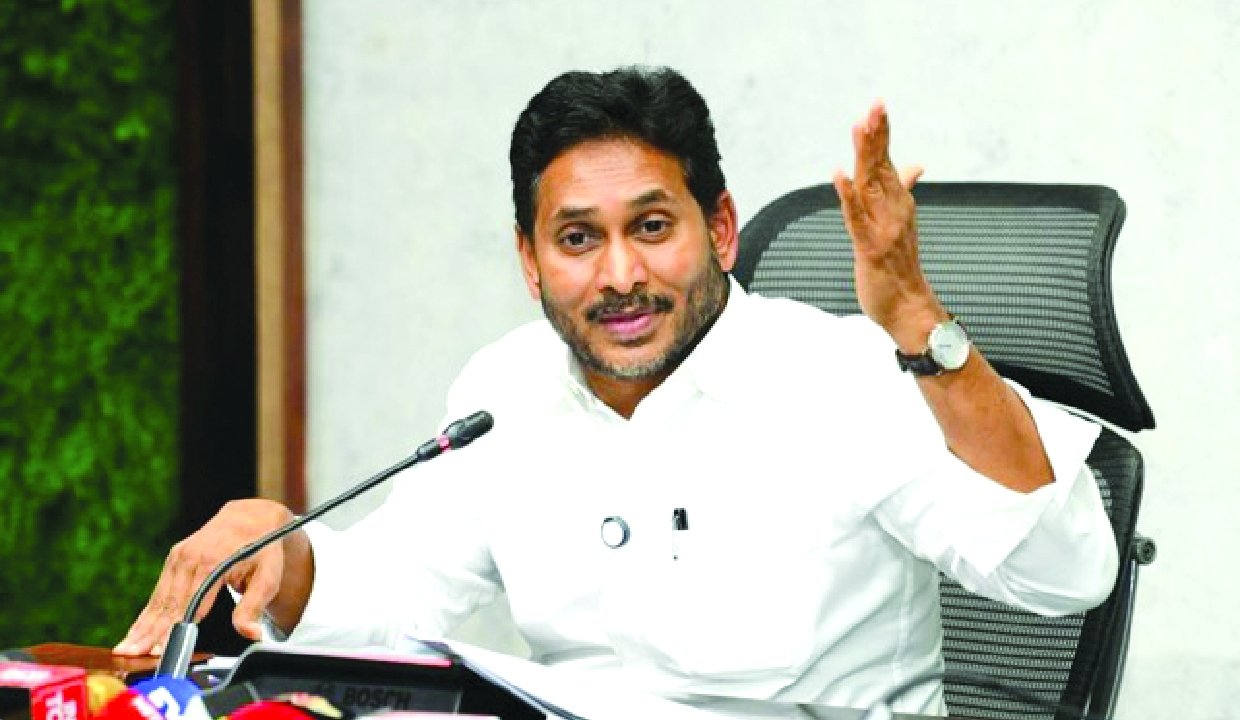
What sharpens the outrage is that Ramayapatnam is not a distressed asset being offloaded for lack of prospects. YSR Congress Party (YSRCP) president and former Chief Minister Y. S. Jagan Mohan Reddy has alleged that the Andhra Pradesh government’s proposed disinvestment of the Ramayapatnam Port would result in substantial financial losses to the State and undermine the project’s long-term economic potential; an asset whose future revenues were already visibly locked in before the handover was conceived.
Consider what has gathered around the port. BPCL chose the site for its greenfield refinery and petrochemical complex a 9–12 MMTPA facility with an investment upward of ₹1 lakh crore, precisely because the port’s deep-water draft can bring in crude. Indosol Solar is building its integrated “quartz-to-module” giga-scale plant nearby because the port is its artery for importing raw material and exporting finished modules. JSW Steel is constructing two berths inside the port itself, to move the iron ore and coking coal that will feed its Kadapa steel plant. Each of these anchors guarantees cargo; guaranteed cargo means guaranteed port revenue; and guaranteed revenue means the asset’s value was set to compound in public hands.
That value did not appear by accident. The land was procured, the statutory approvals secured, financial closure achieved, EPC contracts executed, and substantial construction completed before June 2024 the unglamorous, expensive groundwork done under the previous government. The hard part, in other words, is finished. What remains is the profitable part. It is exactly this part the harvest, after the public paid for the sowing that the TDP government proposes to transfer.
Who benefits from selling low?
A government can legitimately bring in private operators; concession models exist the world over. But legitimacy has a shape: a transparent valuation, competitive bidding, and terms under which the public recovers its investment. The deal as described inverts each element. The upfront payment covers less than a third of what the public spent. The debt stays with the exchequer. And the beneficiaries, the opposition alleges, are not distant institutional investors but parties connected to the ruling establishment — the port converted, in Jagan’s words, into a machine “to generate cash flows for the bigwigs of the TDP.”
That allegation will be contested, as it should be. But the government can dissolve it only by answering questions it has so far avoided. What independent valuation supports ₹1,500 crore for an asset that cost ₹4,929 crore and anchors over a lakh crore of committed downstream investment? Why does the debt not travel with the asset? What revenue share, if any, does the state retain from the BPCL, Indosol, and JSW cargo that its own groundwork attracted? Until those numbers are published, “development” is a word doing the work that a tender document should.
The pattern completes itself
Place Ramayapatnam beside the episodes that preceded it — the 63 acres near Sri City allotted to a company that did not exist, at a fraction of market value, through a Maritime Board with no business handling it — and a governing method comes into focus: public assets moving into private hands, quickly, cheaply, and through routes engineered to avoid scrutiny. Each deal is defended as investment promotion. Each deal’s arithmetic says otherwise.
Ports were supposed to be the bifurcated state’s compensation — the long coastline turned into the engine Hyderabad’s loss demanded. The previous government’s wager was that publicly built ports would seed private industry around them, and Ramayapatnam proved the wager right: the refinery came, the solar plant came, the steel berths came. The current government’s contribution is to sell the engine just as it starts to run, at a loss, while keeping the fuel bill.
Disinvestment Terms are against the State Prospects. The people of Andhra Pradesh only need to do the subtraction: 4,929 minus 1,500, with 3,500 crore of debt still on their side of the ledger. The answer isn’t political. It’s arithmetic.