Somewhere between the LG Electronics site and the ground being readied for Royal Enfield, opposite the humming industrial sprawl of Sri City, lie 63.01 acres of some of the most coveted industrial land in Tirupati district. Land like this by the estimates, trades at valuations that put the parcel’s open-market worth above ₹252 crore.
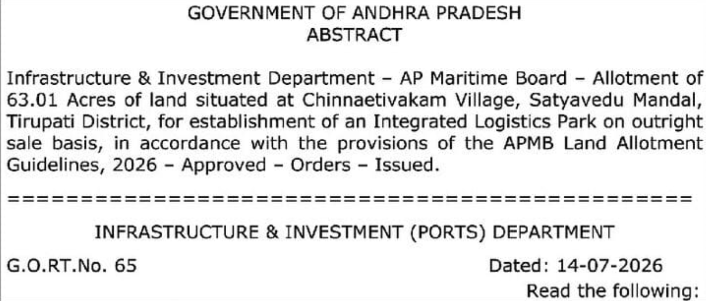
On July 14, 2026, the Government of Andhra Pradesh sold it outright for ₹17.64 crore to a company called Nexus Integrated Logistics Park. That is ₹28 lakh an acre, a fraction of what the plots around it command.
A GO for a company that appears nowhere in the Registrar of Companies
Government Order RT No. 65 of the Infrastructure & Investment (Ports) Department is a remarkable document even by the standards of Andhra’s land politics. It allots 63.01 acres at Chinnaetivakam village, Satyavedu mandal, to an entity that appears nowhere in the Registrar of Companies is nonetheless real enough, in the government’s eyes, to receive a quarter-billion rupees’ worth of land.
Nor do the promoters behind the proposal bring deep pockets, the article says. Of the ₹255-crore project cost, ₹165.75 crore nearly two-thirds is to be borrowed from banks; the four individuals behind it would put up ₹89.25 crore themselves. The government’s own order, per the report, acknowledges the loan-funded structure. Strip away the paperwork and the transaction reads simply: prime state land, sold cheap, to a yet-to-be-incorporated venture that will mortgage its way into existence.
The wrong board, the right connections
Then there is the question of who is doing the selling. Land for industrial units in Andhra Pradesh flows through APIIC, the state’s industrial infrastructure corporation. That is its entire purpose. Chinnaetivakam is nowhere near a port; the parcel sits in the middle of an industrial corridor.
Yet the allotting authority here is the AP Maritime Board — a body whose writ runs to ports and coastal infrastructure, and which, the article notes, does not even possess the land it has allotted. Acquisition is incomplete. The order, in effect, promises to acquire land specifically so it can be handed to the phantom company, under freshly minted “APMB Land Allotment Guidelines, 2026” that conveniently authorize the route.
Why would a maritime board sell inland logistics land? The article’s answer is blunt: its chairman, a TDP leader from Prakasam district, is alleged to have business ties with one of the two promoters who pitched the proposal. Senior officials, speaking privately, are quoted describing the arrangement as one entity’s scheme to capture the parcel routed around APIIC precisely because the normal channel would have invited normal scrutiny, competitive process, and market pricing.
These are allegations, and the individuals named deserve the chance to answer them. But the questions they raise do not require proof of intent to be damning. Why an outright sale rather than a lease? Why ₹28 lakh an acre beside Sri City? Why the Maritime Board? Why a GO before incorporation, before acquisition, before due diligence that a search engine could have performed in seconds?
A pattern wearing a new disguise
The Chandrababu Naidu government came to power promising transparent, investment-led development “Speed of Doing Business” as governance philosophy. But speed, this episode suggests, can also be a method: move fast enough, through an obscure enough agency, and a ₹252-crore parcel becomes a ₹17-crore afterthought before anyone asks questions.
Every government courts industry with land. The legitimate version involves an existing company, a competent agency, a transparent price, and enforceable commitments on investment and jobs. Invert each of those a non-existent company, the wrong agency, a throwaway price, a loan-financed promise and what remains is not industrial policy. It is patronage with a project report attached.
If the government believes this deal serves the public, the remedy is easy: publish the valuation, explain the Maritime Board’s role, disclose the promoters’ credentials, and put the parcel through APIIC’s standard process. Until it does, the people of Andhra Pradesh are entitled to read GO RT No. 65 as the latest chapter in a very old story, in which the state’s most valuable acres find their way, quietly and cheaply, to friends of the men in power.