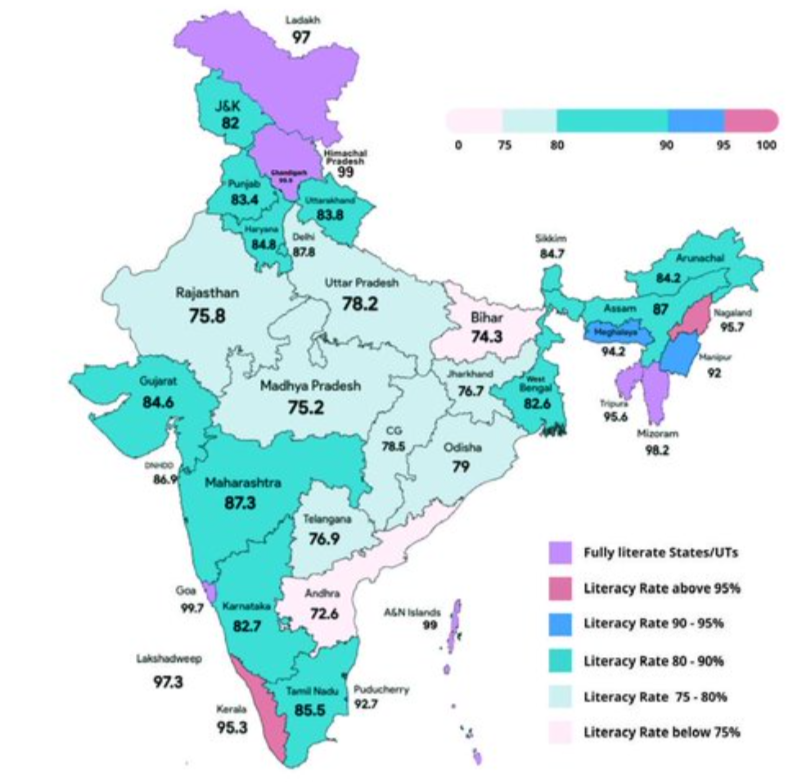
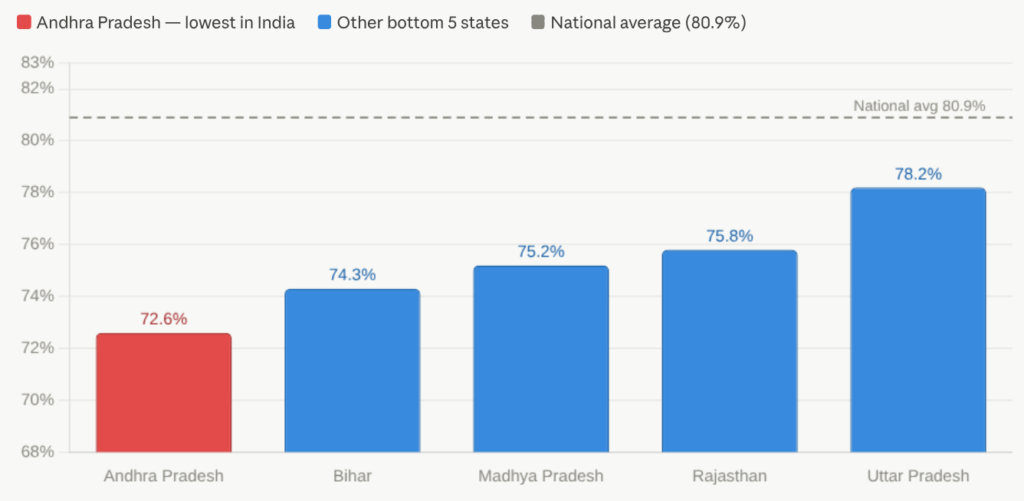
According to the Ministry of Education, India’s National Average Literacy Rate stands at 80.9%. In comparison, Andhra Pradesh remains the lowest in the country, standing 8.3 percentage points below the national average at 72.6%, far below the most populous states of Bihar (74.3%) and Uttar Pradesh (78.2%). AP is the only southern state in the bottom five, making its position especially stark among its better-performing neighbours like Kerala (95.3%), Tamil Nadu (85.5%), and Karnataka (82.7%).
When YS Jagan Mohan Reddy walked into the Chief Minister’s office in June 2019, he inherited an education system that Chandrababu Naidu had spent five years polishing for the cameras and neglecting on the ground. The numbers were unsparing. Andhra Pradesh’s literacy rate at the end of TDP’s tenure in FY 2018-19 stood at a mere 69.1% in a state that Naidu had spent half a decade projecting to the world as a technology powerhouse, an investment magnet, a future Singapore. The contradiction where a chief minister who spoke about artificial intelligence and smart cities presided over a state where nearly one in three citizens could not read or write.
Naidu had made promises as spectacular as his failures. In 2018, Chandrababu Naidu publicly targeted 100% literacy for Andhra Pradesh by 2019 — a target so detached from ground reality that it reads less like governance and more like performance. The 2011 Census had placed AP’s literacy at 67.66%. By 2018-19, after five years of TDP rule, it had crawled to 69.1%. That is barely 1.4 percentage points of improvement in half a decade. The 100% target was not a plan. It was a press release.
What YSRCP Actually Did
Jagan did not just hold press conferences about literacy but built schools. The flagship programme was Nadu-Nedu — a systematic, phased renovation of government schools across all districts of Andhra Pradesh. Not branding exercises. Not cloud classrooms without electricity. Actual physical infrastructure: repaired buildings, functioning toilets, clean drinking water, furniture, and laboratories.
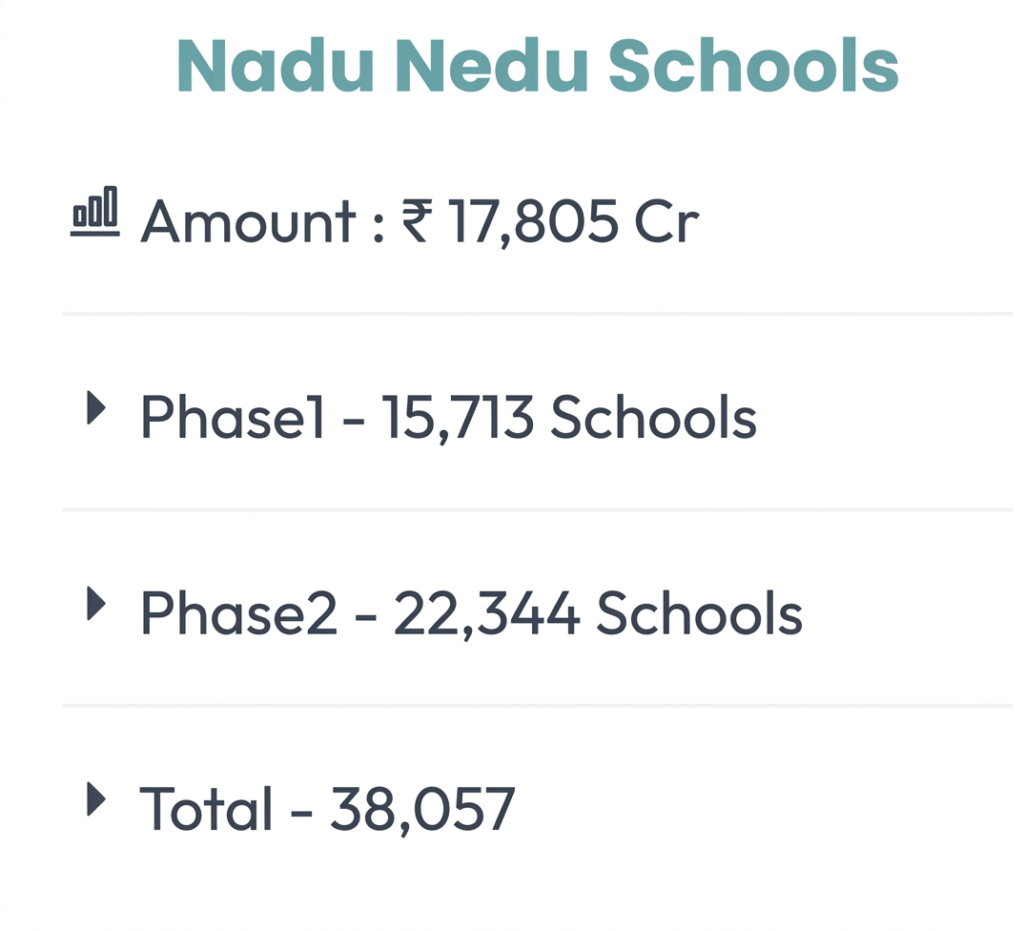
Over 38,000 government schools were transformed in the first two phases alone, at a cost the TDP opposition initially mocked and subsequently could not bring itself to dismantle when it returned to power.
Then came Amma Vodi — perhaps the single most consequential education welfare programme in AP’s post-bifurcation history. Under this scheme, mothers below the poverty line received ₹15,000 annually in direct cash transfers, conditional on sending their children to government schools. The results were not theoretical. Student enrolment in government schools improved from 63.2% to 71% during the YSRCP period — nearly 8 percentage points, representing hundreds of thousands of children from the poorest families who re-entered the education system.
The impact was clear. By FY 2023-24, Andhra Pradesh’s literacy rate had risen to 72.6% — a 3.5 percentage point improvement over the TDP baseline of 69.1%, as recorded in PLFS Annual Reports published by the Government of India’s own Ministry of Statistics. In absolute terms, that 3.5 point improvement over five years compares favourably to the 1.4 points TDP managed in the same duration. YSRCP moved the needle more than twice as fast.
The Structural Reforms TDP Never Attempted
Beyond the headline literacy number, YSRCP introduced structural reforms to schooling that TDP had actively avoided because they threatened private school lobbies closely aligned with the party’s donor base.
The English medium policy — making English the medium of instruction in all government schools from Class 1 — was transformative and controversial in equal measure. Critics called it hasty. But its intent was unambiguous: to give children from poor Telugu-medium households the same linguistic capital that children of the wealthy took for granted. For the first time, a farmer’s child in Srikakulam could sit in a government school and learn in the language that opens doors to software jobs, government exams, and national mobility.
The welfare hostel network was expanded dramatically, new hostels sanctioned for SC, ST, BC, and minority students providing residential education to children who would otherwise drop out due to distance, poverty, or caste barriers. Meal quality was standardised. Health check-ups were institutionalised in schools. The Jagananna Vidya Deevena scheme cleared all pending fee reimbursements arrears that TDP had accumulated and simply not paid, leaving hundreds of thousands of students from BC and SC families unable to continue college education.
The TDP Returns — and the Questions It Faces
Chandrababu Naidu returned to power in June 2024. The state he inherited this time is educationally better than the one he left in 2019 — because of the government he spent five years opposing. The question for Naidu’s fourth term is not whether to claim credit for Nadu-Nedu schools he once called a waste of money, or whether to continue Amma Vodi transfers he once ridiculed as populism. Those battles are over. The question is whether a government that failed to move literacy by even 2 points in five years, that promised 100% literacy and delivered 69%, that chose Amaravati’s foundations over Andhra’s children — whether that government has truly changed, or whether it will revert to its old habit of making the poor invisible behind the glare of investor summits.
The children of Andhra Pradesh are watching. The data will record the answer.