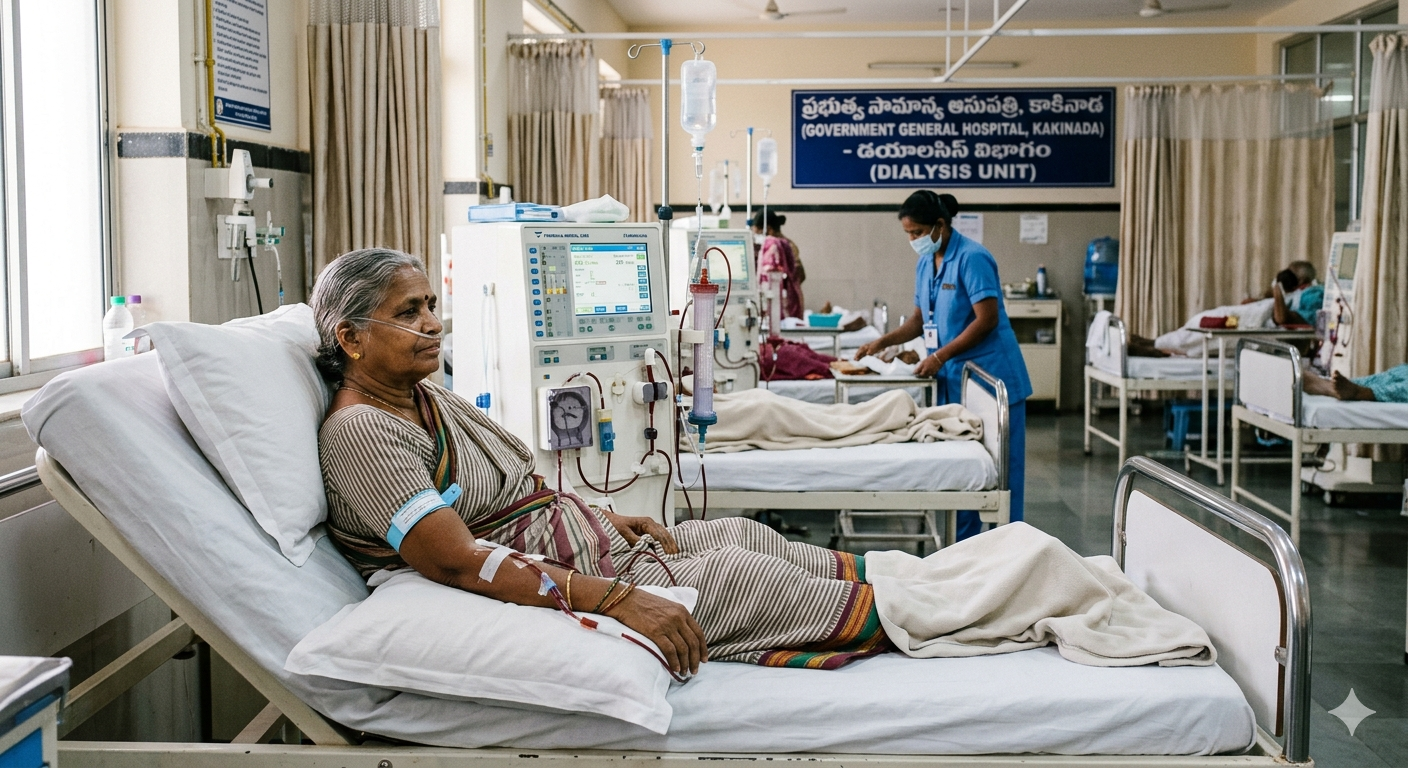
At the Nephroplus dialysis unit inside Kakinada Government General Hospital, kidney patients have been dying. Fifteen deaths over three months occurred among people who came to a government hospital premises for a life-sustaining procedure and did not come back.
The care they were promised under a government contract was not being delivered. The nephrologist mandated by the MoU was visiting once a month. The duty doctor had not attended for three months. The unit was running, taking government money, processing patients, recording sessions without the medical oversight that the contract explicitly required and that basic human decency demands.
Fifteen people are dead and it took a PGRS complaint — a public grievance petition to trigger the first inspection. That is the TDP government’s healthcare system in action.
What the Contract Promised, What the Unit Delivered
The terms of the arrangement are not ambiguous. The government pays ₹1,136 per dialysis session to Nephroplus under a formal Memorandum of Understanding. In return, the MoU mandates the deployment of a nephrologist and two medical officers at the unit. These are not optional staffing suggestions. They are contractual obligations, paid for with public money, designed to ensure that patients receiving dialysis — one of medicine’s most technically demanding and physiologically sensitive procedures are under qualified medical supervision at all times.
What was actually happening at the Kakinada unit? According to patient attendants who have watched their family members deteriorate and die over the past three months, the nephrologist was visiting the unit once a month and the duty doctor, the basic minimum of medical presence, had not attended the unit for three full months.
Three months without a duty doctor. At a dialysis unit. Where patients arrive multiple times a week with failing kidneys, connected to machines that filter their blood because their bodies can no longer do it themselves. Any number of complications — hypotension, sepsis, air embolism, electrolyte imbalance can kill within minutes without immediate medical intervention.
When confronted, T. Suresh Kumar, cluster head of the Nephroplus Dialysis company, offered an explanation that is as inadequate as it is revealing: the unit doctor has resigned but is still serving the notice period, a manager was recently appointed, and doctors will be appointed to cover three shifts within ten days.
What the Kakinada dialysis tragedy exposes is not merely one company’s negligence. It exposes the complete absence of a functional monitoring and accountability architecture for outsourced healthcare under the TDP government.