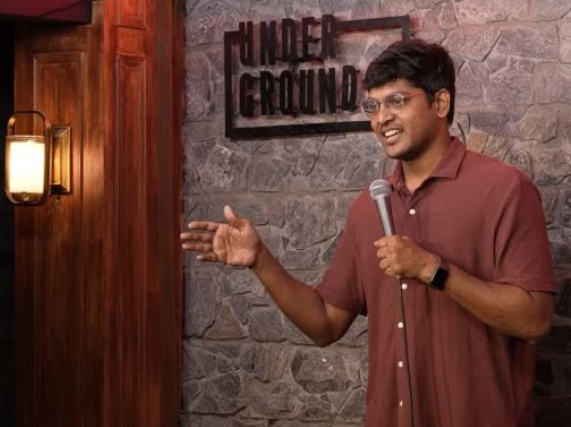
A comedian walks onto a stage in Koramangala, Bengaluru. He is in Karnataka not Andhra Pradesh. He is performing a solo show at a comedy club. He has done nothing that evening to provoke anyone. He has barely begun his set.
Within minutes, a dozen men claiming to be TDP supporters storm the stage. They abuse him. They threaten him. They demand he apologise for a joke he made over a year ago, for which he had already publicly apologised on YouTube. Then, not content with a second apology, they demand he perform an act of political submission: shout “Jai TDP,” “Jai Lokesh Anna,” “Jai Chandrababu Naidu” before his own audience.
He refuses. They issue a “final warning.” They leave only after extracting a refund from the organisers. The police arrive after the mob has gone. This is not a story from a country without a constitution. This is Andhra Pradesh in 2026 or rather, this is what Andhra Pradesh has become under the TDP government: a political climate so intolerant of dissent, so allergic to satire, so devoted to the cult of its leadership that its supporters feel entitled to cross state borders to silence a comedian for a joke told sixteen months ago.
What Sarat Uday Actually Said
Before examining what was done to Sarat Uday, it is worth understanding what he actually said because the disproportionality of the response is itself part of the story.
The jokes at the centre of the disruption were from a video Uday uploaded to his YouTube channel in December 2024, titled “Andhra Politics”, which targets several politicians in Andhra Pradesh from the TDP, Jana Sena and YSRCP. In the video, Uday describes Naidu as a strong political leader and refers to how he survived an assassination attempt in 2003 and returned to work the next day, then pivots to his son. He says Lokesh “became a meme on the internet” and jokes about him freezing during a live interview.
This is standard political comedy. It targets multiple parties. It does not call for violence. It does not spread false information. It observes publicly available facts that Lokesh became a viral meme, that the Tirupati laddu controversy was politically damaging and builds jokes around them. Every functioning democracy in the world has a rich tradition of exactly this kind of political satire. It is not merely tolerated it is considered essential to democratic health.
After the video surfaced, Uday faced threats and online abuse from supporters of the politicians he joked about in Andhra Pradesh. He later posted a public apology. He had already apologised. Once. Publicly. On record. On YouTube. And yet, even after the comedian explained that he had issued a public apology in December 2024, he was forced to apologise again, two years after he had made the jokes.
The demand for a second apology reveals what this was really about. It was not about hurt sentiments. It was not about accountability. It was about power about demonstrating to a comedian, to his audience, and to anyone watching that TDP supporters can walk onto any stage in any city in India, at any time, and extract submission from artists who have dared to make their leaders the subject of humour.
Not an isolated Incident. The Pattern Is Undeniable.
The Bengaluru incident involving comedian Sarat Uday is not an isolated outburst by overzealous fans. It is the third in a documented series of attacks on stand-up comedians for the crime of making jokes about Andhra Pradesh’s ruling coalition.
Earlier this month, Anudeep Katikala and Rafiq Muhammad were arrested for cracking jokes on Andhra Pradesh Deputy Chief Minister and Jana Sena Party supremo Pawan Kalyan. The manner of those arrests was itself a statement of intent. Katikala was picked up by Andhra Pradesh police from Prayagraj and taken to Kakinada, while Rafiq was arrested in Vizag and taken to Machilipatnam, where the case was registered.
Read that again. Andhra Pradesh police travelled to Prayagraj in Uttar Pradesh to arrest a comedian for a joke. Not a threat. Not incitement to violence. A joke, delivered on a stage, about a politician.
These incidents in rapid succession. Arrests across state lines. Stage invasions in Karnataka. A pattern is not an accident. A pattern is a policy or at the very least, a culture that the political leadership has permitted, encouraged, and failed to condemn.
What Is at Stake
Stand-up comedy may seem like a minor arena for a defence of free speech. It is not.
Political satire the mockery of the powerful by ordinary citizens, is one of the oldest and most important democratic traditions. It is the mechanism by which the gap between a leader’s self-image and reality is publicly exposed. It is the tool by which citizens process political frustration without violence. It is the early warning system for authoritarianism: when political satire is suppressed, it is invariably because those in power cannot tolerate being seen clearly.
The TDP government of Andhra Pradesh is not suppressing stand-up comedy because comedians are dangerous. It is suppressing stand-up comedy because it cannot bear to be laughed at. Because Nara Lokesh freezing in a live interview is a fact that happened, and jokes about it remind voters that the carefully constructed image of a dynasty in competent command is a performance, not a reality.
Every comedian arrested, every show disrupted, every “final warning” issued is not about the individual artist. It is about establishing, for the entire creative community of Andhra Pradesh and the Telugu diaspora, where the lines are.