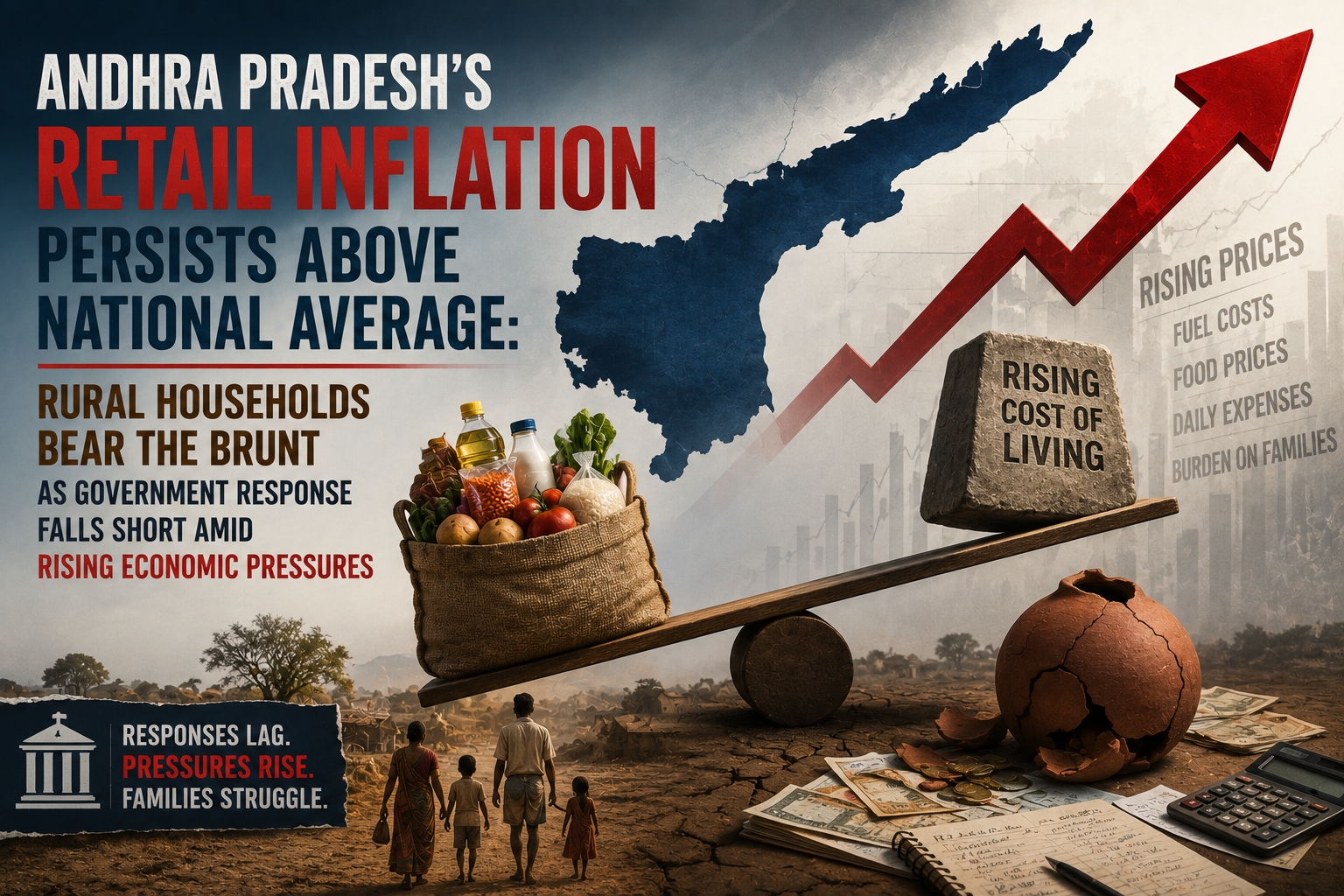
In a worrying economic trend for Andhra Pradesh, retail inflation has now exceeded the national average for five consecutive months, reaching 4.9% in May 2026 compared to India’s 3.9%. This sustained outperformance on the wrong side of the ledger comes at a critical juncture for the TDP-led government under Chief Minister N. Chandrababu Naidu, which came to power promising rapid economic revival, fiscal discipline, and relief to the common man after years of alleged mismanagement. Instead, rising prices, particularly in rural areas, are exposing gaps between political rhetoric and on-ground economic reality.
Comprehensive CPI Breakdown and Rural-Urban Economic Disparity
The State Planning Department’s Consumer Price Index data reveals a sharp and persistent rural-urban divide that is exacerbating inequality:
- Food & Beverages: 6.91% rural | 5.44% urban | 6.42% combined — the dominant driver, hitting rural households hardest due to higher food expenditure share.
- Clothing & Footwear: Modest rises, but still adding to costs.
- Housing, Water, Electricity & Fuel: 2.28% rural | 1.95% urban.
- Health and Transport: Moderate but cumulative pressure.
- Education Services: 4.62% rural | 7.36% urban — burdening families with school-going children.
- Restaurants & Accommodation Services: 3.37% rural | 7.47% urban.
- Personal Care & Miscellaneous: 24.79% rural | 25.71% urban — one of the most alarming categories, affecting daily hygiene and household services.
- Overall CPI (General): 5.09% rural | 4.61% urban | 4.90% combined.
Nationally, June 2026 CPI rose to 4.38% (an 18-month high), with food inflation at 5.32%, rural at 4.74%, and urban at 3.92%. AP’s numbers are not isolated but reflect broader vulnerabilities amplified by local factors such as supply chain inefficiencies and policy lags.
Severe Impact on Households, Sectors, and the Economy
The human and economic costs are mounting. A typical household previously spending ₹10,000 monthly on essentials now faces an effective increase of around ₹490. In rural Andhra Pradesh, where agriculture and informal work dominate, this means reduced consumption of nutritious food, deferred healthcare, and children potentially dropping out or facing compromised education.
Urban middle-class families report school fees and related costs rising by thousands annually. Service sector workers and small businesses grapple with higher input and transport costs passed on from fuel hikes. Farmers face elevated cultivation expenses even as output prices remain volatile. Economically, this risks a demand slowdown: weaker rural consumption could hurt local markets, MSMEs, and overall GSDP growth, undermining the very development agenda the government promotes through investments and infrastructure.
Longer-term, persistent inflation above national averages erodes purchasing power, fuels inequality, and may increase rural distress migration or indebtedness. Experts have long warned that food-heavy rural inflation has multiplier effects on poverty alleviation efforts and social stability.
Government and CM’s Response: Rhetoric vs. Inaction on Rising Prices
The Naidu administration has acknowledged the issue by placing inflation on its “Needs Attention” watchlist and constituting a cabinet sub-committee comprising key ministers for civil supplies, finance, and agriculture. This body reviews prices of essentials like pulses, rice, edible oils, and vegetables, issuing directives for market monitoring and anti-hoarding measures. Kharif preparedness, crop insurance extensions (PMFBY/RWBCIS), and some buffer stock utilization have been highlighted.
The CM has spoken of fiscal prudence, cost controls across departments amid global headwinds (fuel volatility from West Asia), and long-term growth through investments and reforms in irrigation and land records. Welfare schemes, pensions, and farmer announcements form part of the narrative.
However, the criticism is mounting and justified. Despite months of elevated inflation, concrete, visible measures to curb price rises appear conspicuously absent or ineffective. Committees and reviews have not translated into tangible relief at the marketplace. Fuel price hikes continue to ripple through the economy without corresponding state-level tax relief or subsidies promised earlier. Opposition parties, including the YSRCP, have lambasted the government for betraying pre-poll assurances on reducing living costs and instead prioritizing big projects over immediate consumer protection.
Economically, this points to a policy tilt toward long-term structural changes at the expense of short-term stabilization. While attracting MoUs and pushing capital city development are strategic, they offer little solace to families struggling with daily inflation. Why has there been no aggressive expansion of the Public Distribution System, larger subsidies on key edibles, or stricter price controls on personal care and services? The lack of decisive intervention risks turning a manageable inflation episode into a broader economic and political liability.
Historical context adds to the scrutiny: AP had achieved sharper disinflation in 2025-26 (down to around 1.39% in parts of the year). The rebound under the current regime suggests that gains were not consolidated through robust anti-inflationary frameworks. Global factors provide some cover, but effective state governments elsewhere have demonstrated better buffering through proactive supply management and targeted support.
Political and Economic Accountability Needed
The TDP-led government’s narrative of “restoring credibility” and “farmer-friendly” policies now faces a credibility test. If “farmer’s welfare is the state’s welfare,” as occasionally articulated, the failure to tame food inflation, which disproportionately affects rural voters, is glaring. Political opponents argue this reflects misplaced priorities: heavy borrowing and spending on prestige projects while households tighten belts.
Economists would likely advise a multi-pronged approach: immediate supply augmentation, demand-side support via transfers or subsidies, better market intelligence to prevent profiteering, and coordination on fuel policy. Without these, inflation could entrench itself, slow recovery, and fuel public discontent.
Outlook: Urgent Course Correction Required
As new monthly CPI data emerges, the onus is squarely on Chief Minister Naidu and his cabinet to demonstrate results beyond monitoring. Andhra Pradesh cannot afford prolonged above-average inflation if it aims for inclusive growth. Stronger, time-bound measures to stabilize essential prices, protect rural livelihoods, and deliver on relief promises are not optional, they are economic and political imperatives.
The people of Andhra Pradesh, especially in rural heartlands bearing the heaviest burden, deserve accountability. Rising inflation without commensurate action is not just an economic statistic; it is a failure of governance that risks long-term damage to trust and prosperity. The government must act decisively now, or face growing questions on its ability to deliver the “double-engine” development it champions.