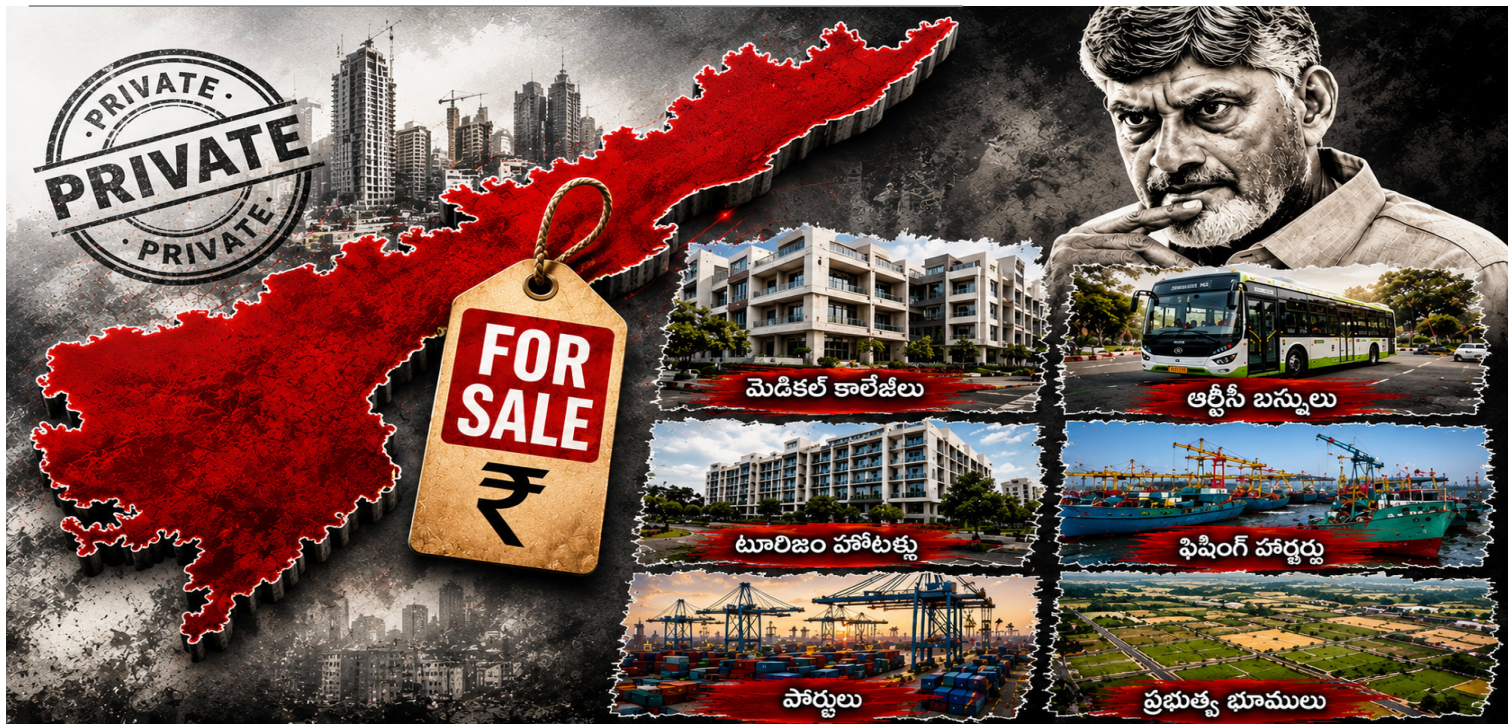
PRIVATISING THE PEOPLE’S STATE
- Ready to hand over every sector to corporates in the name of PPP
- Education, healthcare, transport, registration services, APSRTC, and now even social services, being pushed towards privatisation
- PPP Policy–2026 opens 260 projects worth Rs. 1.23 lakh crore to private participation
- Soon after coming to power, attempts were made to hand over 10 Government Medical Colleges to private players
- Later, moves were initiated to privatise APSRTC through the backdoor in the name of electric buses
- Registration services are also being pushed towards private control through proposed Registration Service Kendras
- Now, with PPP Policy–2026, the government is preparing to place an even heavier burden on the public
- During his tenure as Chief Minister of undivided Andhra Pradesh, Chandrababu privatised 94 government and cooperative-sector institutions
The Chandrababu government, which has been moving step by step to privatise public-sector institutions, medical colleges, ports, harbours, registration centres and APSRTC, is now rapidly advancing towards handing over even the responsibility of delivering social services to private entities, placing an additional burden on the people.
Soon after coming to power, Chandrababu made an unsuccessful attempt to hand over 10 of the 17 medical colleges established by YS Jagan to private players under the PPP model. Ports and fishing harbours built during YS Jagan’s tenure are also being handed over to investors.
Moves were then made to privatise APSRTC in the name of procuring electric buses. As part of this process, land belonging to 12 RTC depots has already been handed over to private entities. Preparations were also made to privatise registration services by establishing privately operated registration centres.
Now, through the PPP Policy–2026, the government is throwing the doors wide open for the privatisation of social-service delivery itself. Chandrababu’s actions could soon create a situation where people have no option but to depend on private operators even for essential public services.
Intellectuals are warning that private operators could impose heavy fees and user charges, placing an unbearable financial burden on ordinary people.
Instead of Strengthening Public Systems, the Government Is Weakening Them
Rather than strengthening institutions built with people’s tax money, the Chandrababu government’s policy is increasingly becoming one of handing them over, one after another, to private companies. Healthcare, transport, registration services, government lands, bus stations, ports and roads—irrespective of the sector, the government is stepping away from its responsibility to mobilise investment and provide services directly to the people.
Under the attractive label of Public–Private Partnership, public assets, essential services and future revenue streams are being opened up to private entities. The newly formulated PPP–VGF Policy 2026 has now created a single statewide gateway for this privatisation drive. The core objective of the policy is to bring around 260 projects worth Rs. 1.23 lakh crore under the PPP framework.
To attract private players, the State Government has also earmarked Rs. 1,500 crore as Viability Gap Funding for 2026–27. This means that apart from providing government land, permissions and concessions for projects, the government will also use public money to provide financial support to make private investment commercially viable.
Public Healthcare: Proposed 33-Year Handover to Private Players
The YS Jagan government took up 17 Government Medical Colleges with the objective of expanding medical education and super-speciality healthcare in backward regions of Andhra Pradesh. Soon after the change in government, instead of completing and operating ten of these colleges directly through the government, the Chandrababu administration moved towards the PPP model.
It decided to develop the medical colleges at Adoni, Markapuram, Madanapalle, Pulivendula, Penukonda, Palakollu, Amalapuram, Narsipatnam, Bapatla and Parvathipuram under this model. In the first phase, tenders were invited for the colleges at Adoni, Markapuram, Madanapalle and Pulivendula.
The tender conditions were designed to hand over the management of the medical college and its attached hospital to the private entity completing the construction for a period of 33 years.
With YS Jagan leading a public movement against the privatisation of Government Medical Colleges, the YSRCP campaign forced the government’s first attempt to hand these colleges over through PPP to come to a halt.
If the government itself constructs and operates these institutions, the hospital, medical seats, fee structure, employment and administration remain under public control. But under 33 years of private management, the private partner gains greater influence over fee determination, the nature of hospital services, recruitment and the utilisation of revenues.
The government has still not placed before the public what legally enforceable safeguards would protect affordable healthcare for the poor, students’ fees, reservations and free medical services under such a long-term private arrangement.
Private Operators Enter APSRTC Depots
Private companies are being given a major role in APSRTC operations in the name of electric buses. Instead of APSRTC purchasing and operating its own buses, the government is implementing a model under which buses are taken from private operators through the Gross Cost Contract (GCC) system. The buses, drivers and charging infrastructure remain under the control of the private operator, while APSRTC makes payments on a per-kilometre basis.
The process has already begun to provide space and infrastructure to private operators at 11 APSRTC depots across the state for operating electric buses. APSRTC employees’ unions openly objected to the decision to hand over the Vidyadharapuram depot in Vijayawada to a private electric-bus operator. They demanded that vacant government land be allotted to private operators instead of giving away APSRTC depot premises.
The bus belongs to a private company. The driver is an employee of the private operator. The charging system belongs to a private company. But the space inside the depot belongs to APSRTC, while the payments come from the government.
As this model expands, APSRTC’s own fleet, permanent employment and institutional operating capacity could gradually shrink. Ultimately, there is a clear danger of APSRTC being reduced to an agency that merely makes payments to private bus operators.
Private Door Opened for Registration Offices
Even a critical government function such as property registration has now been brought under the PPP framework. Through G.O. No.396, the government approved the establishment of Registration Seva Kendras in 26 district headquarters across the state. These centres are proposed in all district headquarters except Alluri Sitarama Raju and Polavaram districts.
These centres will provide services similar to Sub-Registrar Offices, including Anywhere Registration, slot booking, online payments, public data entry and delivery of documents. However, private participation will be involved in establishing and operating these centres.
Instead of modernising existing government Sub-Registrar Offices, the introduction of parallel privately operated centres is raising serious questions about the future of the registration system.
Property documents, Aadhaar details, fingerprints, photographs and land values are among the highly sensitive information handled through the registration system. This raises several unanswered questions: What exactly will be the role of the private company? On whose servers will citizens’ data be stored? Who will determine service charges? If a fraudulent or incorrect registration takes place, will responsibility lie with the government or the private operator?
The system is being taken forward without clear answers to these concerns. Strong criticism is also being voiced that the privatisation of registration centres is intended to create a backdoor mechanism to gain control over people’s property.
Commercial Eye on Government Assets
The new PPP policy allows lands and buildings held by government departments and public-sector institutions, which the government decides are underutilised or unused, to be commercially exploited. The policy proposes developing retail spaces, commercial complexes and transit hubs on lands surrounding APSRTC bus stations and depots with private investment.
When government land is handed over to a private company for a long period, public control over that land effectively becomes nominal. Profits go to the private player, while losses or the consequences of project failure can fall back on the government. Even if the same land is needed in future for a public purpose, taking it back could become complicated.
Ports and Roads Too on the Same PPP Route
During the YSRCP government, then Chief Minister YS Jagan, with foresight and vision, initiated four ports, 10 fishing harbours and six fish landing centres. Soon after Chandrababu came to power, works on these projects were deliberately stalled with the intention of eventually handing them over to his close associates.
With the objective of developing Andhra Pradesh’s 1,053-km coastline, the YSRCP government had taken up ports and fishing harbours at a cost of Rs. 26,501 crore. After Chandrababu returned to power, these works were pushed aside. The Jagan government had secured all necessary approvals, arranged full funding and launched the projects in a manner designed to ensure that works would not stop midway.
By the time of the 2024 elections, Ramayapatnam Port was more than 90 per cent complete, and its bulk cargo berth was fully ready. Construction of the Juvvaladinne Fishing Harbour had also been completed. It was inaugurated by Prime Minister Narendra Modi on August 30, 2024.
Despite this, Chandrababu did not make either the nearly completed Ramayapatnam Port or the already inaugurated Juvvaladinne Harbour fully operational. With operations at Ramayapatnam Port yet to begin, industrial development in the surrounding region has suffered.
Ramayapatnam Port, which was around 95 per cent complete during YS Jagan’s tenure, is now being handed over to private interests. A port valued at nearly Rs. 5,000 crore is being offered for just Rs. 1,500 crore, with a condition allowing only half that amount to be paid initially. The government has also given the green signal to allot highly valuable land for future port expansion at a nominal rate of Rs. 1 per acre. As part of this process, the Andhra Pradesh Maritime Board has invited bids.
On the other hand, tenders have been invited to hand over the operation of Juvvaladinne Fishing Harbour, completed during YS Jagan’s tenure, to private companies. Even without fully opening the harbour for fishermen, 30 acres inside the harbour have been allotted to the private company Sagar Defence. Now, the harbour’s operation itself is also being handed over to the private sector.
As a result, the burden will ultimately fall on the public through port charges, harbour fees, road tolls and various user charges.
Public Money Used to Guarantee Private Profits
PPP does not mean that a private company uses its own money to provide free services to the public. The government provides the land. The government gives the approvals. If necessary, the government itself pays a portion of the construction cost through a Viability Gap Fund. Agreements may even provide minimum-revenue guarantees if project revenues fall short. After that, the private company earns revenue through user charges, tolls, fees, leases and commercial activities.
Unless there is a firm guarantee that people will receive services at affordable prices, PPP can ultimately turn into a model of “public assets – government investment – private profit.” Announcing PPP projects one after another without legally ensuring concessions for the poor, regulation of fees, protection of employees’ rights, safeguards for government assets and transparency in contracts is against the public interest.
Then in the Name of Reforms… Now in the Name of PPP
During Chandrababu’s tenure in undivided Andhra Pradesh, large-scale restructuring, closure and disinvestment of public-sector institutions, voluntary retirement schemes and private participation were implemented. It was during that period that government and cooperative-sector institutions were weakened in the name of losses and their activities increasingly left to the private sector.
Now, the same philosophy is being extended through PPP Policy–2026 to education, healthcare, transport, registration services, infrastructure and government assets.
Why Can’t the Government Run Them? Why Hand Them Over to Private Players?
Why can’t the government itself complete Government Medical Colleges? Why should APSRTC not purchase and operate its own electric buses? Why introduce private service centres instead of modernising Sub-Registrar Offices? Why should public land be given for private commercial use? Why should Rs. 1,500 crore of public money be paid as Viability Gap Funding to private companies? Why are the complete project agreements, revenue projections, user charges and government guarantees not being placed before the public?
Development does not mean abandoning the government’s responsibility. It does not mean handing over public assets on long-term leases. And it certainly does not mean imposing fees, tolls and user charges on people.
Real development means keeping institutions created with public money accessible to the people and strengthening them further.
But the path chosen by the Chandrababu government appears to be different, the land belongs to the people, the money belongs to the people, and the burden falls on the people, while control and revenues go to private companies.
If this continues at the same pace, there may soon come a time when people will have to pay at a private gate whether they need healthcare, want to travel, register a property or access a government service.
Turning public service into a business and reducing the government to a partner of private companies, this is the real betrayal of the people by the Chandrababu government.