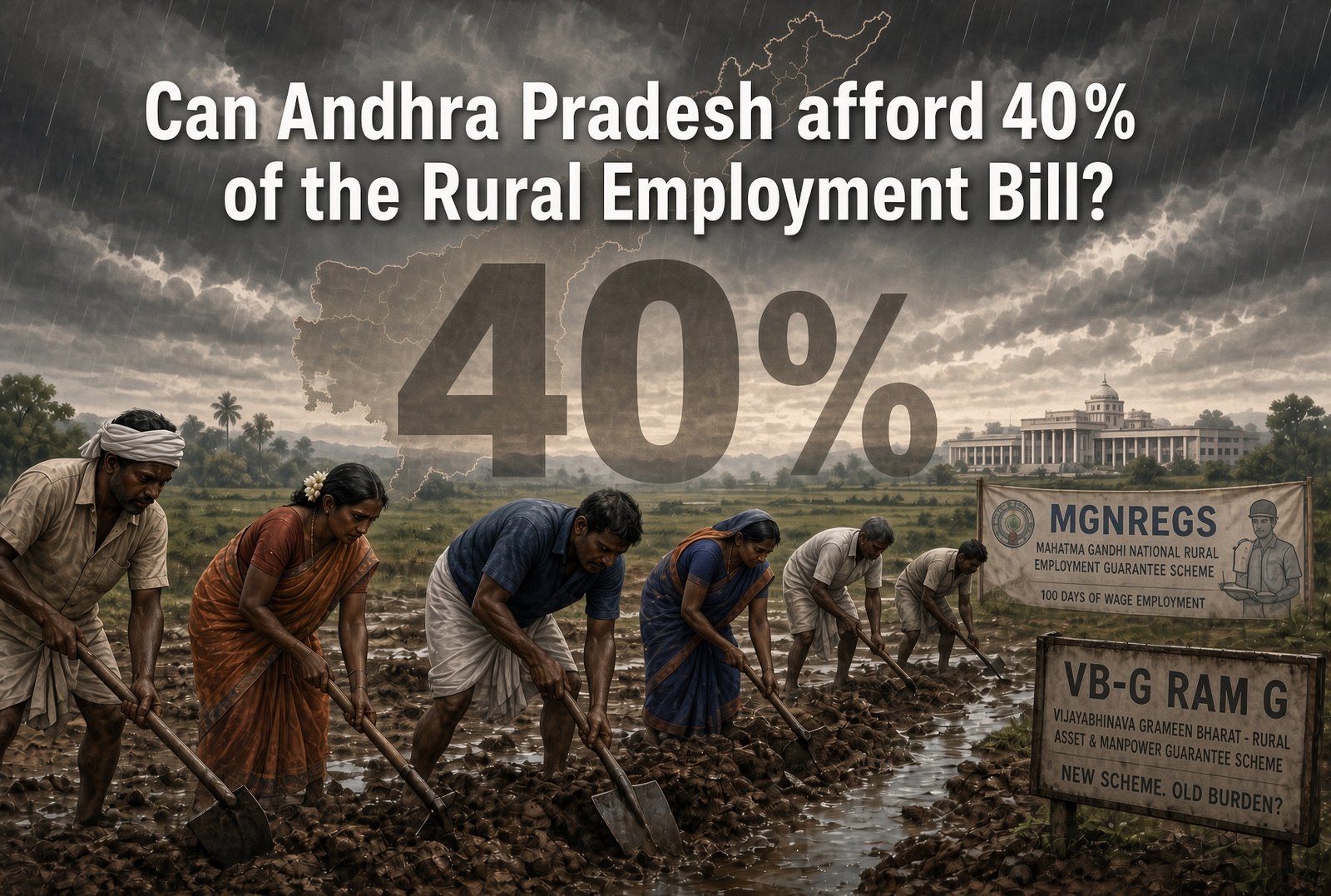
The story of Viksit Bharat – Guarantee for Rozgar and Ajeevika Mission (Gramin), or VB-G RAM G, in states like Andhra Pradesh is not primarily about expanded employment guarantees. It is about the redistribution of financial risk in a federal system where many states already operate close to their fiscal limits. The additional price tag is real. The capacity to pay it is being tested, one budget line and one person-day at a time.
For nearly two decades, the Mahatma Gandhi National Rural Employment Guarantee Scheme had served as a demand-driven safety net, with the Centre covering almost the entire wage bill. That compact ended on 1 July. Under VB-G RAM G, the guarantee rose on paper from 100 to 125 days. The funding formula, however, shifted sharply. Most states must now contribute 40 percent of the cost, against the earlier arrangement in which the Centre bore virtually the entire labor component. The change is not cosmetic. It is a transfer of fiscal risk.
Official data as of 9 August 2026 captured the immediate impact. Only 7.67 crore person-days were generated under VB-G RAM G in July—49.94 percent lower than the 15.33 crore person-days recorded under MGNREGS in July 2025. Households that found work fell even more steeply. In just 15 days between 29 June and 14 July, registered workers in Andhra declined by roughly 1.66 lakh and active workers by 1.23 lakh. The numbers reflected not only transition friction and agricultural-season pauses but also the new arithmetic of shared cost.
Andhra Pradesh entered this arrangement already under pressure. The state’s 2026-27 budget projects a revenue deficit of 1.1 percent of GSDP (₹22,003 crore). The fiscal deficit is targeted at 3.8 per cent of GSDP (₹75,868 crore), down from the revised 4.6 per cent. These are consolidation numbers, not surplus numbers. Revenue receipts in 2025-26 had already shown a 10 per cent shortfall against budget estimates. Debt remains a structural constraint.
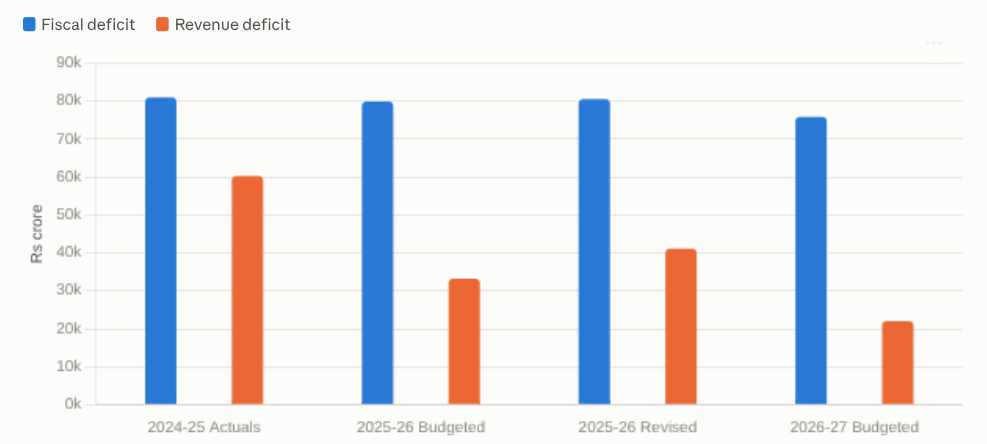
Table : Budget 2026-27 – Key figures (in Rs crore)
Yet the same Budget raised the Rural Development sector allocation from ₹14,410 crore (2025-26 Revised Estimates) to ₹20,610 crore (2026-27 Budget Estimates) — a 43 per cent jump. Of this, ₹8,365 crore was specifically earmarked for VB-G RAM G. That single line item is larger than many entire departmental budgets in earlier years. On paper, the state has budgeted to its new 40 per cent share.

Table: Sector-wise expenditure under Andhra Pradesh Budget 2026-27 (in Rs crore)
Whether the allocation becomes actual expenditure is another matter. State budgets can be optimistic; releases depend on the finance department’s cash-flow decisions and on the Centre’s matching releases. Earlier data suggests one installment of ₹2,545.50 crore was released in July—but the state’s matching contribution must keep pace if works are not to stall. Analysts have long noted that budgetary provision is not the same as cash in the district accounts.
The deeper question is how a state already running deficits absorbs an additional recurring liability that was previously central. The answer lies less in sudden fiscal strength and more in political prioritization and constrained choice. Andhra has historically drawn a large share of national rural employment funds.
Nationally, the early data is not positive. Person-days have roughly halved. In Andhra, the picture has been more mixed in absolute terms in some reports, yet the broader pressure on active worker participation is visible. It is a jointly financed, allocation-capped programme; States that cannot or will not put up their 40 percent will simply generate fewer days of work.
Union agriculture and rural development minister Shivraj Singh Chouhan launched VB-G RAM G at Railway Koduru in Andhra Pradesh’s Tirupati district. He announced that ₹11,700 crore would be undertaken under the VB G-RAM G scheme in Andhra Pradesh, with ₹7,700 crore coming from the center and ₹4,000 crore contributed by the state government.
For Andhra, the ₹4,000 crore line is therefore both a statement of intent and a fiscal stress test. It demonstrates that even debt-constrained states can, in the short term, stretch budgets to meet the new cost-sharing formula. Whether they can sustain that stretch without cutting other development spending, delaying wage payments, or quietly reducing the scale of works will become clearer only in the months ahead—when monsoon urgency gives way to the slower arithmetic of quarterly releases and audited accounts.