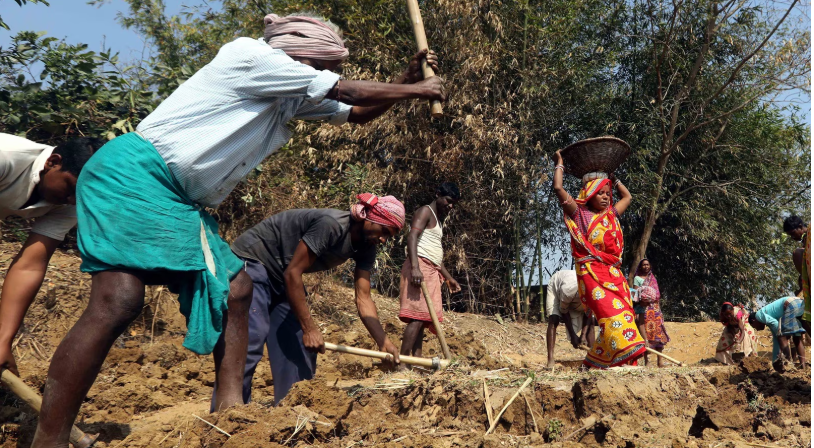
The Mahatma Gandhi National Rural Employment Guarantee Act has long served as a critical safety net for rural livelihoods. In Andhra Pradesh, it remained a central pillar of employment generation through the previous decade. However, recent data suggests a sharp reversal in its performance.
A programme that had been steadily strengthened over five years, expanding coverage, improving delivery, and pushing households toward their full entitlement, showed clear signs of weakening in 2024–25 and a pronounced contraction in 2025–26.

Source: LibTech India — AP MGNREGA Reports (April 2024, April 2025, April 2026) · nrega.nic.in
The Starting Point
When the YSRCP government inherited power in 2019, Andhra Pradesh’s MGNREGA performance was decent but unremarkable. In 2019-20, the state generated 2,002 lakh person-days. The average household worked 49.6 days. About 6.23 lakh households completed 100 days of employment, 15.43% of those who worked.Household income from MGNREGA stood at ₹10,085 per family a meaningful but modest figure.
The COVID Year: When the Safety Net Held
2020-21 was the year the world shut down. Migrant workers poured back into villages from cities across India. Families that had never needed MGNREGA suddenly needed it desperately. The question was whether the state government would respond or whether the programme would buckle under the sudden surge in demand.
Under the YSRCP government, Andhra Pradesh responded. Person-days surged to 2,586 lakh a 29% increase. Households that worked rose to 47.53 lakh. Most strikingly, 8.63 lakh households completed their full 100 days of employment 18.16% of those who worked. This remains the highest 100-day completion figure across all seven years in the dataset.
That year, MGNREGA household income rose to ₹12,448. The state had delivered when it was needed most.
Consistent Delivery Through Difficult Years
The years 2021-22 and 2022-23 were difficult nationally. The Central government tightened budget allocations. New compliance requirements the National Mobile Monitoring System, mandatory Aadhaar-based payments, created administrative friction. States across India saw MGNREGA performance dip.
Andhra Pradesh was not immune. Person-days fell to 2,414 lakh in 2021-22 and 2,395 lakh in 2022-23. But the YSRCP government held the floor. Average workdays per household stayed above 51 days in both years, consistently above the national average. Even in the difficult year of 2022-23, when 100-day completions fell nationally, the programme kept functioning. Households kept getting work.
The Peak: 2023-24
The YSRCP government’s final full year 2023-24 was its best. Every indicator in the table reached its highest point of the five-year tenure:
Person-days: 2,554.88 lakh the highest in any year across all seven rows of the table, and a 27.6% increase over 2019-20.
Average workdays per household: 54.89 days the highest across all seven years, significantly above the national average.
Households completing 100 days: 6.87 lakh a 14.76% of all households that worked, compared to 5.66% the previous year.
Household income: ₹13,484 the highest recorded in any year in the dataset.
Potential income — what households could have earned if the notified wage had been fully paid: ₹14,930.
This was not the performance of a government that stumbled into success. It was the result of five years of administrative effort, of political will applied consistently to a programme that delivers for the people who need it most.
The Transition Year: The First Warning Signs
The 2024-25 is the year of political changeover. The YSRCP government lost the election in June 2024. The new TDP-led coalition took charge. The numbers for 2024-25 already show the early signs of deterioration. Person-days fell from 2,554 lakh to 2,422 lakh a 5.2% decline.
Average workdays per household fell from 54.89 to 51.62 days. Households completing 100 days fell from 6.87 lakh to 5.10 lakh a 25.8% drop in a single year. Household income fell from ₹13,484 to ₹13,190 a loss of ₹294 per family.
These were warning signs. The programme was weakening before the new government had completed even one full year. The decline was already steeper than the national average. And the worst was yet to come.
The TDP Year: Collapse Across Every Indicator
2025-26 is where every number falls off a cliff.
Person-days: 1,859.77 lakh.
This is not just the lowest figure in seven years. It is the weakest MGNREGA performance in Andhra Pradesh since the state was formed in 2014 a decade’s low, achieved in the first full year of TDP governance.
The fall of 23.2% from the previous year 563 lakh person-days lost represents an enormous withdrawal of employment from the state’s rural economy. To put it in human terms: if those person-days had been maintained at 2024-25 levels, approximately 563 lakh additional days of work would have reached rural households. At the actual wage rate of ₹267.83 per day, that is over ₹1,500 crore in wages that rural Andhra Pradesh did not receive.
Average workdays per household: 43.37 days.
Under the YSRCP government, this number had risen steadily to a peak of 54.89. Under TDP, it has crashed to 43.37 a 16% fall in a single year, and the lowest in the seven-year dataset. Andhra Pradesh, which had historically outperformed the national average of around 43 days, has now converged with it. The state’s advantage built over five years has been erased in twelve months.
Households completing 100 days: 2.16 lakh.
From the YSRCP peak of 6.87 lakh from 14.76% of working households to 2.16 lakh and 5.00%. A fall of 68.6% from the peak in just two years. The 100-day guarantee that MGNREGA is built around has become, for 95% of Andhra Pradesh’s working households, a promise that went undelivered.
Household income: ₹11,616.
This figure deserves particular attention because of what surrounds it in the table. The notified wage rate actually increased — from ₹297 to ₹307 per day. Workers were entitled to earn more per day under TDP than under the transition year. The actual wage received also increased from ₹255.52 to ₹267.83.
And yet household income fell by ₹1,574. Workers earned more per day and took home less per year. The reason is simple and damning: there were so few days of work available that even a higher daily wage could not compensate for the collapse in employment. The potential income what households could have earned if 2024-25 employment levels had been maintained was ₹13,825. The actual income was ₹11,616. The gap between what workers were entitled to and what they received: ₹2,209 per household, the largest gap in the entire seven-year dataset.
Vulnerable Sections Paid the Price
Rural employment loss is not evenly distributed. The people who depend most on MGNREGA are those with fewest alternatives the landless, the Dalits, the women who cannot migrate for work, the elderly who cannot compete in casual labour markets.
LibTech India’s report, which underpins this data, is precise about who absorbed the cost of the TDP government’s failure. Scheduled Caste and Scheduled Tribe households accounted for approximately 40% of the total ₹1,210 crore wage expenditure, a decline of an estimated ₹484 crore that did not reach the most marginalised communities.
Every single one of Andhra Pradesh’s 26 districts recorded a decline. The worst-hit were NTR district (-46.5%), Chittoor (-38.5%), and Annamayya (-30.9%) districts whose rural populations are among the most dependent on MGNREGA as a livelihood buffer.
The TDP government’s MGNREGA failure was not concentrated. It was universal. It reached every corner of the state and hit hardest where it could least be absorbed.
The Conclusion
Under the YSRCP government, a rural household in Andhra Pradesh worked an average of 54.89 days and earned ₹13,484 from MGNREGA in its peak year. Under the TDP government in its first full year, the same household worked 43.37 days and earned ₹11,616, with a potential income of ₹13,825 left unrealised due to the collapse in work availability.