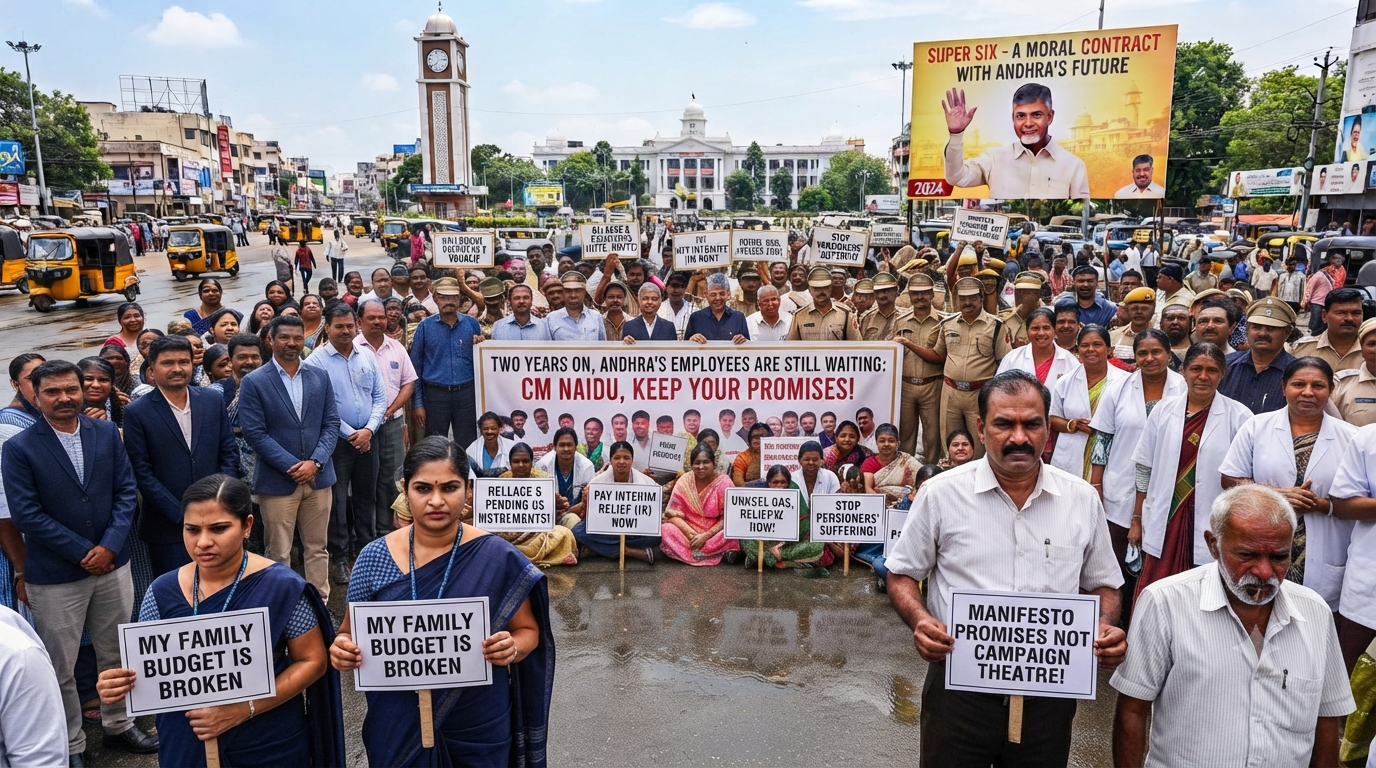
When Chandrababu Naidu returned to power in 2024, he did so wrapped in one of the most extravagant promise packages Andhra Pradesh has seen in years. The “Super Six” was projected not merely as an election slogan, but as a moral contract with voters. For government employees, teachers, police personnel, pensioners, and contract staff, it sounded like relief was finally on the way. Two years later, that promise looks increasingly like campaign theatre.
Two Years On, Andhra’s Employees Are Still Waiting
The anger is not hard to understand. Employees say the government has delayed five Dearness Allowance instalments, stalled Interim Relief, frozen surrender leave encashment, and left the Pay Revision Commission in limbo. In the language of spreadsheets, these may look like deferred liabilities. In the language of family budgets, they are rent unpaid, fees postponed, loans stretched, and retirement pushed further into uncertainty.
What makes the issue more damaging is that this is not a fringe complaint from one corner of the bureaucracy. It cuts across the state’s working machinery: regular employees, village and ward secretariat staff, police personnel who cannot strike, and pensioners who no longer have the leverage to bargain. The claim now circulating in employee circles is blunt: the government has transferred its financial stress onto the shoulders of those who keep the administration running.
The arithmetic of neglect :
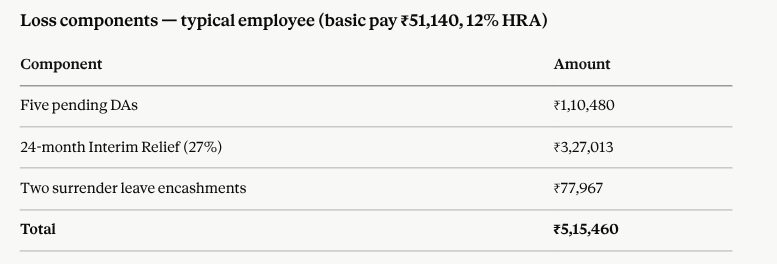
The numbers being cited are politically explosive. A mid-level employee with a basic pay of around ₹51,140 is said to have lost more than ₹5.15 lakh over two years when unpaid DAs, interim relief, and surrender leave dues are added up.
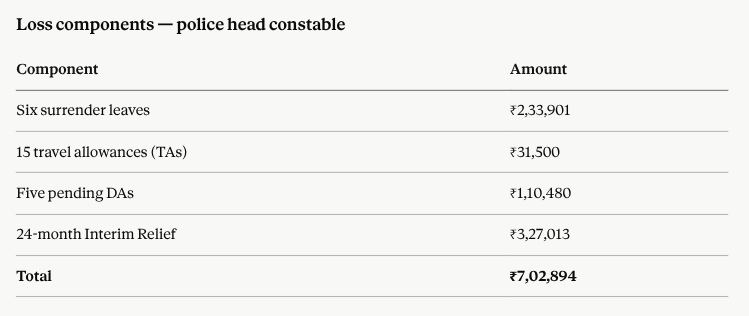
For a head constable, the estimate is even higher, crossing ₹7 lakh once surrender leaves and travel allowances are included.
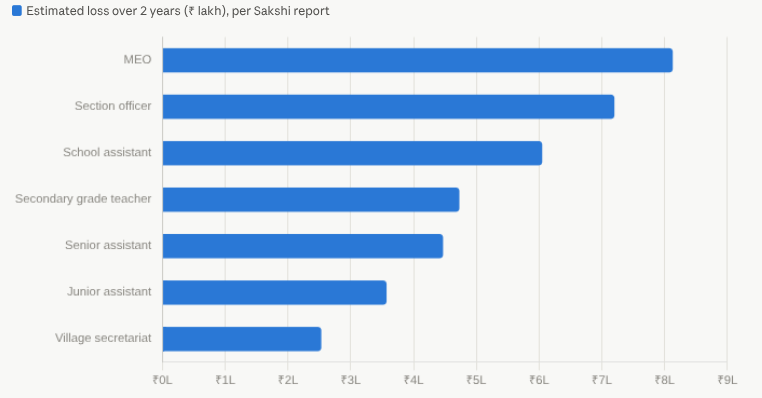
Whether every figure survives forensic scrutiny or not, the larger point is clear: employees believe they have been made to absorb the cost of the state’s fiscal hesitation.
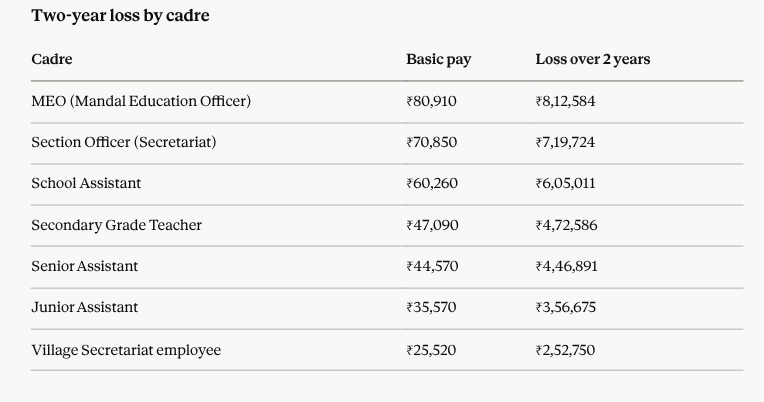
The pattern is clear from the chart: the loss scales with basic pay, since the pending DAs and IR are percentages of salary — so senior cadres like MEOs and Section Officers have forgone the most in absolute terms, while village secretariat employees, the lowest paid, have lost the least in rupees but arguably feel it hardest relative to income. This is where the political damage deepens. A manifesto is not supposed to be a decorative pamphlet. It is meant to be a public commitment, a promise that voters can measure after the election dust settles. When campaign slogans are used to harvest trust and then quietly sidelined in office, the injury is not just financial. It is democratic. It tells people that promises are for elections, not governance.
The government’s defenders will argue that the state faces liquidity constraints and inherited fiscal pressures. That may be true, at least in part. But fiscal stress does not explain the absence of clarity. Employees are not asking for rhetoric; they are asking for dates. They want a timetable for pending dues, a clear word on PRC, a firm commitment on GPS and CPS issues, and a serious explanation for why obligations to the workforce continue to move slower than the government’s own publicity machine.
That contrast has become central to the anger. Governments always find money for optics. They can fund events, announcements, summits, and ceremonial launches with remarkable speed. But when the same government takes months or years to clear earned dues, the message is unavoidable: it has chosen its priorities, and employees are not at the top.
The most troubling part of this episode is the normalization of delay. Once a government gets away with postponing one DA, then another, then another, postponement stops looking like exception and starts looking like policy. Employees begin to accept that what is contractually due must be begged for politically. That is a dangerous precedent, because it weakens not just morale but the very idea of public service as a stable and respected profession.
And then there is the human cost. Behind every stalled allowance is a household that has already adjusted its life around the expectation of salary revision. Teachers, assistants, constables, and pensioners do not live in budget documents. They live in the gap between what they were promised and what actually reaches their bank accounts. That gap is where resentment grows, and where political credibility quietly dies.
If the Naidu government wants to recover trust, it needs to stop treating employee grievances as background noise. It must publish a clear schedule for pending DA payments, resolve PRC uncertainty, settle the GPS issue, and release the dues that have been withheld for too long.