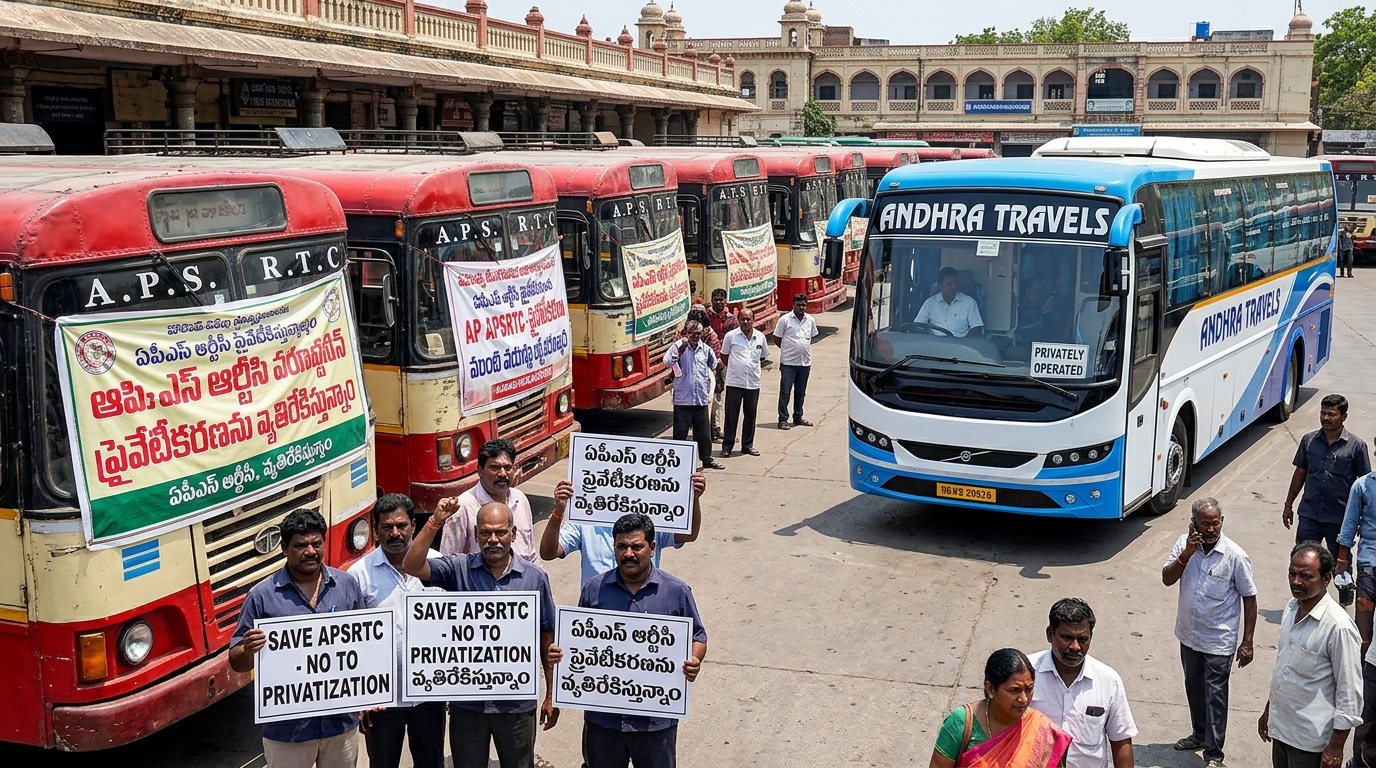
A fresh political and labour confrontation has erupted in the state after APSRTC chairman Konakalla Narayana Rao publicly said that private participation in electric bus operations had become unavoidable due to the corporation’s mounting financial burden and inability to independently fund a full-scale electric fleet transition. This is not a technical announcement about electric buses. This is a political declaration about who controls public transport in Andhra Pradesh.
The Numbers Being Used to Justify the Surrender
APSRTC currently operates nearly 10,000 buses, and replacing the entire fleet with electric buses would require investments of around ₹15,000 crore, which the corporation cannot presently sustain. Each electric bus costs between ₹1.6 crore and ₹1.7 crore, making direct procurement financially unviable for the state-run transporter.
These numbers are real. The financial challenge is real. But the conclusion the TDP government draws from them that private operators must therefore own and run the fleet is a political choice, not an economic inevitability. It is the same choice that governments across the world make when they have decided, for ideological or donor-related reasons, to transfer public assets to private hands and need a financially compelling narrative to justify it.
Blaming Women for the RTC’s Financial Stress
Narayana Rao also linked the RTC’s worsening financial stress to the government’s free bus travel scheme for women, stating that the Stree Shakti initiative had significantly increased operational liabilities while reducing the corporation’s ability to purchase new buses.
This statement deserves particular scrutiny, because it represents a specific and troubling political manoeuvre: blaming a welfare scheme for women — one of the most tangible benefits that working-class, rural, and low-income women in AP have received from any government for the financial condition that is now being used to justify privatisation.
Employee unions further argued that while women ridership had increased under the free travel scheme, the number of buses in operation had simultaneously declined. The unions are right. More women are travelling. Fewer buses are running. That is not the fault of the women. That is the fault of a government that inherited a welfare scheme, continued it for political reasons, and simultaneously refused to adequately compensate APSRTC for the revenue foregone — leaving the corporation to absorb the cost of a state welfare commitment from its own operational budget.
The Evidence on the Ground: Depots Being Vacated
Workers at APSRTC have not been fooled by the language of electric mobility reform. Employee unions alleged that depots were already being vacated and restructured to facilitate private EV operations. They pointed to the relocation of the large Vidyadharapuram depot in Vijayawada to Guntur as evidence of gradual restructuring linked to the incoming electric bus fleet.
The RTC has already initiated procurement of 1,050 electric buses, including 750 buses for which tenders have reportedly been finalised. The first batch is expected to enter service within the next two to three months. The question is not whether electric buses are coming. It is who will own them, who will operate them, who will profit from them, and what happens to the 10,000 vacancies and the outsourced workers when private operators bring their own workforce.
The TDP government’s response will predictably be to deny that privatisation is planned, to accuse unions of spreading misinformation, to reframe private participation as “partnership,” and to assure workers that their jobs are safe. This government’s promises to working people have a record. The record is not reassuring.