“History does not repeat itself, but it often rhymes” said Mark Twain and now Tamil Nadu politics is rhyming. Y.S. Jagan Mohan Reddy’s YSR Congress Party and Thalapathy Vijay’s Tamilaga Vettri Kazhagam are separated by geography, language, and political context. But when you lay the manifestos of YSRCP and TVK side by side, examine their ideological positioning, study their communication strategies, and observe how each leader has constructed his political identity, what emerges is not coincidence. It is convergence — around a specific, coherent, and increasingly proven model of democratic politics that begins with the outsider, speaks to the forgotten, delivers through the direct, and wins by making the establishment irrelevant.
The Policy Mirror: Schemes That Are Twins
Amma Vodi and Kamarajar Kalvi Urudhi Thittam: The Same Idea, Different Names
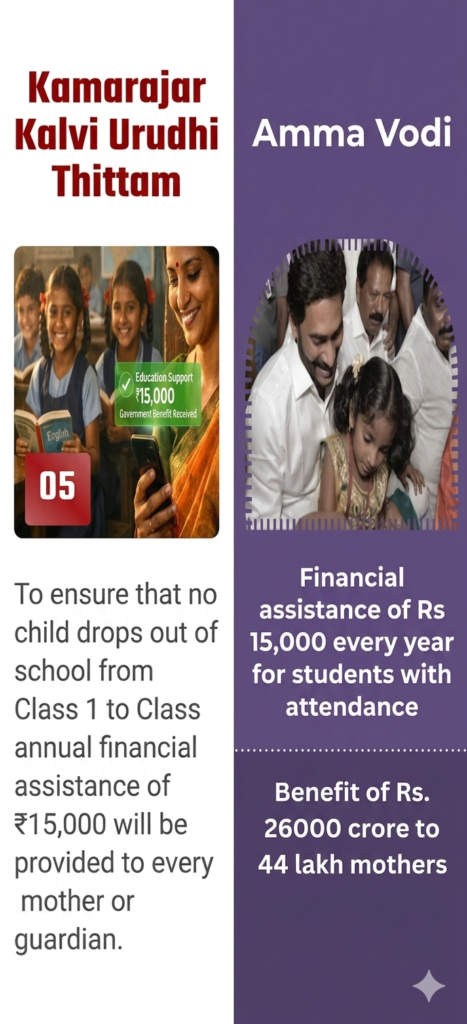
The amount, mechanism, and target beneficiary are identical. The political logic is identical: if you put money directly into a mother’s hands, tied explicitly to her child’s school attendance, you simultaneously address dropout rates and create a direct government-to-citizen relationship.
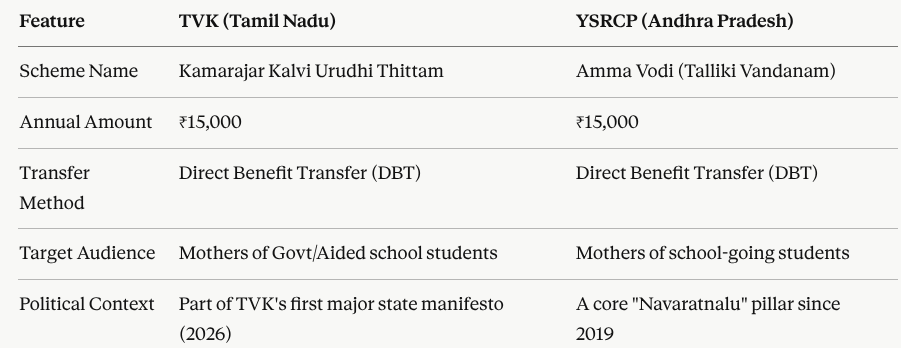
Jagan implemented this in 2019 and paid ₹15,000 annually to millions of mothers across Andhra Pradesh. It became one of YSRCP’s most politically powerful schemes — not because of its scale alone, but because of its directness. The money came from the government to the mother. Just a direct transfer that every recipient knew came from one source.
Vijay has announced the same scheme, same amount, same mechanism, for Tamil Nadu. Whether he studied Jagan’s model specifically or arrived at the same logic independently is less important than the fact that the political instinct driving both decisions is identical: trust mothers with money, trust them to make the right decisions for their children’s education, and in doing so create a political compact that is personal, financial, and lasting.
The Volunteer Model: YSRCP’s Most Innovative Governance Tool, Reimagined for Tamil Nadu
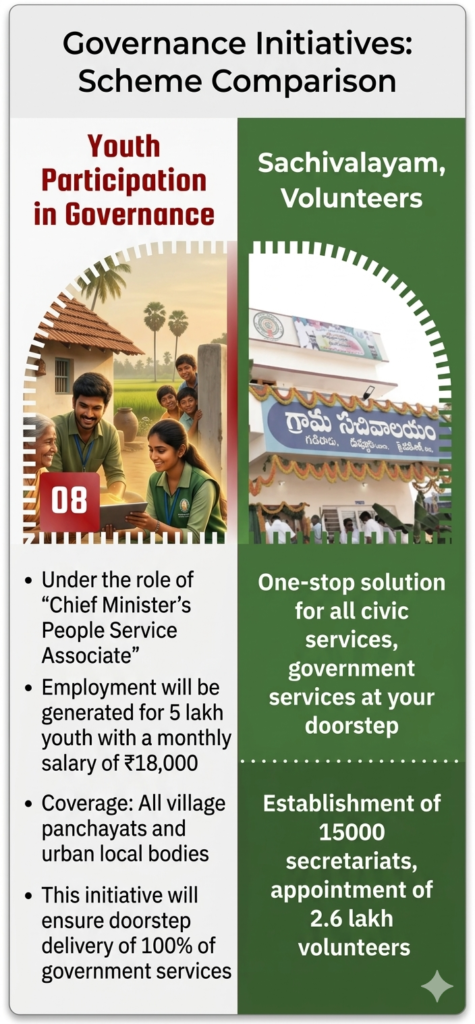
The second major policy parallel is equally striking. TVK has proposed a “CM People Service Associate” programme — a network of ground-level government service facilitators who would connect citizens directly to government schemes and services at the village and ward level. The party has promised to employ half a million young people at the village level as part of the “CM People Service Associate” programme, a job that will earn them ₹18,000 a month.
This is, in its conception and intent, a direct parallel to YSRCP’s Village and Ward Volunteer system — one of the most innovative and politically transformative governance mechanisms implemented by any Indian state government in recent years.
Jagan’s volunteer system placed trained volunteers in every village and urban ward across Andhra Pradesh. These volunteers served as the human interface between the government and the citizen, helping beneficiaries navigate application processes, ensuring that scheme benefits reached the right people, and providing the government with real-time ground-level intelligence about delivery gaps. At its peak, the system covered virtually every household in the state.
TVK’s “CM People Service Associate” programme is the Tamil Nadu version of this idea. The name is different. The principle that the government must have human presence at the last mile, and that this presence must be service-oriented rather than bureaucratic is identical.
Free Crop Insurance Scheme: Same Scheme and Same Concern towards Farmers
The structural identity is complete. Both schemes share the same philosophy: the farmer who loses his crop to forces beyond his control — cyclone, flood, drought, hailstorm should not bear that loss alone. The state, which exists precisely to provide the security that individuals cannot provide for themselves, must stand behind the farmer at the moment of his greatest vulnerability.
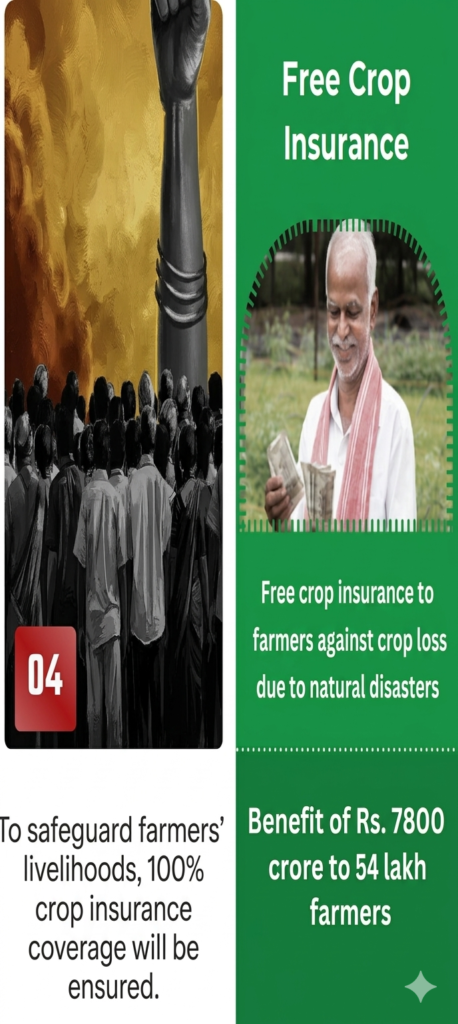
When Thalapathy Vijay’s TVK released its manifesto for Tamil Nadu, one commitment stood out for farmers: 100% crop insurance coverage to safeguard farmers’ livelihoods against natural disasters — free of cost to the farmer.
Between 2019 and 2024, the YSRCP government of Y.S. Jagan Mohan Reddy implemented exactly this model — free crop insurance against natural disaster losses and delivered across Andhra Pradesh. The premium was paid entirely by the government. The farmer paid nothing. When the cyclone came, when the flood arrived, when the unseasonal rain destroyed the standing crop, the cheque went directly to the farmer’s bank account.
Now TVK is promising Tamil Nadu’s farmers the same protection. The comparison is instructive — both for what it reveals about the political philosophy both parties share, and for what Tamil Nadu’s farmers can expect if Vijay delivers on his commitment.
The Ideological Architecture: Seven Pillars That Both Parties Share
Beyond specific schemes, the deeper parallels between TVK and YSRCP lie in the ideological architecture that shapes how each party positions itself, communicates, and builds political identity.
1. Independent Political Positioning: The Alliance Question
Both leaders have made the same foundational strategic choice: self-reliance over coalition dependence.
Jagan built YSRCP from scratch in 2011 and contested the 2014 and 2019 elections on his own strength — refusing to enter a pre-electoral alliance that would have diluted his mandate and complicated his governance. His instinct was correct. The 2019 landslide — 151 /175 seats was delivered to YSRCP alone, unencumbered by coalition obligations, free to govern without the constraints of alliance arithmetic.
Vijay launched TVK without leaning on established Tamil political structures. He resisted the enormous pressure from DMK, from political analysts, from coalition stakeholders to take shelter under an established party’s umbrella. The result: a debut at 34.9%, the highest first-election vote share of any party since 2000, with a mandate that belongs entirely to TVK and to Vijay. No coalition partner can claim it. No alliance can qualify it.
Both leaders understood something that conventional political wisdom resists: the outsider mandate is most powerful when it is uncontaminated by alliance with the establishment being challenged. The moment you ally with DMK, you inherit DMK’s baggage. The moment you ally with Congress or BJP, you are no longer the alternative — you are part of the system.
Going alone is terrifying. Both Jagan and Vijay chose terror over compromise. Both were rewarded.
2. Direct Appeal to the Masses: Speaking to the Forgotten
The communication style of both leaders shares a fundamental orientation: they speak to ordinary people, in ordinary language, about ordinary problems — not to the political class, not to the English-language media establishment, not to the think-tank discourse that shapes elite political opinion.
Jagan’s political communication during the padayatra years — sitting in the homes of farmers, eating with daily wage workers, listening to the grievances of widows and students — was the antithesis of the technocratic governance-speak that Chandrababu Naidu had perfected. Where Naidu spoke of Singapore and smart cities, Jagan spoke of the price of rice and the unpaid hospital bill.
Vijay’s political speeches frame politics consistently in terms of “people versus system” — a narrative that immediately resonates with the Tamil voter who has watched the DMK-AIADMK duopoly treat the state as a family inheritance for five decades. His language is accessible, his imagery is drawn from lived experience, and his presence at rallies carries the emotional directness of someone who is genuinely — not performatively — angry about the condition of ordinary people.
Both leaders have mastered what political scientists call “populist communication” — but without the pejorative associations that word sometimes carries. This is not demagoguery. It is the genuine act of making politics legible and relevant to people who have been excluded from its rewards.
3. Welfare-First Governance: The DBT Model as Political Philosophy
Jagan’s governance was built around a specific and consistent philosophy: welfare must be direct, personal, and unmediated. The Navaratnalu — nine flagship welfare schemes covering education, health, agriculture, women’s empowerment, and housing — were all delivered through Direct Benefit Transfer, all tied to verifiable beneficiary criteria, and all designed to eliminate the intermediary extraction that had historically consumed a significant portion of every welfare rupee before it reached the intended recipient.
The political consequence of this model was equally specific: it created millions of individual beneficiaries who had a direct, personal, financial relationship with the government — and therefore with Jagan. Not with the local MLA. Not with the party functionary. With Jagan. The Amma Vodi mother who received ₹15,000 knew exactly where it came from. The farmer who received Rythu Bharosa knew exactly who sent it.
Vijay’s manifesto signals the same welfare-first philosophy. The Kamarajar Kalvi Urudhi Thittam is structured identically to Amma Vodi. The CM People Service Associate programme mirrors the volunteer system designed to ensure last-mile delivery. The political logic is the same: put resources directly in people’s hands, build a personal relationship between the government and the citizen, and make the welfare receipt a repeated, reinforcing political signal.
The difference is that Jagan’s model has been tested in governance and proven — the 596-mark government school students of Andhra Pradesh are its most eloquent testimony. Vijay’s model is, at this moment, aspirational. The test of governance lies ahead. But the aspiration is rooted in the same political philosophy.
4. Carefully Crafted Public Image: The Minimalist Leader
Both leaders have constructed public personas that are deliberate in their simplicity and consistency.
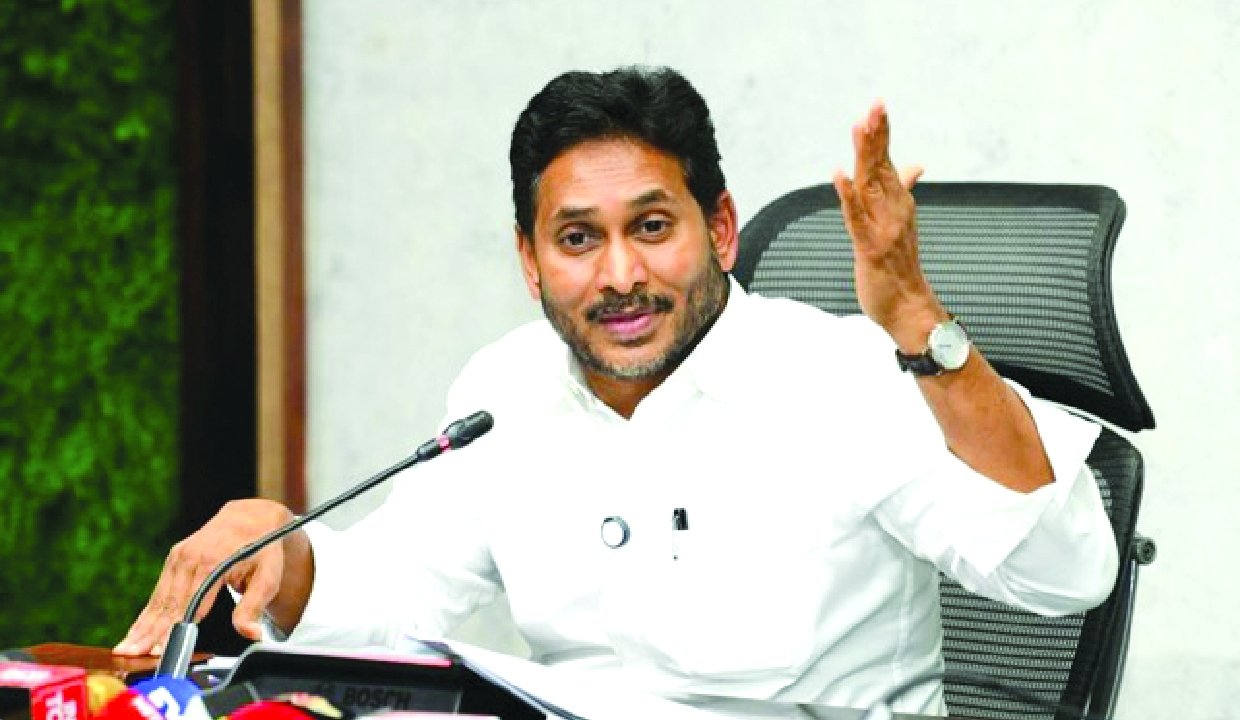
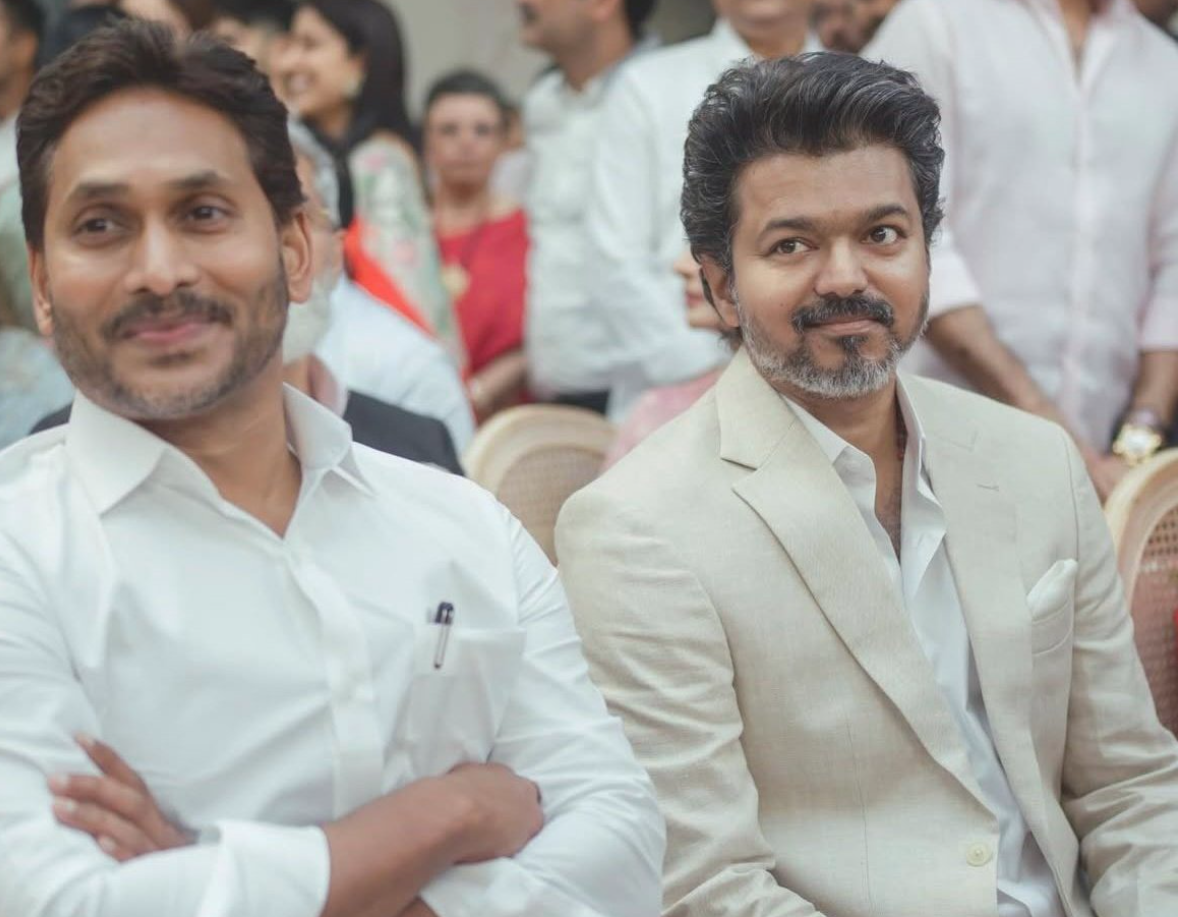
Jagan: calm, composed, white kurta, padayatra dust, unhurried speech, the quality of someone who has been through the worst and emerged unbroken. The political imprisonment, the padayatra, the years of opposition — all of it has contributed to a public image of quiet, determined resolve that is the opposite of the performative energy of the typical Indian politician.
Vijay: simple dressing, controlled public appearances, a deliberate transition from cinematic flamboyance to political sobriety. He arrived in politics not as Thalapathy the action hero but as Vijay the citizen — and the consistency of that persona, maintained through the launch of TVK and through the election campaign, signals a political seriousness that his critics initially doubted.
Both images share a quality that is increasingly rare in Indian politics: authenticity. Neither feels manufactured for a marketing campaign. Both feel rooted in something real about who these men are and what they have been through.
5. Leader-Centric Party Architecture
Both YSRCP and TVK are, to a significant degree, extensions of their leaders’ personal political identity.
YSRCP without Jagan is politically unimaginable — the party draws its credibility, its voter loyalty, and its organisational coherence from his personal brand. This is a structural vulnerability but also a structural strength: the personal loyalty to Jagan that drives YSRCP’s base is deep, emotional, and not easily transferred to rival parties.
TVK without Vijay is similarly unimaginable at this stage of its development. The 34.9% that TVK won in its debut election was, to a very significant degree, a vote for Vijay personally — for his credibility, his celebrity-to-seriousness transition, and the specific promise that he embodies as a political figure.
Both leaders are aware of this structural reality. Jagan has spent his years in power attempting to build YSRCP as an institutional party rather than purely a personality vehicle. Vijay will face the same challenge: converting personal loyalty into institutional party strength that can survive and succeed beyond the exceptional magnetism of its founder.
6. The Anti-Establishment Challenger Narrative
Jagan rose in direct challenge to the Andhra Pradesh political establishment — specifically to Chandrababu Naidu’s TDP, which had the resources, the media, the administrative machinery, and the accumulated alliance networks of a dominant state party. Jagan challenged it from a position of disadvantage — a young leader, a new party, personal legal persecution — and overcame it.
Vijay positions himself explicitly as an outsider entering Tamil politics to “change the system” — a system that the DMK-AIADMK duopoly has defined and controlled for over fifty years. He arrived without the endorsement of that system, challenged it on its own ground, and won 34.9% in his first attempt.
The challenger narrative is not merely a rhetorical choice for either leader. It is rooted in lived experience: Jagan was literally imprisoned by the political establishment he was challenging. Vijay was the subject of sustained political and media pressure to abandon his political ambitions. Both men’s challenger credentials are genuine — which is precisely why voters respond to them as authentic rather than performed.
7. Fan-to-Voter Conversion: Emotional Loyalty as Political Capital
Jagan inherited a specific and powerful political legacy — the emotional loyalty of the followers of his father, Y.S. Rajasekhara Reddy, one of Andhra Pradesh’s most beloved Chief Ministers. That loyalty, sustained through Jagan’s personal tribulations and his identification with his father’s welfare legacy, became the emotional foundation of YSRCP’s political capital.
Vijay brings a different but structurally similar form of emotional loyalty: the devotion of a massive fan base built over decades of cinema. The Thalapathy fan base — organised, passionate, geographically distributed, and accustomed to collective action in support of their hero — is one of the largest and most disciplined political mobilisation assets in Tamil Nadu’s history.
Both leaders faced the same conversion challenge: transforming emotional loyalty (to a political legacy, to a cinematic icon) into electoral votes for a specific political party, in a specific election, against specific opponents. Both succeeded. The mechanism of conversion — sustained direct communication, welfare promise, challenger narrative, personal credibility — was remarkably similar.
The Model That Is Working
What the comparison between TVK and YSRCP ultimately reveals is that a specific model of democratic politics — outsider entry, independent positioning, direct welfare delivery, authentic communication, challenger narrative, and emotional loyalty converted to political capital is not a one-off accident. It is a reproducible approach that, when executed with genuine commitment, produces electoral success and, in government, measurable welfare outcomes.
Jagan proved it in Andhra Pradesh. Vijay has demonstrated its electoral power in Tamil Nadu. The question is whether he will now prove it in governance.
If he does, if the Kamarajar Kalvi Urudhi Thittam reaches Tamil mothers the way Amma Vodi reached Andhra mothers, if the CM People Service Associates connect Tamil citizens to government the way village volunteers connected Andhra citizens then Tamil Nadu will have witnessed not just a remarkable political debut but the beginning of a governance transformation that the state’s political establishment, for all its decades of power, never delivered.
The blueprint exists. Jagan drew it. Vijay is using it. This is the story Tamil Nadu is only beginning to write.