There is a particular kind of political victory that arrives not on the shoulders of allies, not through the machinery of coalition arithmetic, not with the blessing of the establishment — but despite all of them. A victory earned by speaking directly to people who had been spoken at for too long, by an outsider who the system was certain would fail, who the commentators dismissed, who the veterans condescended to, and who won anyway. Tamil Nadu has just witnessed one such victory.
The Man the Establishment Underestimated
When Thalapathy Vijay announced the formation of Tamilaga Vettri Kazhagam — TVK — the political establishment of Tamil Nadu did what political establishments always do with outsiders who presume to enter their domain: it laughed.
A film star with no political experience, no cadre base built over decades and no alliance with DMK or AIADMK — the two tectonic plates between which Tamil politics has moved for half a century. A celebrity vanity project that would evaporate the moment the crowds discovered that stardom does not translate to electoral machinery.
The analysts were certain. The veterans were dismissive. The alliance brokers waited for the phone call that would signal Vijay’s surrender to the coalition system — the call asking to be accommodated, to be given a few seats, to be brought under the umbrella of an established party in exchange for TVK’s mobilisation capacity. The call never came.
Vijay went alone. TVK contested without a principal alliance, without the structural support that Tamil political wisdom insists is non-negotiable for a new entrant, without the patronage networks that decades-old parties take for granted. He built his campaign on direct communication — on the issues of the young, the unemployed, the first-generation aspirant who had watched Tamil politics serve everyone except them for decades.
In Tamil Nadu, the voter Vijay spoke to is the young person who grew up watching the DMK-AIADMK duopoly treat Tamil politics as a family inheritance to be passed between Karunanidhi’s children and Jayalalithaa’s successors. The student burdened by unemployment in a state with one of India’s highest youth populations. The aspirant who wants a politics that is not about caste arithmetic and dynastic succession but about genuine governance and social justice.
Vijay’s TVK won convincingly enough to announce, without ambiguity, that TVK is not a temporary phenomenon. It is a political force that Tamil Nadu must now permanently reckon with.
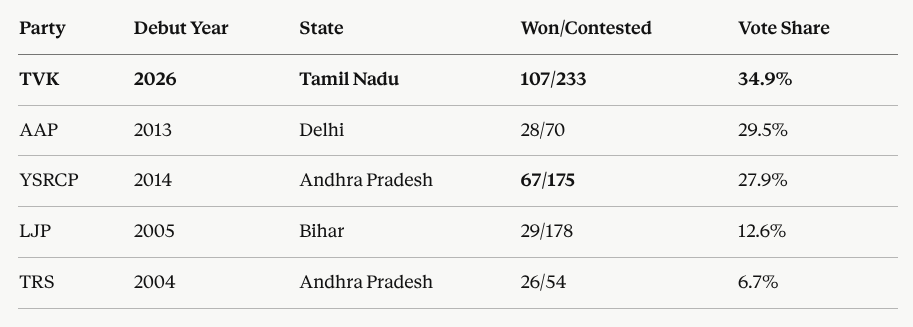
Tamil Nadu just witnessed the greatest political IPO in post-2000 Indian democratic history. Thalapathy Vijay’s Tamilaga Vettri Kazhagam — TVK, contesting its very first election, won 107 of 233 seats with a 34.9% vote share. No party making its electoral debut in India since the turn of the millennium has matched this.
The Alliance Question: Why Going Alone Was the Right Call
The most important strategic decision and the one most counterintuitive to conventional political wisdom was the decision to contest without a principal alliance.
Every experienced political advisor will tell you that going alone in a first major election is reckless. Alliance partners bring constituencies, cadres, and vote transfer that an untested party cannot generate on its own. The mathematics of coalition politics is not merely about addition — it is about the legitimacy that comes from being chosen by established political actors.
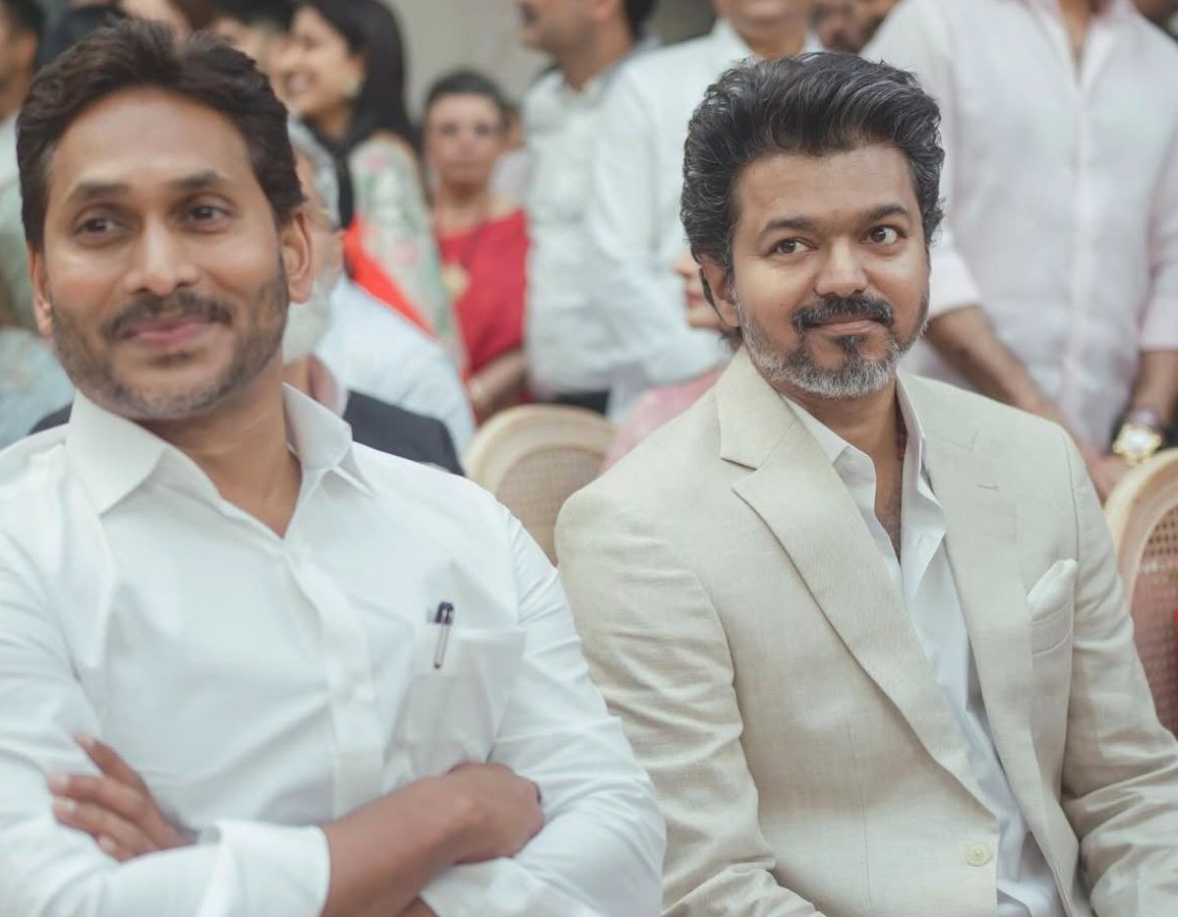
YS Jagan Mohan Reddy in Andhra Pradesh rejected this logic. He understood that the moment he entered an alliance with an established party, he would be seen as part of the system he was challenging — as another accommodation, another negotiated entry into the political establishment that had already failed the people he was claiming to represent. His power came precisely from his separation from that establishment, and an alliance would have contaminated it.
Vijay has demonstrated the same understanding with remarkable political maturity for a first-time contestant. TVK’s refusal to anchor itself to either DMK or AIADMK is not stubbornness or naivety. It is a sophisticated reading of why his constituency came to him in the first place.
The people who voted for TVK did not do so because they wanted a better version of the DMK. They voted for TVK because they wanted something the DMK and AIADMK could not offer — politics untainted by the accumulated compromises, the family networks, the corruption cycles, and the governance failures of fifty years of two-party dominance.
The moment Vijay allies with either, he inherits their baggage. The moment he goes alone and wins, he owns his mandate completely — and that mandate becomes the foundation of genuine, independent political power.
The Democracy That Keeps Surprising Itself
What Vijay’s TVK victory confirms is that Indian democracy retains a capacity to surprise itself that its cynics consistently underestimate. The system is not closed, and the establishment is not impregnable. The two-party dominance that looks permanent from inside is not permanent at all — it is maintained only for as long as no one credibly offers the alternative that a significant portion of the electorate is waiting for.
Both YS Jagan and Vijay found that alternative. Both spoke directly, honestly, and consistently to people who had been taken for granted. Both went alone when conventional wisdom said an alliance was mandatory. Both won in ways that reshaped their states’ political geography.