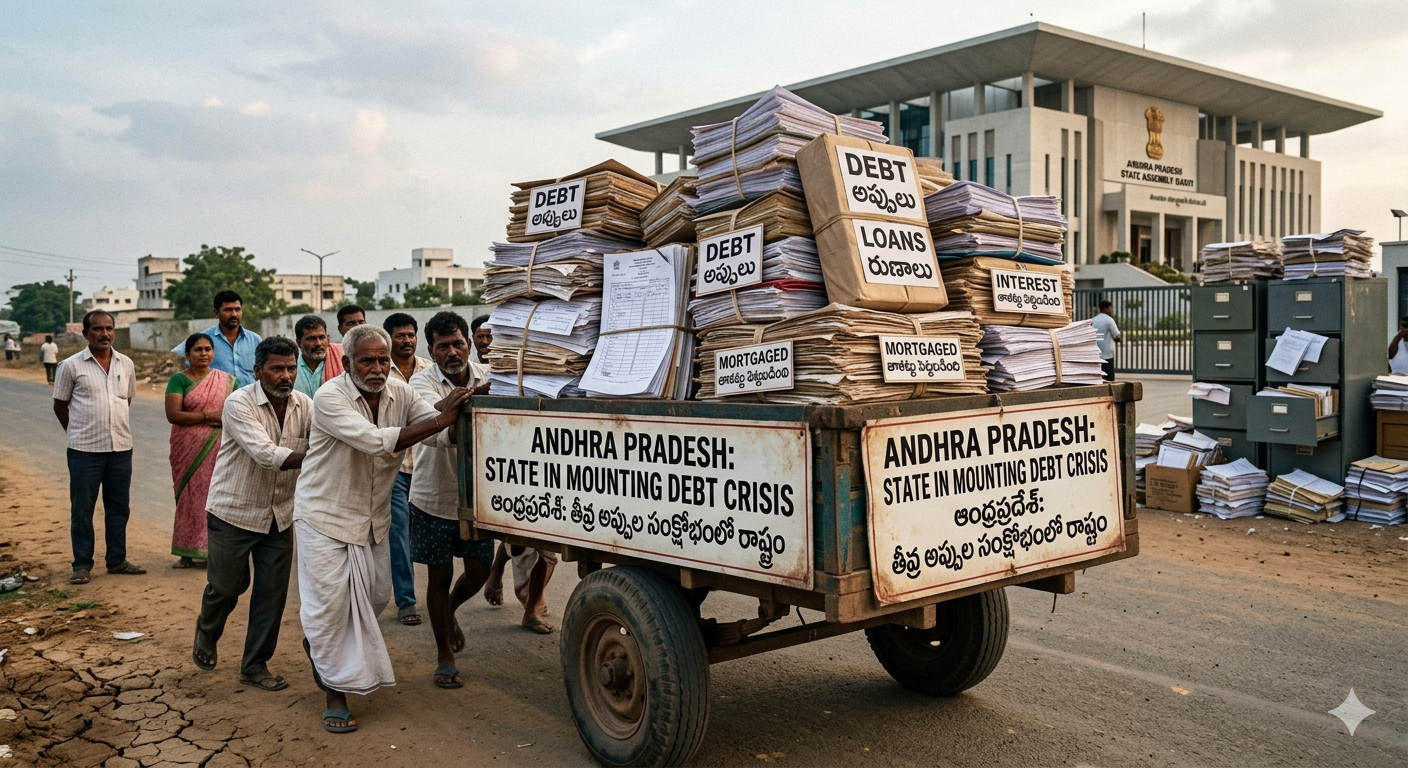
On a Tuesday morning in Andhra Pradesh, the state government borrowed ₹4,600 crore in a single day at an interest rate of 7.81%. It was not an emergency. It was not a crisis response. It was routine because under the TDP-led coalition government of N. Chandrababu Naidu, borrowing at this scale has become the ordinary business of governance.
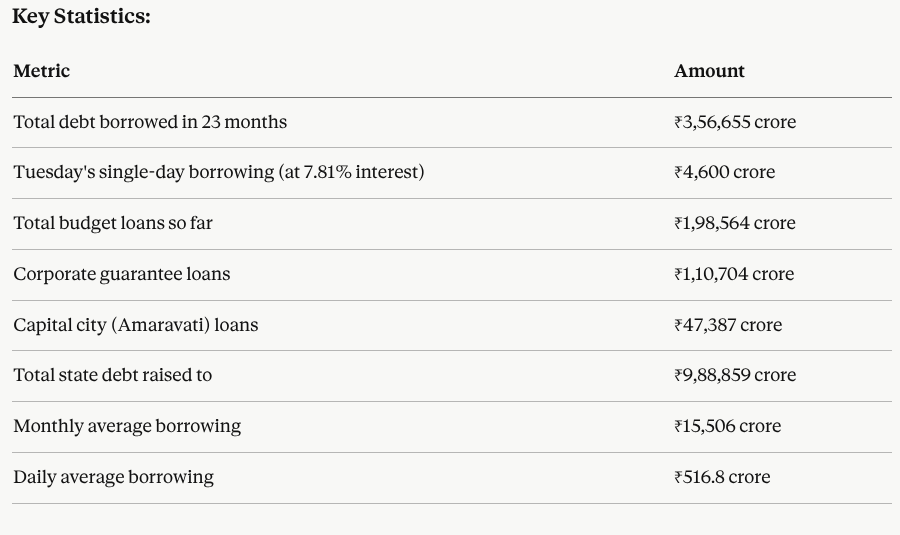
In just 23 months of TDP rule, the Chandrababu Naidu government has borrowed ₹3,56,655 crore, an average of ₹15,506 crore every month, ₹516.8 crore every single day. Andhra Pradesh is being buried in debt, where income of the people of the state are not growing at anywhere near this pace, they will spend decades paying for it.
From ₹6.32 Lakh Crore to ₹9.88 Lakh Crore in 23 Months
When the YSRCP government handed over power in June 2024, the total state debt stood at approximately ₹6,32,204 crore. The TDP spent five years in opposition, characterising the YSRCP government as fiscally reckless a government that borrowed without restraint, accumulated debt without accountability, and mortgaged Andhra Pradesh’s future for present consumption.
The numbers now on record tell a different story. In 23 months, the TDP government has borrowed ₹3,56,655 crore — a pace that exceeds the YSRCP’s borrowing per unit of time and has pushed total state debt toward ₹9.88 lakh crore
To put that in perspective: the TDP government is borrowing more per month than was borrowed on average in any comparable period under YSRCP. No previous government has borrowed this heavily in such a short period. This scale of borrowing in this timeframe belongs uniquely to Chandrababu Naidu’s current administration.
Three Debt Streams, One Direction: Down
The ₹9,88,859 crore total debt is not a single pile. It flows from three distinct streams, each revealing a different dimension of the government’s financial strategy.
Budget loans — ₹1,98,564 crore: These are the borrowings that appear in the official budget, the on-book debt that the government acknowledges formally. Even this figure alone represents an extraordinary pace of borrowing, with the state accessing capital markets at rates that are placing significant pressure on revenue budgets through interest payments.
Corporate guarantee loans — ₹1,10,704 crore: This is where the debt becomes structurally dangerous. The government has provided guarantees on loans taken by various corporations and entities loans that do not appear directly on the budget but for which the state is ultimately liable. Rather than disbanding existing corporations that have taken on debt, the government is creating new corporations and adding to the guarantee burden. When these entities cannot service their debt as many state corporations historically have, the liability falls to the state budget and ultimately to the taxpayer.
Amaravati capital city loans — ₹47,387 crore: The Amaravati project, the greenfield capital city that is the signature ambition of the Chandrababu Naidu government, has generated ₹47,387 crore in borrowings. This figure, as discussed in previous analyses, is built on the assumption that land monetisation and private investment will generate returns sufficient to service the debt. If those assumptions prove optimistic, as the Naya Raipur precedent suggests is possible, the Amaravati debt becomes a long-term fiscal commitment carried entirely by the state.
The Super Six Promises: Made With Borrowed Money, Delivered in Part
The TDP government came to power in 2024 on the strength of six major welfare promises — the Super Six schemes. But those promises: the loans taken to fund outside-budget commitments and the Super Six promises are being executed selectively. Revenue expenditure has not been increased to match the borrowing pace. The people of Andhra Pradesh were promised welfare delivery. What they have received is welfare promises alongside debt accumulation. The promises were partially implemented, and the debt was fully incurred.
Meanwhile, the state’s ability to raise its own revenues to grow the tax base, improve GST collections, and increase the income available to fund both welfare and development has lagged.
Interest: The Invisible Tax
At 7.81% interest, the rate on Tuesday’s ₹4,600 crore borrowing, the mathematics of debt service becomes sobering. On ₹9,88,859 crore of total debt at an average interest rate in the range of 7-8%, annual interest payments are in the range of ₹70,000-79,000 crore. That is money that must be found every year before a single rupee is spent on medicines, schools, roads, wages, or welfare. It is money paid to lenders, banks, institutional investors, but not to a government hospital, a government school, or a rural employment programme.
As debt grows, interest payments grow with it. As interest payments grow, the space available for productive expenditure shrinks. This is the debt trap mechanism: borrowing to fund current expenditure creates future obligations that crowd out the very expenditure they were meant to fund.
The drug budget cuts at major government hospitals are one visible manifestation of this squeeze. When ₹70,000+ crore per year must be set aside for interest before discretionary spending begins, something has to give. In Andhra Pradesh under TDP, what has been given includes the drug budgets at KGH Visakhapatnam, GGH Kurnool, and eight other major hospitals.
The People Who Will Pay
Every rupee of debt incurred by the state government will ultimately be serviced from state revenues, revenues generated by Andhra Pradesh’s taxpayers, its businesses, its farmers, its workers. The debt clock that ticked ₹516.8 crore on Tuesday will tick again on Wednesday, Thursday, and every day that follows.
The people of Andhra Pradesh did not choose to borrow ₹9.88 lakh crore. They did not sign the loan documents. They were not consulted about the interest rates or the repayment schedules. But they and their children, and their children’s children, will be the ones who service this debt through decades of revenue obligations.
Conclusion: A Government That Governs by Borrowing
Andhra Pradesh, under the TDP government, is not borrowing to invest in transformative infrastructure with measurable returns. It is not borrowing to fund a temporary emergency that will resolve and allow debt stabilisation. It is borrowing ₹516 crore every day to fund a combination of capital ambition, corporate commitments, and current expenditure while the state’s own revenue generation lags and its welfare programmes are cut.
That is the definition of a debt trap: borrowing that generates obligations faster than it generates returns, creating a cycle in which future borrowings are required to service past ones.
The state that was promised, Swarnandhra, is being mortgaged at ₹516.8 crore per day. The gold, if it exists, is going somewhere. It is not reaching the medicine shelf at GGH Kurnool. It is not reaching the MGNREGA worker in Anantapur. It is not reaching the 25,000 fishing families of Juvvaladinne.