In the history of Indian state governments finding novel ways to manage fiscal distress, the Andhra Pradesh government under Chandrababu Naidu has achieved something unprecedented.
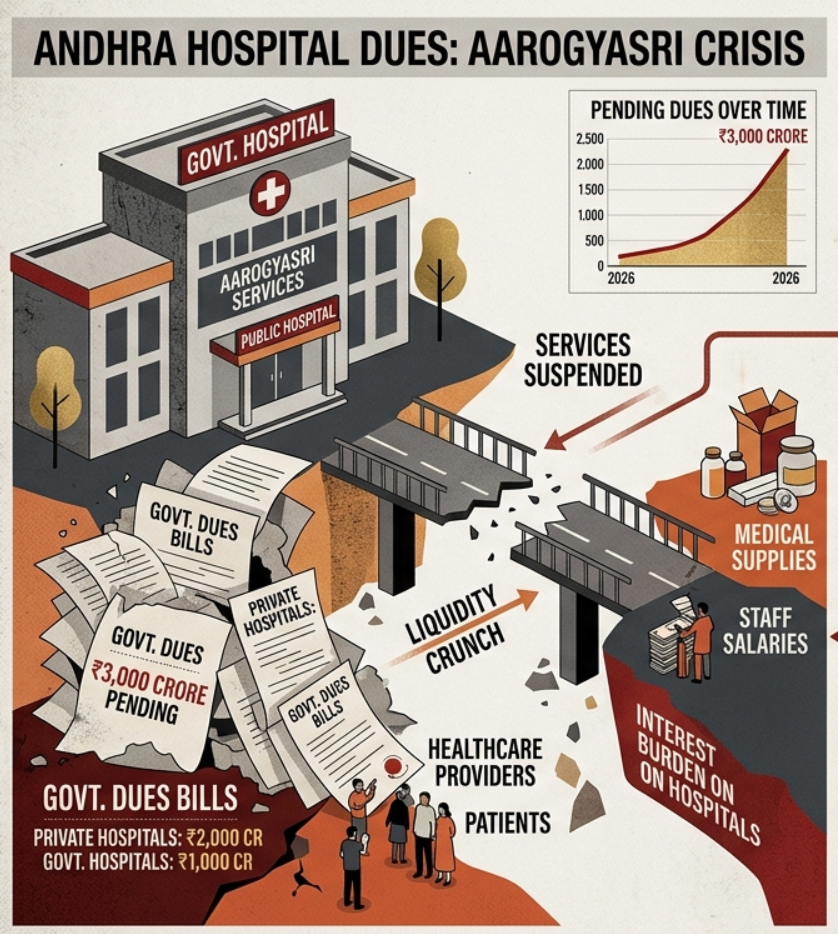
The government owes ₹1,000 crores to Government hospitals and ₹2,000 crores to private hospitals in unpaid Aarogyasri dues, money owed to network hospitals for treating the state’s poorest patients. Unable to pay from its own revenues, it has decided to take a loan from a finance corporation to clear those dues.
So far unconventional but not unheard of, but what is unprecedented is asking the hospitals to pay 8% interest on that loan i.e taking a loan to repay a debt and then asking the person you owed the debt to pay the interest. It is a formulation that would be dismissed as absurdist fiction if it appeared in a novel. In Andhra Pradesh in 2026, it is government policy.
How Andhra Pradesh Got Here
The Aarogyasri health insurance scheme is one of the flagship welfare programmes that successive AP governments have maintained by providing treatment to patients below the poverty line in private hospitals. The state pays the hospitals for those treatments through insurance mechanisms.
Under the TDP government, payments to these network hospitals fell badly behind and dues accumulated. Hospitals operating as businesses with their own staff costs, equipment maintenance, medicine procurement, and facility overheads began feeling the financial pressure of providing services for which they were not being paid.
Some hospitals began refusing to treat Aarogyasri patients. Others reduced the scope of treatments they would offer under the scheme. The poor patients who depended on Aarogyasri had no private insurance, no savings, and no alternative found themselves turned away or undertreated at the very facilities that were supposed to serve them.
The government’s response to this crisis is a proposal to borrow ₹1,000 crores from the APPFCL Andhra Pradesh Power Finance Corporation Limited to pay part of its dues to private hospitals. However, the government has asked hospitals to bear the 8 per cent interest burden on this loan after deducting 10 per cent TDS.
The Guarantor Clause: When Disbelief Becomes Policy
If the interest arrangement shocked observers, the guarantor clause completed the picture. The government has brought in another proposal to make the private hospitals the entities that are owed money as the guarantors for the loan being taken to pay them.
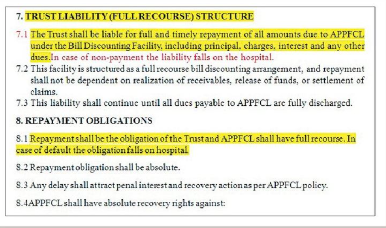
A guarantor is the party that stands behind a loan and agrees to repay it if the primary borrower defaults. In this structure, if the government defaults on the loan taken to pay the hospitals, the hospitals are liable for repayment. The hospitals are being asked to guarantee the government’s ability to repay the debt incurred to pay the hospitals. It is a financial structure of breathtaking audacity. The party that failed to pay its dues is now asking the party it failed to pay to guarantee its creditworthiness.
Legal and financial experts quoted in coverage of this scheme have expressed shock. Healthcare administrators have described it as unconscionable. Governance observers have struggled to find a precedent anywhere where a state government has imposed interest costs and guarantor liability on the very entities it owes money to. However private hospitals objected to an earlier clause requiring them to act as guarantors and rejected this condition.
Eligible network hospitals have been asked to access the portal and are required to accept the terms and conditions of payments. Once accepted, payments will be processed after deducting 10 per cent TDS and an additional 8 per cent interest payment from the billed amount.
Now ASHA representatives articulated the impossible position of private hospitals .”Given the situation, we have no choice but to agree. If payments are delayed by nine months to a year, the financial burden would be similar. It is better to accept an 8 per cent deduction now and get immediate funds.”