The commencement of an academic year should ideally bring hope, structured routine, and equal opportunity for every child. Yet, across Andhra Pradesh, the reopening of schools for the 2026–27 academic calendar has instead exposed deep institutional neglect and structural failure.
While grandiose electoral declarations promised enhanced welfare and structural modernization, a sobering look at government schools reveals an absolute collapse of the state’s educational supply chain. From missing textbooks to the outright withholding of financial support, the safety net that once shielded millions of vulnerable students has been completely pulled away.
The Day-One Disarray: Student Kits Vanish from Government Schools
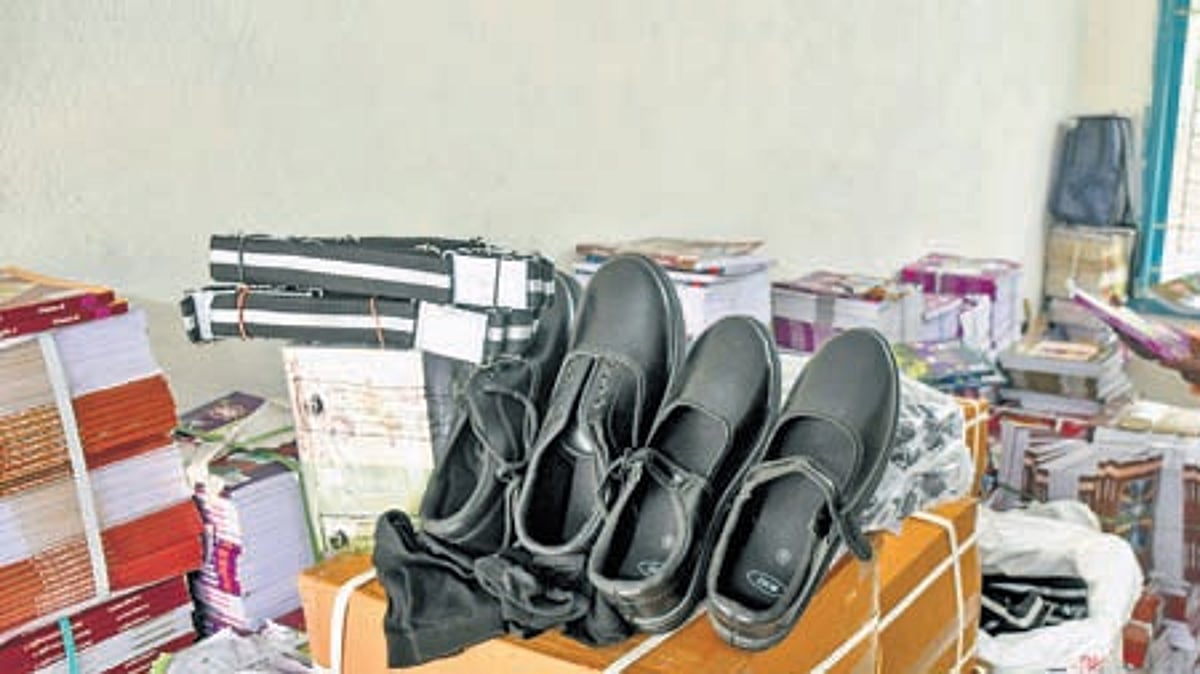
The most immediate casualty of the current administrative paralysis is the standard distribution of vital student kits. What was once a seamless operation ensuring millions of children received bilingual textbooks, notebooks, workbooks, uniforms, and shoes on the very first day of school—has turned into a logistical nightmare.
Rather than procuring fresh, high-quality supplies for the estimated 32 to 35 lakh students returning to classrooms, administrators have resorted to a patchwork strategy, forcing schools to adjust with leftover, ill-fitting stocks from previous years.
The collapse of this vital supply chain is driven by clear operational failures:
- The Debt Crisis in Supply Procurement: The administration has consistently delayed clearing outstanding dues to contractors and suppliers, which have accumulated to a staggering ₹1,372 crores.
- Bidding Boycotts: Due to these massive unpaid bills, major printing and manufacturing companies refused to participate in recent procurement tenders, stalling the production of basic classroom essentials.
- Absurd Supply Chain Excuses: In an attempt to deflect accountability, official circles blamed the shortages on sudden global scarcities of raw materials like gas, crude oil, and fiber—an explanation that rings hollow to struggling families whose children are left without books.
A Micro-Level Look at Regional Deprivation
The data breaking down regional distribution highlights how unevenly and poorly these resources have been managed. Far from an isolated administrative hiccup, the shortage of materials is widespread, hitting rural and marginalized districts the hardest:
| District / Region | Nature of Educational Deprivation |
|---|---|
| The Chief Minister’s Home Territory | Out of an estimated 1,40,012 uniforms required across the home constituency, a mere 20,618 were actually delivered. Basic shoes and bags were entirely absent, leaving thousands of students empty-handed. |
| Vizianagaram District | Out of 27 mandals, six were forced to make do with outdated uniform styles, while children in another six mandals received no textbooks at all. |
| NTR District | Distribution lists indicate that only core textbooks made it to the schools, with zero workbooks or supplementary learning materials provided. |
| Kurnool & Kakinada | Across dozens of mandals, notebooks and workbooks remained completely missing, while only a small fraction of ordered footwear was distributed. |
Broken Promises: The Erasure of ‘Thalli Ki Vandanam’
Beyond the immediate physical shortages of backpacks and workbooks, the financial safety net designed to keep impoverished children in school has been completely compromised. The flagship Thalli Ki Vandanam initiative—a direct financial assistance program promised to mothers to incentivize and support their children’s continuous education—has been functionally shelved for the current season.
Under previous student-centric paradigms, families could count on direct, timely financial assistance to offset the hidden costs of public schooling. Today, that support is entirely missing. This failure points to a broader systemic crisis within the state’s welfare architecture:
- Redirection of Public Funds: Financial resources meant for grassroots human capital development are being diverted to balance growing off-budget debts.
- Exposing Vulnerable Children: Without this financial cushion, families from weaker socioeconomic backgrounds face immediate financial strain, a factor heavily linked to rising student dropout rates in developing education systems.
- The Rise of Commercialization: As public schools languish without basic amenities, families are quietly pushed toward predatory, unassisted private schooling options, mirroring long-standing challenges in educational equity and privatization.
“A government that cannot supply a child with a textbook or a pair of shoes on the first day of school has lost its moral claim to governing. The current crisis is not a failure of resources; it is a failure of priority.”
The Cost of Neglecting the Future
The scenes unfolding across Andhra Pradesh’s government schools are a stark reminder of what happens when political theater replaces committed governance. Budgets are strained, contracts are neglected, and basic supplies are missing, yet the official rhetoric continues to promise unearned prosperity.
Educational infrastructure takes decades to build but only a few terms of neglect to destroy. The families and students of Andhra Pradesh deserve immediate accountability, a clearance of outstanding administrative debts, and a swift return to a governance model that puts the welfare of the classroom ahead of corporate and political interests.