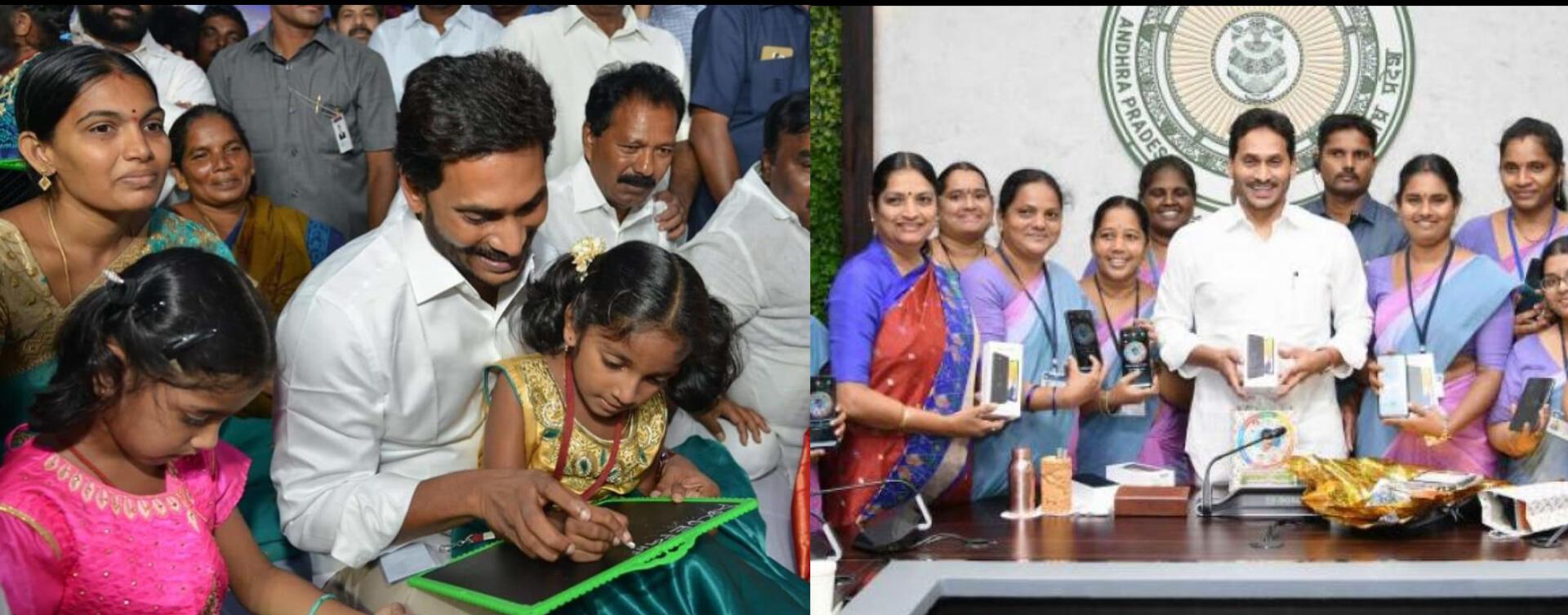
The release of the National Family Health Survey (NFHS-6) datasets offers a rare, empirically backed look at socio-economic transformation in real time. For policy analysts and economic writers, the data presents a striking case study: Andhra Pradesh has systematically outpaced national averages across a spectrum of critical developmental indicators.
When analyzed through a longitudinal lens, these metrics reveal a distinct inflection point. The sharp variance between the macro-developmental trajectory of the 2014–19 administration and the aggressive, welfare-led infrastructure model of the Y.S. Jagan Mohan Reddy administration (2019–24) provides undeniable proof of how political intent translates into measurable human development.
1. Closing the Digital and Educational Gap
In modern economics, digital literacy is no longer a luxury; it is a core determinant of financial mobility. The shift in digital access for women in Andhra Pradesh over the past decade highlights this transformation:
- The 2014–19 Baseline: During this period, digital inclusion for women was largely stagnant, leaving the state lagging behind with a meager 21% internet penetration among the female demographic.
- The 2019–24 Breakthrough: Following targeted digital literacy campaigns and structural reforms, internet usage among women witnessed an unprecedented surge, skyrocketing to 63.6% by 2024.
- Educational Consolidation: This digital leap was reinforced by structural academic gains. The proportion of women completing more than 10 years of formal schooling climbed sharply from 39.6% in the previous survey cycle to 46.4%, matching and building upon broader national-level shifts.
2. Institutionalizing Healthcare: From Marginal Gains to Historic Highs
The hallmark of the Y.S. Jagan Mohan Reddy administration was its aggressive overhauling of the rural healthcare delivery system. By replacing fragmented healthcare access with decentralized village health clinics, the administration drove rapid shifts in maternal and child wellness:
- Early Medical Intervention: Early-stage prenatal care achieved unprecedented compliance, with 81.7% of pregnant women successfully undergoing comprehensive medical examinations within their first trimester.
- The Institutional Birth Revolution: In the 2019–21 assessment window, hospital-assisted deliveries stood at 96.5%. Through systematic investments in public health infrastructure and maternal incentive programs, institutional deliveries reached a near-absolute historic milestone of 98.4% by 2024.
- Universal Pediatric Immunization: A similar trajectory is visible in preventative child healthcare. Complete vaccination coverage among children aged 12–23 months, which stood at 73.2% in the 2019–21 data, climbed steadily to 87.7% by 2024—comfortably outperforming the national benchmark of 82.6%.
3. Financial Agency: Redefining Grassroots Empowerment
True structural empowerment requires moving past symbolic representation and granting direct financial autonomy. The NFHS-6 data shows that the state’s focus on direct benefit transfers (DBT) directly bypassed traditional gatekeepers:
- Independent Banking Maturation: Women managing their own financial portfolios via exclusive or joint bank and savings accounts stood at 81.8% during the 2019–21 period. By 2024, this figure surged to a definitive 92.3%.
- Outperforming the National Curve: This high rate of financial integration positions Andhra Pradesh well ahead of the national average of 89.0%, demonstrating the efficacy of linking state welfare schemes directly to women’s bank accounts.
4. The Macro Picture: Decoupling from National Averages
The structural shifts engineered between 2019 and 2024 become even clearer when contrasting past state data against current national benchmarks:
| Key Developmental Metric | The 2014–19 / 2019–21 Baseline | The Jagan Administration Era (2023–24) | Current National Average |
|---|---|---|---|
| Women’s Internet Literacy | 21.0% | 63.6% | Varies by Region |
| Institutional Delivery Rate | 96.5% | 98.4% | 89.0% |
| Child Vaccination (12–23 Months) | 73.2% | 87.7% | 82.6% |
| Female Financial Inclusion (Bank A/Cs) | 81.8% | 92.3% | 89.0% |
Parallel to these advancements, the survey highlights a Total Fertility Rate (TFR) of 1.5, placing the state below the national replacement threshold of 2.1. This signals a stabilizing population that will require sustained, high-value human capital investments in the coming decades.
The Professional Take: The empirical evidence published by the International Institute for Population Sciences (IIPS) cuts through political rhetoric. The data demonstrates that the strategic governance blueprint implemented by Y.S. Jagan Mohan Reddy from 2019 to 2024 successfully telescoped decades of developmental lag into a single five-year window, establishing a resilient model for human resource development in southern India.